
Update2026.11.10 (화)

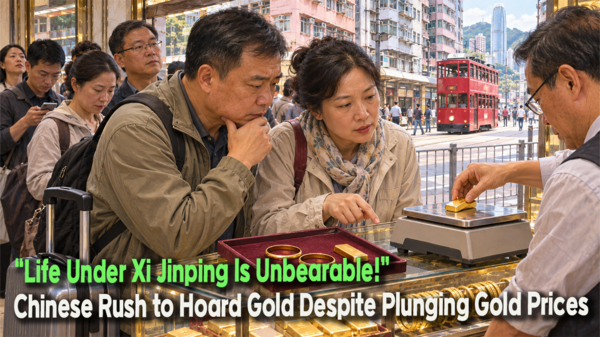
[Wealthy Chinese flock to Hong Kong, driving gold and jewelry sales up 22%]
An extraordinary gold-buying spree is unfolding in China. Even as global gold prices plunged nearly 30% from this year's peak, China’s affluent class is aggressively snapping up gold and jewelry in Hong Kong, and the People’s Bank of China has increased its gold reserves for 24 consecutive months. In particular, as the Chinese Communist Party tightens tax scrutiny on overseas assets owned by the wealthy alongside strict capital controls, how to protect wealth already accumulated has become a far more urgent question for Chinese citizens than how to make more money. While the affluent fear abrupt shifts in the Communist Party's policies and the Chinese government worries about the stability of the dollar-dominated global financial order—differing in their motives—the fact that both are simultaneously seeking refuge in gold prompts serious reflection on the broader credibility of China’s economy and its financial system.
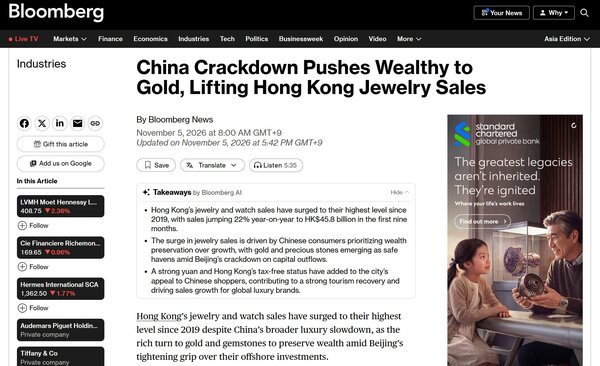
U.S.-based Bloomberg reported on the 6th that Beijing’s stepped-up crackdowns on wealthy individuals' assets are fueling a surge in gold and jewelry sales in Hong Kong. Bloomberg noted that even amid a contraction in luxury consumption across mainland China, sales of gold, gemstones, and luxury watches in Hong Kong are experiencing sharp growth.
Citing statistics from the Hong Kong government, Bloomberg further reported that sales of jewelry, watches, and luxury gifts from January to September this year rose 22% year-on-year to 45.8 billion Hong Kong dollars (approximately 7.9 trillion won). This accounts for roughly 15% of Hong Kong’s total retail sales. The outlet highlighted that while mainland China's luxury spending contracted by more than 10% in the most recent quarter, related sales in Hong Kong maintained double-digit growth.
This shift indicates a transformation in the consumption goals of China's wealthy. While spending in the past focused on displaying affluence through designer bags and high-end fashion, the emphasis is now shifting toward tangible assets like gold and gems that can preserve value over the long term.
Hong Kong’s price competitiveness has also played a role. Due to a stronger yuan and Hong Kong’s tax-free advantages, certain gold jewelry items can be purchased at prices more than 5% cheaper than in mainland China. However, not all jewelry and watch sales in Hong Kong reflect purchases of investment-grade gold.
[“Protecting wealth is paramount”… The rich tremble amid the Communist Party’s asset crackdowns]
Manna Wang, a Hong Kong insurance industry professional interviewed by Bloomberg, explained that the investment preferences of affluent mainland clients are undergoing a major shift. While clients previously showed keen interest in high-return insurance policies, they have recently shown far greater interest in stable wealth management and gold jewelry purchases. Some clients have reportedly spent up to $15,000 per person on gold in a single visit.
Alexis Bonhomme, Chief Executive Officer of Trinity Asia, also pointed out that wealthy Chinese are cutting back on seasonal fashion purchases in mainland China while increasing their spending during overseas trips on items with long-term value retention, such as gold and fine jewelry.
According to Bloomberg, the catalyst behind this shift is the Chinese Communist Party's tightening grip on private assets. Chinese authorities have recently intensified tax monitoring on the offshore trusts and foreign investment income of wealthy individuals, signaling that holding assets abroad will no longer shield individuals from the reach of Chinese tax authorities.
Bloomberg reported in late September that Chinese tax authorities established dedicated special task forces to investigate the overseas assets and tax compliance of the ultra-rich. Some task forces are reportedly dedicated to probing the specific holdings and tax affairs of single billionaires.
Bloomberg added that amid these developments, some affluent individuals fear additional taxation on offshore trusts and are actively weighing emigration, nationality changes, or full-scale asset restructuring.
To be sure, legitimate tax audits must be distinguished from arbitrary seizures of wealth. Yet, when government policy predictability declines, anxiety among the wealthy inevitably escalates. The concern is that no matter how much wealth one amasses, asset management could be restricted overnight by a government decree.
This is precisely where the contradictions of the Xi Jinping administration become apparent. While calling for expanded private investment and consumer spending, the regime simultaneously tightens control over private assets and outbound financial movements. Policies intended to stimulate the economy are, ironically, exacerbating private-sector anxiety.
[People’s Bank of China buys gold for 24 consecutive months despite a 30% drop in gold prices]
Even more striking is the fact that not only are China's wealthy buying gold, but the Chinese government itself is doing so. Bloomberg reported on the 7th that the People’s Bank of China expanded its gold reserves for the 24th consecutive month despite falling international gold prices. According to data released by the central bank, gold reserves stood at 78.3 million ounces at the end of October—an increase of 830,000 ounces (about 25.8 metric tons) from the previous month—bringing the cumulative increase from January to October of this year to approximately 129 metric tons.
According to Bloomberg, international gold prices reached around $5,595 per ounce in late January before sliding to near $3,900 by late October, marking a decline of roughly 30% from the peak. Nonetheless, the People’s Bank of China continued its gold purchases without interruption.
According to the World Gold Council (WGC), net gold purchases by central banks worldwide reached 321 tons in the third quarter of this year, representing a 42% increase year-on-year. Notably, among the central banks that publicly disclosed official purchase volumes, China ranked first with approximately 63 tons. The People’s Bank of China's sustained gold accumulation is interpreted not as a short-term trade for profit, but as a strategic maneuver to diversify its dollar-centric foreign reserve portfolio and hedge against geopolitical risks.
This highlights an intriguing paradox in the Chinese economy: China's wealthy are turning to gold out of deep anxiety over Beijing's shifting domestic policies, while the Chinese government is buying gold to reduce its dependence on the U.S.-led international financial architecture. They are seeking the exact same asset, albeit for fundamentally different reasons.
[Why Times Insight | Why China's Rich Are Buying Gold: What Is More Terrifying Than the Economy Is Political Uncertainty]
The gold-buying rush among wealthy Chinese should not be viewed merely as an investment fad. Against the backdrop of a protracted real estate slump and turbulent financial markets, the Xi Jinping administration's tightened grip over private wealth is fundamentally altering the psychology of investors.
Beijing continually champions the expansion of domestic consumption and private investment to revive the economy. At the same time, however, it is tightening surveillance over overseas assets and cross-border capital flows. If such measures erode private-sector confidence, they could ultimately backfire on economic recovery efforts.
Even more noteworthy is the simultaneous gold accumulation by both the government and the affluent. While the Chinese authorities build their gold reserves to reduce reliance on the U.S. dollar, the wealthy turn to gold amid pervasive economic and policy anxiety.
A nation's wealth does not grow simply because its government tightens control. It expands when citizens believe their assets are secure and when entrepreneurs feel confident investing in the future. The phenomenon of wealthy Chinese snapping up gold even in the face of plunging bullion prices vividly illustrates just how vital this issue of trust truly is.
Are Chinese citizens buying gold because they believe its price will climb, or because they are anxious about whether they can hold on to what they already own? For a growing segment of China’s affluent, the latter appears to be the far more compelling driver.
The most alarming signal for the Chinese economy is not that people are buying gold during a price drop. Rather, it is that more and more people are prioritizing how to defend what they already have over seeking opportunities to build new wealth. This presents yet another dimension of the crisis of economic confidence confronting the Xi Jinping regime.


-중국 푸단대학교 한국연구원 객좌교수
-전 EDUIN News 대표
-전 OUR NEWS 대표
-제17대 대통령직인수위원회 정책기획팀장
-전 대통령실 홍보기획비서관
-사단법인 한국가정상담연구소 이사장
-저서: 북한급변사태와 한반도통일, 2012 다시우파다, 선거마케팅, 한국의 정치광고, 국회의원 선거매뉴얼 등 50여권