
Update2026.11.10 (화)

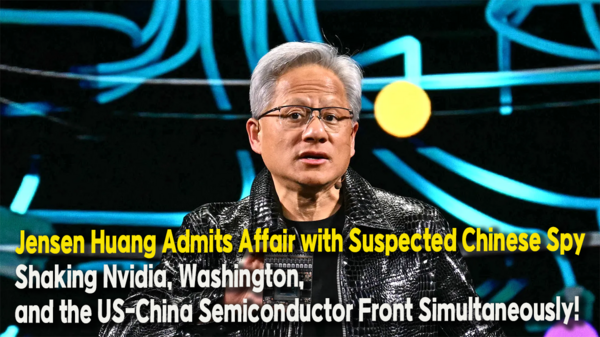
[A Single Apology Changes the Game, Rocking the Semiconductor Market!]
Jensen Huang, CEO and founder of Nvidia, has admitted to having an extramarital affair with a businesswoman assessed by US intelligence agencies to have been recruited by China’s Ministry of State Security (MSS). With this admission, the issue has escalated beyond a personal scandal into a crisis of confidence for the entire US AI security framework. The board of directors of the $4.5 trillion company has launched an independent investigation. Concurrently, both Democrats—who regained control of both the Senate and the House of Representatives in the midterm elections—and China-hawk Republican committee chairs are demanding formal explanations. A relationship Nvidia had described for nearly two weeks as routine business engagement has turned out to be an intimate personal one. Consequently, the Trump administration's progressive relaxation of AI chip export controls toward China—lobbied for heavily by CEO Huang—is now likely to face full reexamination. While China denies the allegations as "slander," the episode underscores that the front line of the US-China tech hegemony race has expanded from state institutions directly into the personal lives of corporate chief executives.
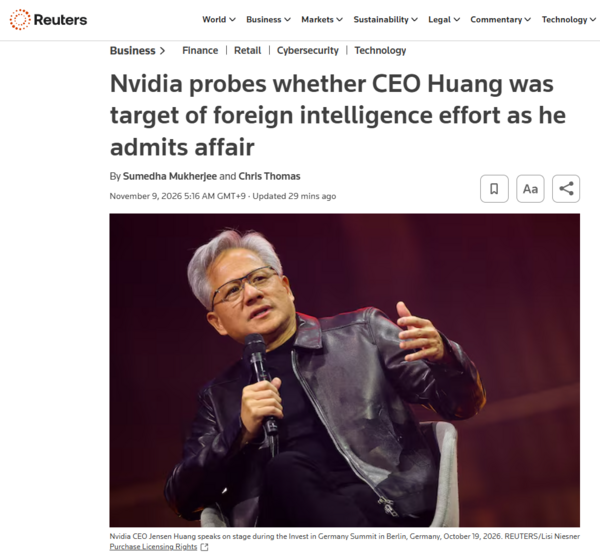
Reuters reported on the 9th: “Nvidia has opened an independent investigation into allegations of foreign intelligence operations targeting Jensen Huang. A board committee of independent directors, assisted by outside independent legal counsel, will oversee the probe. In an email to employees, Huang admitted to the affair and pledged to cooperate fully with the investigation. The board stated it would review all available information while expressing full confidence in Huang and the executive leadership team, and the company indicated he will remain in his role as CEO.”
According to Bloomberg, which first broke the story regarding Jensen Huang’s letter, the CEO wrote to staff on the 9th: “I apologize to my family and to all of you. I was unfaithful to my wife. My actions have caused deep pain to my wife and children. There are no excuses for what I have done.”
In tandem, Nvidia's board established its defensive line. In a statement, the board affirmed that there is “no reason to believe national security or corporate trade secrets were compromised” and reiterated its “full confidence in executive management.” Nvidia spokesperson John Rizzo stated that “CEO Huang will continue to lead the company without interruption.” The fundamental challenge, however, lies in the credibility of this messaging. Since the New York Times (NYT) first reported the matter on the 29th of last month, Nvidia had persistently characterized their interaction as ordinary business contact. Rizzo argued at the time that “meeting with customers is part of a CEO’s job.” Yet, in just ten days, the company's official narrative was upended by the CEO’s own confession.
[Megaspeed and Alice Huang: The Anatomy of the Allegations]
At the epicenter of the controversy is Alice Huang (Chinese name: Huang Le). She is not related to Jensen Huang and previously served as a senior executive at Singapore-headquartered Megaspeed International. Spun off from a Chinese company in 2023, Megaspeed operates as a data center provider and an Nvidia cloud partner that procures Nvidia chips, deploys them in data centers, and leases computational power. Trade records reviewed by the NYT reveal that Megaspeed's Malaysian affiliate purchased at least $4.8 billion worth of Nvidia technical hardware between June 2024 and February 2026. The US government's inquiry originated in late 2024, when a Department of Commerce official spotted crated stockpiles of Nvidia chips at a Megaspeed data center facility in Malaysia.
Assessments by intelligence authorities grew more specific with subsequent reporting. On the 29th of last month, the NYT reported that “US intelligence agencies concluded through surveillance that Alice Huang passed intelligence to Beijing,” adding that “President Trump was briefed on this roughly a year ago but took no action, and Jensen Huang was never given a 'defensive briefing'—a standard counterintelligence alert provided to targets of foreign intelligence agencies.” Two days later, The Wall Street Journal (WSJ) reported that “authorities in Singapore and Taiwan separately investigated her and deployed physical surveillance teams; once surveillance commenced in late 2024, she went into hiding in China for an extended period.” The Financial Times (FT) subsequently reported that “an intelligence-backed US memorandum detailed an intimate personal relationship between the two and assessed that Alice Huang was recruited by the MSS to target Jensen Huang for intelligence gathering.” According to the NYT, this memorandum was prepared under the supervision of Secretary of State Marco Rubio.
Nevertheless, significant elements remain unverified. Available public reporting does not definitively prove what Alice Huang passed to Beijing, nor whether Nvidia trade secrets were included. Furthermore, no evidence has surfaced proving that Jensen Huang was aware of her intelligence activities. In an interview with Bloomberg, Jensen Huang stated: “We audited every single GPU deployed at Megaspeed and accounted for each one.” He also noted that “Alice Huang has already departed Megaspeed.” Chinese Foreign Ministry spokesperson Guo Jiakun dismissed the reports as “pure, baseless slander.”
[Aftermath in Washington: From Nvidia Security to White House Decision-Making]
The timing could hardly be worse for Nvidia. In the midterm elections on the 3rd, the Democratic Party achieved a historic sweep, taking control of both the Senate and the House. In the upcoming 120th Congress convening in January, Democrats will hold executive oversight authority. Huang has been viewed as one of the tech CEOs closest to President Trump. In September, he was invited to the White House state dinner hosting President Xi Jinping. Senator Chris Coons (D-DE), considered a top contender to chair the Senate Foreign Relations Committee, posted on X: “The more we learn about the extraordinary web connecting the Trump administration, Chinese spies, and AI billionaires, the clearer it becomes that corruption permeates this administration’s actions,” adding, “Congress will uncover the truth.”
Pressure is also mounting from Republicans. According to Reuters, House Foreign Affairs Committee Chairman Brian Mast, House Select Committee on China Chairman John Moolenaar, and House Intelligence Committee Chairman Rick Crawford demanded on the 5th that “CEO Jensen Huang appear for a closed-door briefing on the 18th to address the NYT report and Nvidia’s security protocols against espionage by foreign adversaries.”
Congressional suspicion has been brewing for months. In March, Senators Elizabeth Warren (D) and Jim Banks (R) sent a bipartisan letter demanding a probe into whether Huang’s remarks that there was “no evidence of chip diversion” misled regulators during the export licensing process. That same month, Wally Liaw, co-founder of server maker Supermicro, was arrested on charges of attempting to smuggle $2.5 billion worth of Nvidia GPU servers into China. Huang’s admission of the affair substantially erodes the credibility of his past explanations.
Scrutiny is turning directly toward the White House as well. On the 31st of last month, President Trump commented, “I have tremendous respect for Jensen,” adding, “We will look into it very closely.” However, reports revealing that the President received counterintelligence briefings a year ago yet chose not to warn the party involved while continuing to ease export restrictions will likely prompt the Democratic-led House to pursue full-scale congressional investigations. The American political arena is particularly sensitive to "honeypot" espionage. Former Representative Eric Swalwell was stripped of his seat on the House Intelligence Committee in 2023 over his ties to suspected Chinese intelligence operative Christine Fang (known as "Fang Fang"). Swalwell resigned in April amid separate misconduct allegations, and an FBI document declassified in August noted his admission of a sexual relationship with Fang.
[Nvidia's Aftermath… Founder’s Authority and China Business Put to the Test]
Nvidia faces an immediate test next week. The company is scheduled to report its Q3 fiscal 2027 earnings after the market closes on the 17th, with the congressional closed-door briefing scheduled for the very next day. Nvidia's quarterly revenue guidance stands strong at around $108 billion, with core operating metrics remaining robust. However, the market’s primary concern is governance rather than quarterly figures. Huang has led the company for 33 years since founding it in 1993 and embodies Nvidia’s corporate identity. With no set timetable or scope for the independent probe's conclusions, sustained uncertainty could weigh heavily on the stock.
The underlying business model is also compromised. The Southeast Asian cloud partner framework—where companies like Megaspeed purchase chips and lease computing power—has long been scrutinized as a regulatory gray area in US export controls. Legislation mandating built-in location-tracking capabilities on advanced GPUs is currently awaiting a committee vote in the House Foreign Affairs Committee. Prior to export curbs, China accounted for a fifth of Nvidia's revenue. The lobbying effort to reopen that market has suffered a devastating blow to its moral and political standing.
[Aftermath for US-China Relations… The Chip Trade Landscape Is Being Reshuffled]
Over the past year, the Trump administration’s semiconductor policy toward China shifted toward relaxation. While an export licensing regime was introduced for the H20 in April 2025, conditional sales of the more capable H200 to select Chinese customers were permitted in January 2026, under terms granting the US government a 25% cut of the proceeds. Axios summarized the dynamic: “Alice Huang’s objective was to persuade Jensen Huang to actively lobby the US government for Chinese chip export clearances.” If this assessment is substantiated, the H200 licenses will face intense condemnation as the direct dividend of a Chinese intelligence operation. Demands to freeze or thoroughly review existing export authorizations will be virtually impossible to resist.
Beijing’s strategic calculus has grown equally fraught. While China wholly rejects the claims, the diplomatic goodwill established during Xi Jinping’s US visit in September risks being undone. The US administration had previously refrained from levying severe sanctions on Megaspeed to preserve broader trade negotiations; such restraint is now politically untenable. Demands for crackdowns on intermediary hubs like Singapore, Malaysia, and Taiwan will intensify. Furthermore, the fact that Taiwan-born Huang became entangled with a figure under Taiwanese surveillance could ignite fierce domestic debates over semiconductor security within Taiwan.
[Why Times Insight]
First, the core issue of this controversy is not the extramarital affair itself, but "information asymmetry." The US government knew for roughly a year, while the CEO, shareholders, and the broader market remained in the dark. If reports are accurate, commercial sensitivities regarding Nvidia’s market capitalization and broader trade talks superseded counterintelligence protocol. The primary focus of the new Congress will almost certainly center on this executive decision-making chain rather than the personal relationship.
Second, the moral authority behind the "necessity of the China market" argument has crumbled. Huang has long lobbied Washington under the premise that global US leadership depends on China remaining reliant on American silicon. The moment those lobbying efforts are suspected of aligning with foreign intelligence objectives, the argument loses its political viability, regardless of its commercial logic.
Third, the operational targets of Chinese intelligence have shifted decisively from government corridors to corporate boardrooms. In the AI supremacy race, critical strategic intelligence resides within data center supply lines and executive notebooks rather than the State Department. This incident exposes a severe blind spot in Western tech leadership counterintelligence preparedness.
Looking ahead, three primary scenarios are likely to unfold:
① The board's probe concludes with "no leaks identified," resulting in a limited containment where Huang retains the CEO post;
② Governance restructuring, such as scaling back public-policy lobbying or separating the roles of CEO and Chairman of the Board;
③ A comprehensive, congressional-led clampdown on Chinese tech exports, accompanied by an immediate freeze on H200 export licenses. Our channel assesses a hybrid outcome of ① and ③ as the most probable: CEO Huang remains in place, but Nvidia's direct access to the Chinese market is shut down once again.
Lastly, this carries immediate implications for South Korea. For companies like Samsung Electronics and SK Hynix, which are deeply integrated into Nvidia’s ecosystem through High Bandwidth Memory (HBM), this crisis hits home. Renewed US export restrictions could dampen infrastructure demand across Southeast Asian data centers. Furthermore, South Korean semiconductor leaders must treat this as a catalyst to rigorously review their own corporate counterintelligence security frameworks.
-중국 푸단대학교 한국연구원 객좌교수
-전 EDUIN News 대표
-전 OUR NEWS 대표
-제17대 대통령직인수위원회 정책기획팀장
-전 대통령실 홍보기획비서관
-사단법인 한국가정상담연구소 이사장
-저서: 북한급변사태와 한반도통일, 2012 다시우파다, 선거마케팅, 한국의 정치광고, 국회의원 선거매뉴얼 등 50여권