
Update2026.11.10 (화)

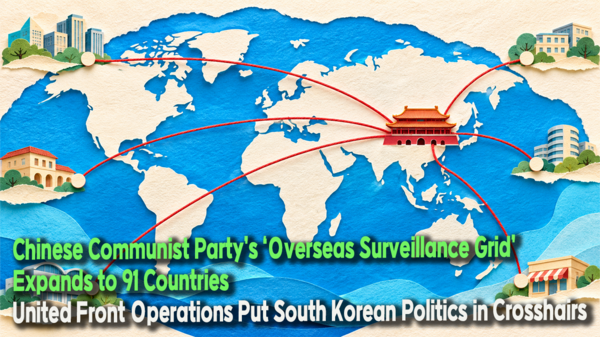
[4 Years After Secret Police Stations Exposed… What Has China Exported Overseas?]
The Chinese Communist Party (CCP) is exporting its domestic surveillance apparatus abroad. International human rights group Safeguard Defenders disclosed that it identified 1,247 overseas contact points established by Chinese party and government agencies, confirming that South Korea is among the countries and territories where such locations operate. The core warning delivered by the report is that these communication channels—used to monitor overseas diaspora communities and harass dissidents—can also be weaponized to shape foreign public opinion and influence sovereign policy decisions. South Korea’s political sphere must scrutinize which channels have accessed domestic policymakers on matters involving Beijing’s interests, and what support was exchanged during that engagement.
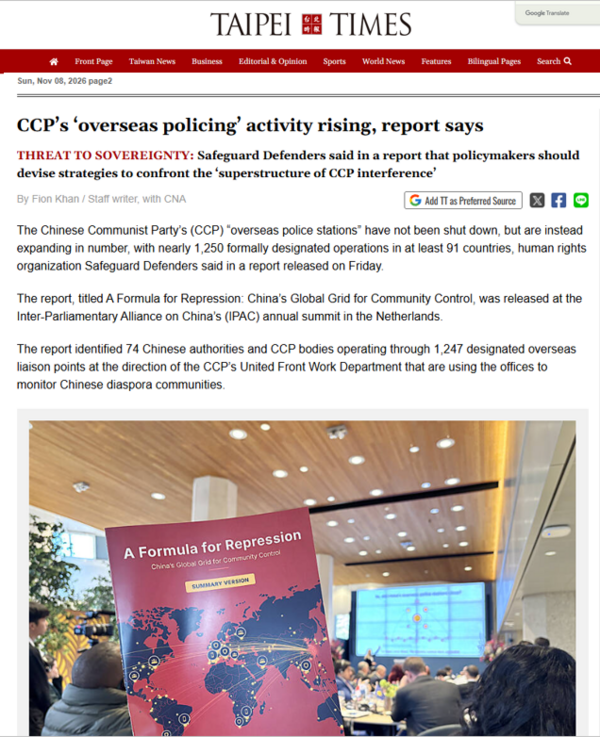
Taiwan’s Taipei Times reported on the 8th: “It has been identified that 74 Chinese Communist Party and government agencies established 1,247 overseas contact points. The report, unveiled in The Hague, Netherlands, on the 6th, analyzed official public records published by Chinese party and state authorities.” Taipei Times further noted: “Of the 1,247 sites, at least the host country or city was identified for 724, while the remaining 523 appear exclusively in official statistics released by Chinese authorities. South Korea is included in the roster of at least 91 countries and territories with verified sites.”
The source material cited by Taipei Times is Safeguard Defenders’ report titled “A Formula for Repression – China’s Global Grid for Community Control.”
In 2022, Safeguard Defenders exposed over 100 overseas police stations spanning around 50 countries. The latest investigation broadens the lens beyond public security organs to include liaison hubs operated by courts, procuratorates, and judicial administration entities. Reconstructing the timeline of establishment under identical criteria, the report documents a surge from 73 hubs at the end of 2015 to 1,178 by late 2025. This demonstrates a systematic decadelong expansion where multiple party and state organs jointly leverage overseas interpersonal networks.
The report places primary focus on China’s ‘grid management’ mechanism. Domestically, residential sectors are partitioned into granular units where designated grid workers monitor residents’ movements and relay intelligence to local law enforcement and judicial security networks. Overseas, the All-China Federation of Returned Overseas Chinese (known as the Qiaolian), operating under the direct guidance of the CCP’s United Front Work Department, functions as a bridge between local diaspora organizations and authorities in Beijing. According to the report, five nationwide policy directives enacted by China since late 2024 have instructed relevant authorities to escalate overseas activities. The estimated 60 million people cited in the report represents the diaspora population that the CCP unilaterally categorizes as "overseas Chinese," regardless of individual citizenship.
The operational reality of this framework was laid bare in a New York court case. According to the US Department of Justice, Lu Jianwang, who established an outpost in Manhattan under instructions from China’s Ministry of Public Security, was directed to track down Chinese pro-democracy dissidents living in the United States. In May of this year, a US federal jury convicted him of conspiring to act as an unregistered agent of the Chinese government and destroying related evidence. It stands as a concrete case study showing how localized outposts are deployed to track and target dissidents abroad.
[Another Front in the Hegemony Rivalry… Infiltrating Decision-Making in Advanced Democracies]
Article 37 of the Chinese Communist Party's United Front Work Regulations defines the overseas mission as strengthening ‘ideological and political guidance,’ deepening understanding of and alignment with the CCP and Socialism with Chinese Characteristics, curbing Taiwan independence, and creating a favorable international environment for China. Beijing systematically aligns ties with overseas Chinese communities with its own state objectives. Decades-long networks cultivated on the ground can be used to amplify Beijing’s narrative throughout local communities and cultivate intermediaries positioned to lobby parliaments and sovereign governments.
In this context, the United Front operates as an asymmetric political tactic employed by China to catch up with advanced economies and seize the initiative in the international order. While closing technical and military gaps in areas such as semiconductors and defense, this approach creates domestic political friction within partner nations, stifling their ability to execute counter-China policies. If Beijing can influence who speaks out on Taiwan, control the narrative framing Chinese human rights, or cap the scope of multilateral security alliances, its diplomatic costs drop significantly. When the CCP's governance rationale is echoed within another country through the voices of local political figures, that influence achieves lasting structural traction.
In Australia, a case where community organizing was weaponized to gain access to a cabinet minister reached federal court. According to Australian federal prosecutors, businessman Di Sanh Duong cultivated a relationship with then-Minister Alan Tudge by involving him in a COVID-19 hospital charity donation. A jury convicted Duong of preparing for an act of foreign political interference. The court ruled that Duong targeted Tudge under the assessment that he could persuade the minister to tilt Australian government policy in favor of the CCP. What the court established was an operative preparing an operation targeted at a sitting cabinet official.
[South Korean Politics as a Target… Convergence Revealed in the THAAD Debate]
Instances of United Front-linked organizations intervening in domestic policy debates in South Korea have already been brought to light. In a 2023 study by Russell Hsiao for the US-based Jamestown Foundation, the overlapping leadership between China’s peaceful reunification promotion councils and Chinese associations in South Korea was systematically mapped. The study documented that these affiliated organizations actively participated in public anti-THAAD deployment rallies, with several domestic Chinese associations issuing joint opposition statements. While domestic public opposition to THAAD stemmed from various political motivations, the notable takeaway is that organizations tied directly to Beijing intervened directly in an open domestic discourse involving the core security posture of the US-ROK alliance.
The controversy surrounding the ‘Oriental Style’ Chinese restaurant in Songpa-gu, Seoul, illustrates the evidentiary thresholds required when investigating domestic operations. The restaurant faced allegations in 2022 of functioning as a Chinese overseas police station, which the Chinese Embassy in Seoul vehemently denied. In December 2025, a court of first instance sentenced the operator to a suspended prison term solely on charges of credit card fraud and customs duty evasion. The confirmation of South Korea on the list of host nations in the latest report and the specific verification of operational activities at Oriental Style remain distinct issues requiring separate scrutiny.
A July study published by Cambridge University Press concluded that “Beijing has sought to cultivate personal networks among South Korean politicians, policymakers, and opinion shapers to influence policy outcomes and public sentiment.” An analysis by the Stimson Center in the US in February also noted that “the Chinese People’s Liberation Army has studied avenues to influence South Korean public opinion and the US-ROK alliance,” though it evaluated the measurable scope and efficacy based on open-source material as “limited.” While whether South Korean politics has served as an operational target and whether those operations successfully changed state policy remain separate empirical questions, it is indisputable that the South Korean political arena remains widely exposed to Chinese political warfare operations.
[Why Times Insight | Questions South Korean Politics Must Answer]
United Front work is an instrument the CCP formally designates as one of its ‘Three Magic Weapons.’ The latest report demonstrates that this weapon is not merely aimed at overseas dissidents. Transferring domestic grid management overseas effectively seeks to carve out enclaves within advanced democratic societies where Communist Party governance methods operate unchecked. While publicly framed as diaspora welfare and community management, our channel assesses this as a calculated, long-term wedge strategy designed to unravel the cohesion of advanced democracies from within and condition them to accommodate Beijing’s vision for the global order.
South Korea is an exceptionally vulnerable target within this playbook. A February 2026 joint study by researchers from the US Stimson Center and the RAND Corporation assessed that “Beijing views South Korea as the ‘weakest link’ in the US alliance network.” The same report referenced an academic paper authored by a PLA-affiliated researcher which explicitly recommended: “Deepen ties with South Korean media, particularly progressive and China-friendly outlets.” When United Front-linked figures take on roles across both ruling and opposition parties, figures implicated in secret police station allegations attend embassy events openly, and reforms to the domestic Espionage Act remain paralyzed by decades of partisan deadlock, the recurring pro-China narratives voiced by segments of the political establishment can hardly be dismissed as coincidental. Our channel views this as the organic outgrowth of a United Front infrastructure patiently cultivated over decades.
Accordingly, whenever South Korean politicians articulate stances that mirror Beijing's foreign policy positions, scrutiny must center on the provenance of those statements. Who engaged those lawmakers when the issue was debated? Who arranged and financed delegations to China and consultative roundtables? Were formal requests made regarding legislative policy phrasing or resolution drafts, and do paper trails exist? Documenting these details is essential to distinguish between principled diplomatic judgments, transparent interest representation, and covert interference orchestrated by a foreign state. In the Australian trial, what the court dissected was precisely the conduit of approach and the concealed relationships behind it.
In this light, it is necessary to ask: on issues vital to Beijing’s strategic interests—such as THAAD or the Taiwan Strait—who sought access to South Korean policymakers, and were those connections ever disclosed to the public? That standard must apply symmetrically across both sides of the aisle. If China's geopolitical ambitions have reached into South Korea's sovereign policy formation, the public has an inherent right to verify the origins of those decisions and subject them to relentless scrutiny.
South Korea still lacks a Foreign Agents Registration Act, nor does it have institutional mechanisms obligating officials to disclose contact with United Front-affiliated organizations. Amending the Espionage Act is merely an opening move. Establishing robust transparency legislation that informs the public of who maintains relationships with which foreign entities is the urgent next frontier.
-중국 푸단대학교 한국연구원 객좌교수
-전 EDUIN News 대표
-전 OUR NEWS 대표
-제17대 대통령직인수위원회 정책기획팀장
-전 대통령실 홍보기획비서관
-사단법인 한국가정상담연구소 이사장
-저서: 북한급변사태와 한반도통일, 2012 다시우파다, 선거마케팅, 한국의 정치광고, 국회의원 선거매뉴얼 등 50여권