Update2026.11.05 (목)

['A Week That Shook the Belief in State-Backed Infallibility']
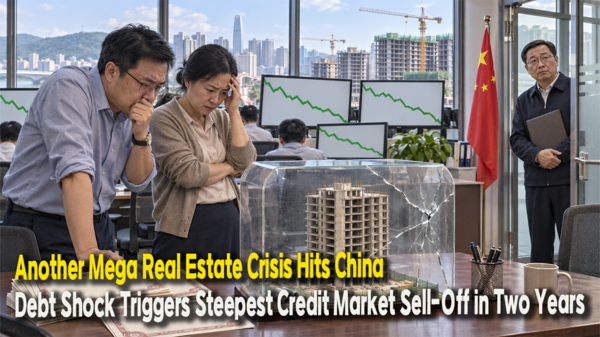
Zhuhai Huafa Group, a massive state-owned conglomerate wholly owned by the Zhuhai municipal government in Guangdong Province, failed to repay trust products and requested maturity extensions on bank loans. In the fallout, China's corporate bond market was engulfed in its steepest sell-off in two years over the two days leading up to the 2nd. Offshore bonds issued by the company, which carries interest-bearing debt totaling 413 billion yuan (approx. 83 trillion won), plunged at one point to around 54% of face value. The shockwaves rippled across China's high-yield dollar bond market and the 30-year sovereign bond futures market. The long-standing premise underpinning China's bond market—that "local government-owned enterprises will ultimately be bailed out by the government"—has been put to a direct test. The real estate slump that began in 2021 has persisted for over five years, spreading beyond private developers into the very heart of state capital. It serves as a stern warning that local government finances, long reliant on land sale revenues, have reached their breaking point without securing replacement growth engines.
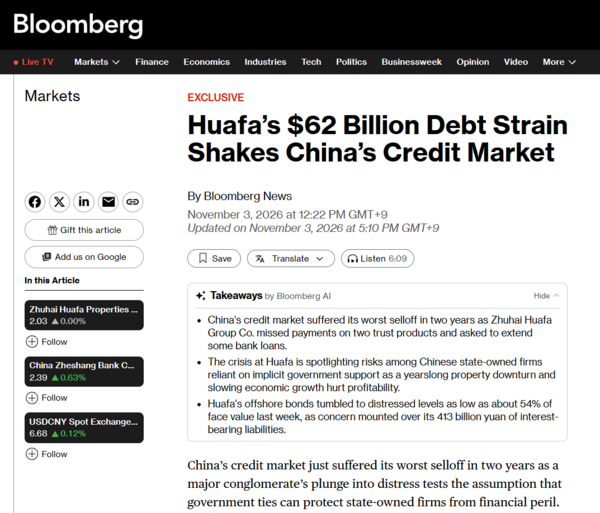
Bloomberg reported on the 3rd (local time) that "debt concerns surrounding Zhuhai Huafa Group sparked the fiercest sell-off in China’s credit market in two years," adding that "Huafa failed to make timely payments on two maturing trust products and requested extensions on certain bank loans; even in China, where liquidity crunches among property firms have become frequent, the reality that a colossal conglomerate wholly owned by a local government faced repayment strain rattled the benchmarks the market uses to gauge risk."
On the day of the report, Huafa's offshore bonds recorded their largest single-day drop in history. The following day, shares of its Shanghai-listed property subsidiary, Zhuhai Huafa Properties, tumbled 8.9% intraday to hit a one-month low.
The anxiety was not confined to a single company, spreading across the wider market as investors began re-evaluating what defaults by state-owned enterprises (SOEs) mean in a country where such events have been rare. According to Bloomberg, the average yield premium demanded by institutional investors to hold benchmark corporate bonds rose 10.3 basis points (1 bp = 0.01% point) over the two days leading up to that date, marking the worst two-day stretch since October 2024. Over the same period, Chinese high-yield dollar bonds endured their worst week in roughly a year. On the 30th of last month, 30-year Chinese sovereign bond futures posted their sharpest single-day decline since March. Traders singled out the Huafa turmoil as the primary driver dampening investment sentiment.
The market responded with such heightened sensitivity because Huafa bonds are widely dispersed across the financial system. Li Huan, co-founder of asset management firm Forest Capital Hong Kong, remarked, "Almost every major financial institution I know holds Huafa bonds, particularly state-owned financial institutions." Zerlina Zeng, head of East Asia credit strategy at CreditSights Singapore, was more direct, warning that "local government financing vehicles (LGFVs) and certain state-owned enterprises with weak standalone credit profiles are essentially ticking time bombs."
[Born the Same Year as the SEZ: Why 'Zhuhai’s Eldest Son' Stumbled]
Founded in 1980, Huafa is the same age as the Zhuhai Special Economic Zone (SEZ) and stands as one of the two flagship state-owned enterprises representing Zhuhai. The State-owned Assets Supervision and Administration Commission (SASAC) of Zhuhai holds approximately 93.5% of its shares, with the Guangdong Provincial Department of Finance holding the remainder. As of the end of March this year, its total assets stood at roughly 765 billion yuan. The company has developed more than 200 residential complexes across China and built iconic municipal landmarks such as the 330-meter-tall Zhuhai Tower. It has also been deeply involved in the development of the Hengqin New Area adjacent to Macau. Its operations center on real estate while spanning financial services, technology, and urban operations.
Although its outward structure appeared diversified, its actual revenue model remained tethered to real estate. Last year, roughly half of its revenues came from property development and urban operations, and the company cited the real estate downturn as the primary driver behind fluctuating profitability. Its real estate subsidiary posted a net loss of 6.44 billion yuan in the January–September period alone this year. This subsidiary also recorded a net loss of approximately 9.496 billion yuan (approx. 1.2922 trillion won) in fiscal year 2025, with its debt-to-asset ratio climbing to 69.27%. Consequently, plans emerged in July for the parent group to absorb a rights issue of up to 2.65 billion yuan (approx. 531.7 billion won). The parent company that once propped up its subsidiary has now become strained under its own weight.
Credit ratings also diverge sharply. Domestic agency China Lianhe Credit Rating maintained Huafa's top "AAA" rating earlier this year despite its heavy debt load and high dependence on external financing, citing expectations of strong local government support. In contrast, Fitch Ratings placed Huafa—which sits at the lower end of investment grade at "BBB"—on "Rating Watch Negative" last week, formalizing the possibility of a downgrade. Fitch cited "weakening debt-servicing capacity, imminent short-term debt maturities, and widening bond spreads amid unverified market rumors regarding potential debt extensions."
[Memories of the 2020 'Yongmei Shock', and How This Differs]
Some investors recall the "Yongmei incident" of November 2020. Yongcheng Coal and Electricity Holding Group, a subsidiary of Henan Energy and Chemical Industry Group—the largest state-owned enterprise in Henan Province—defaulted on 1 billion yuan (approx. 200.6 billion won) in commercial paper on November 10 of that year. The bond had been rated AAA just a month prior. The sell-off spread across the coal sector and to Henan SOEs as a whole, leading four Henan state firms to cancel a combined 3.1 billion yuan (approx. 621.9 billion won) in bond issuances that month. The rating agency involved received a three-month operational suspension. Yongcheng Coal eventually repaid the principal and interest within a few months after the provincial government intervened to restore market confidence.
However, the environment surrounding this current crisis is fundamentally different. Over the past few years, Chinese authorities have maintained an accommodative monetary stance while running unprecedented refinancing programs to ring-fence risks associated with local government debt. As a result, repayment disruptions by state enterprises were treated as events that "must not happen." Furthermore, Huafa’s home base of Guangdong boasts the largest economic output among China's 31 provincial-level administrative divisions. The realization that a flagship SOE in the nation’s wealthiest province is stumbling has made the market far more anxious.
For now, an immediate crisis appears to have been temporarily contained. News that Huafa repaid one trust product and that its property subsidiary settled onshore yuan bonds due on the 2nd helped its offshore yuan bonds maturing in 2027 recover to around 63% of face value. China Zheshang Bank outlined two potential trajectories in a report: if Huafa continues servicing public bonds and makes progress in monetizing assets, the current anxiety could resolve as a temporary liquidity squeeze managed by local authorities; conversely, if debt maturity extensions or broader restructuring unfold, it could trigger a sweeping reassessment of the entire state-owned sector.
[Collapsed 'Land Finance': Local Governments Left Without Alternatives]
The root of the Huafa crisis lies in the structural breakdown of local government finances. According to China's Ministry of Finance, local government revenues from state-owned land-use rights transfers totaled 4.1518 trillion yuan (approx. 833 trillion won) in 2025, falling 14.7% year-on-year and marking four consecutive years of contraction. That decline has accelerated this year. Land sale revenues plunged 31.5% in the first half to 977.8 billion yuan (approx. 196 trillion won), and were down 27.9% cumulatively from January to September. Caixin reported that residential land sale revenues in 2025 contracted by roughly 65% from their 2020 peak.
The outlook remains bleak. Goldman Sachs projected that land sale revenues would drop 30% this year, accelerated by regulatory reforms replacing pre-sales of new homes with sales of completed properties. This represents a far steeper drop than the average annual decline of 17% observed over the previous four years. Luo Zhiheng, chief economist at Yuekai Securities, analyzed that "declining land sale revenues simultaneously constrain the fiscal resources available to local governments and intensify debt-servicing pressures." According to a commentary in Caixin, over 90% of newly raised funds by local financing platforms this year were deployed simply to roll over existing debt and service interest payments.
Ultimately, the "implicit guarantee" supporting SOE bonds hinges on the fiscal capacity of their guarantor: local governments. Yet land sales, the traditional source funding those pockets, are drying up. Local governments that failed to build an industrial base capable of replacing real estate and instead pushed debt-fueled development via property-focused SOEs are now receiving that risk back along the very same pipeline. Alongside Huafa's long-term debt burden, lingering uncertainty remains regarding how far Beijing is willing to go in backstopping debt-laden state firms.
[Why Times Insight]
First, the descriptor "once again" is fitting for this crisis. Late last year, when Vanke—whose largest shareholder is Shenzhen Metro—sought bond maturity extensions, the market also drew comparisons to the Yongmei incident. While Vanke was a hybrid developer backed by state capital, Huafa is an SOE directly owned by a local government. The crisis is moving step by step into the institutional core of the state.
Second, the dilemma facing Beijing is structural. Bailing out Huafa would entrench the moral hazard that "state-owned enterprises never fail." Conversely, stepping aside risks allowing financial distress to spill over into state-owned financial institutions that heavily hold Huafa paper. The two core objectives championed by the Communist Party leadership—"market-oriented debt resolution" and "financial stability"—are colliding head-on.
Third, it must be underscored that a formal default on public bonds has not yet occurred. Moving forward, observers must monitor: (1) whether Huafa continues servicing its public debt obligations; (2) whether the Guangdong provincial government intervenes directly; and (3) whether Fitch executes an actual rating downgrade. These three factors will determine whether this episode concludes as a transient liquidity squeeze or broadens into a fundamental reassessment of the entire state-owned enterprise sector.

-중국 푸단대학교 한국연구원 객좌교수
-전 EDUIN News 대표
-전 OUR NEWS 대표
-제17대 대통령직인수위원회 정책기획팀장
-전 대통령실 홍보기획비서관
-사단법인 한국가정상담연구소 이사장
-저서: 북한급변사태와 한반도통일, 2012 다시우파다, 선거마케팅, 한국의 정치광고, 국회의원 선거매뉴얼 등 50여권