
Update2026.10.24 (토)

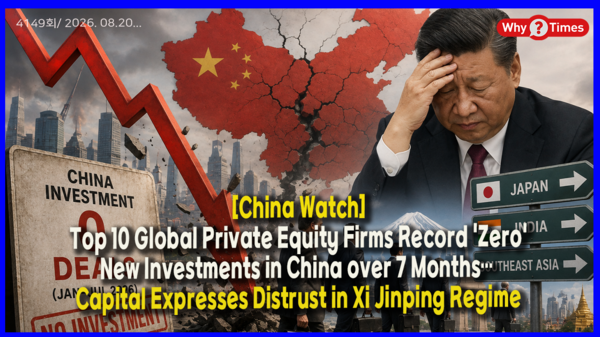
[New Investments in China by the Top 10 Global PEFs Drop to Zero]
A virtual "investment strike" targeted at China has commenced in global capital markets. Over the first seven months of 2026, the world's top ten private equity firms—including KKR, Blackstone, and Warburg Pincus—executed zero new public equity investments in mainland China. Once a prime destination for global funds, China has turned into an isolated financial zone where finding viable deals or executing exit strategies is increasingly difficult. This shift reflects more than temporary economic weakness; it signifies collective distrust by global capital toward the political and economic uncertainties generated under Xi Jinping's governance.
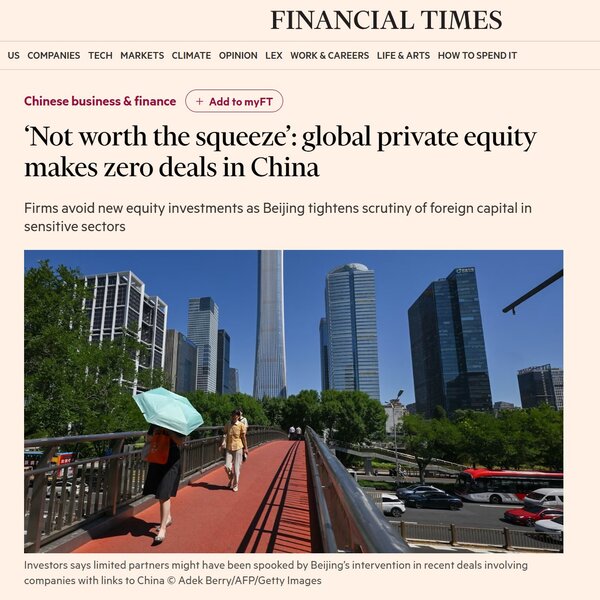
The Financial Times reported that data from Dealogic and PitchBook revealed zero new public equity investments by the top 10 global private equity firms in mainland Chinese companies between January and July. This list includes major global players with long-standing operations in China, such as KKR, Blackstone, and Warburg Pincus. As recently as 2021, these mega-PEFs closed roughly a dozen deals in China; that number dropped to a handful in 2024 and 2025, reaching absolute zero this year.
This does not mean Wall Street institutions have legally ceased all China-related transactions. Private Equity Wire—a publication offering news and research on global PE and private capital markets—noted that exchange trading, existing asset management, and overseas deals involving Chinese enterprises continue. However, the decision by top global buyout firms to refrain from deploying fresh equity into mainland companies for seven consecutive months carries a distinct meaning. Because private equity relies on locking in capital for extended periods to scale business value before exiting, this pause serves as a leading indicator of deep skepticism toward both China's future profitability and its capital retrieval prospects.
The Financial Times further highlighted that exiting existing investments has become as problematic as making new ones. Major global buyout firms operating in China recorded no publicly disclosed full divestments from mainland companies in 2025. As U.S. and Hong Kong IPO listings for Chinese firms face stricter hurdles and valuations decline, exit pathways for PEFs to sell equity and liquidate capital have narrowed sharply. Consequently, foreign capital views China as a market that is not only hard to enter, but equally difficult to leave.
[Capital Leaving China Remains in Asia, Redirecting to Alternatives]
Reuters observed that while Beijing may attribute the drop in investment to high global interest rates and a general slowdown in PE markets, capital is not exiting Asia entirely; it is bypassing China in favor of markets like Japan and India. For instance, Blackstone raised a record $13.1 billion Asia-focused private equity fund in June 2026 and deployed over $7 billion into Japanese and Indian companies over the past two years. Bain Capital is similarly raising an estimated $10.5 billion Asia fund alongside a dedicated vehicle for middle-market investments in Japan. Capital availability remains strong, but funds allocated specifically for China have evaporated.
This trend is mirrored in broader foreign direct investment (FDI) data. Statistics from China’s Ministry of Commerce show that actually utilized FDI in the first half of 2026 declined 5% year-on-year. While certain metrics like new foreign-invested entity registrations and high-tech investments showed gains, total actual capital inflows into China remain locked in a three-year downward trend. Despite continuous incentive measures announced by the Chinese government, international investors continue to hold back long-term capital.
[Xi Jinping’s Control-Oriented Politics Turns China into an Investment No-Go Zone]
The Financial Times noted that the main driver behind global capital avoiding China goes beyond standard economic deceleration. Under the Xi Jinping administration, national security parameters have expanded to encompass data, AI, semiconductors, finance, and M&A deals. As a result, legitimate corporate transactions face elevated risks of sudden intervention driven by political discretion. Strict vetting of foreign investment in sensitive sectors like AI, combined with tighter tax and data regulations, has led investors to conclude that political risks in China now outweigh potential returns. As one market insider quoted by the FT remarked, investing in China no longer offers rewards proportional to the risk involved.
Following its reform and opening-up era, China leveraged access to foreign capital, technology, and global markets to grow into the "factory of the world." Under Xi Jinping, however, Communist Party control and national security priorities take precedence over market autonomy, requiring private and foreign enterprises to demonstrate political compliance. Even when complying fully with domestic Chinese laws, businesses face potential exposure to U.S.-China conflicts or regulatory shifts that can undermine business models and exit plans overnight. This structural exposure—often termed "Xi Jinping risk"—cannot be hedged through traditional contracts or insurance mechanisms.
Reuters highlighted that distrust is exacerbated by Beijing encouraging foreign investment while simultaneously restricting access to independent external inquiries. When the EU initiated investigations into state subsidies regarding overseas acquisitions by Chinese firms, China’s Ministry of Justice instructed domestic entities and individuals not to cooperate. From a foreign investor's standpoint, China promotes open markets when convenient, yet invokes national security and sovereignty to restrict access whenever inconvenient inquiries arise.
[Becoming an 'Economic Galapagos', China Suffers the Most]
Relying solely on domestic consumption and state capital presents long-term vulnerabilities for China. The withdrawal of foreign capital involves more than just a reduction in monetary flow. Global investors bring advanced technology, corporate governance standards, international customer networks, and market credibility. As new investments dry up, domestic enterprises lose vital connections to global markets, limiting the creation of high-wage employment and hindering tech innovation. Against a backdrop of sluggish consumer demand and property market pressures, declining foreign capital further weakens the broader economy. Reuters noted that fixed-asset investment in China fell 6.7% year-on-year during the January–July 2026 period, signaling softer economic momentum.
While Chinese leadership emphasizes "self-reliance" over dependence on foreign capital, self-reliance differs from structural isolation. In a modern global economy defined by interconnected supply chains and capital flows, a broad retreat of foreign capital serves as a clear signal of elevated systemic risk within China. The fact that the world's largest PEFs are redirecting record capital to alternative markets like Japan and India demonstrates that international investors are rejecting the political and regulatory uncertainties engineered under current governance, rather than the Chinese market itself.
[Why Times Insight]
Global capital rarely relies on political manifestos or public declarations; it simply redirects capital away from environments deemed overly risky. The zero mark in new public investments by the top 10 PEFs represents a clear financial vote of no confidence toward current policy directions.
While reform and opening-up integrated China into the center of the global economy, state-centric control policies risk turning the country into an isolated economic island passed over by international capital and technology. As market scrutiny and political controls intensify to maintain state dominance, foreign capital moves away faster. Ultimately, China's growing economic isolation may stem less from external containment policies and more from domestic strategic choices.


-중국 푸단대학교 한국연구원 객좌교수
-전 EDUIN News 대표
-전 OUR NEWS 대표
-제17대 대통령직인수위원회 정책기획팀장
-전 대통령실 홍보기획비서관
-사단법인 한국가정상담연구소 이사장
-저서: 북한급변사태와 한반도통일, 2012 다시우파다, 선거마케팅, 한국의 정치광고, 국회의원 선거매뉴얼 등 50여권