
Update2026.10.24 (토)

['Growing Pains': The Word Bloomberg Chose on Day One]
Apple's first foldable iPhone has finally arrived, yet expectations that overwhelming perfection would compensate for its late market entry have been met with skepticism. The Wall Street Journal (WSJ) pointed to inadequate readiness across both the product and its supply chain, while apps failing to adapt to the new display have emerged as a significant weak point in user experience. Compounded by display durability controversies, the adoption of Google's AI technology, and soaring memory prices, Apple's competitiveness is being tested on multiple fronts. The former icon of innovation now finds itself in a position where it must re-justify its premium pricing to consumers.
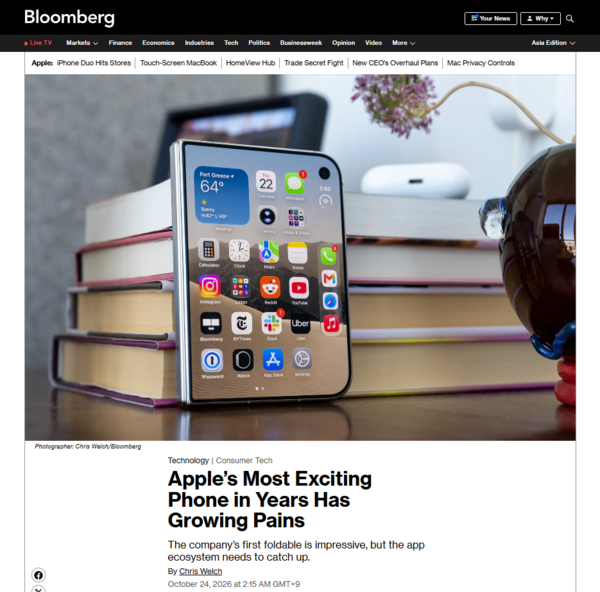
Bloomberg reported on the 24th (local time) that “Apple’s first foldable smartphone, the iPhone Duo, began shipping to early buyers on the 23rd.” Following a two-day hands-on review, Bloomberg evaluated the Duo as “the most intriguing device Apple has released in recent years,” while simultaneously pointing out that “the app ecosystem has failed to keep pace with the hardware.” The term chosen for the headline was 'growing pains.' Ever since the launch of the original iPhone, Apple has been the company setting industry standards from day one of any new product. The fact that a brand-new Apple device is being framed not as a 'finished product' but as a 'work in progress' is symbolic in itself.
The Duo represents Apple's late foray into the foldable arena. For seven years following the launch of the first Galaxy Fold, Apple virtually ignored the category. CEO John Ternus recently dismissed Android foldables as feeling "cheap and clunky." Disparaging early movers and later sweeping the market with sheer perfection is an old Apple playbook. However, with doubts regarding its refinement surfacing from the very first day of shipment, that strategy is no longer working as reliably as it once did.
[Hardware Cracks: The Price of a 'Creaseless Display']
Apple touted an 'invisible crease' as the core selling point of the Duo, employing a nano-texture coating on the inner display to diffuse light. Immediately after the September unveiling, several media outlets praised the screen, noting that while the crease could be felt, it was visually imperceptible. However, as early production units reached users ahead of the official retail launch, a different reality began to emerge.
In a video posted by Weibo user 'Kang' in China, the display area above the hinge was seen yielding under direct finger pressure. The user asserted that pressing this area could induce creases and claimed the identical issue occurred across multiple test units. Tech outlet Notebookcheck analyzed: "While the crease is barely visible when untouched, it becomes apparent to the eye and noticeable to the touch when swiped, leaving long-term durability uncertain given that repeated folding and unfolding inherently deepens creases on foldable displays."
Other hardware characteristics also fall short of 'Apple-tier refinement.' According to Bloomberg’s review, the Duo’s outer screen measures 5.4 inches—comparable to the previous 'mini' lineup. Despite this compact profile, the titanium frame makes it heavier than the iPhone 18 Pro Max. Samsung's Galaxy Z Fold 8, which utilizes an aluminum frame, feels lighter in the pocket. Despite housing an internal vapor chamber, heat generation was more pronounced than on the 18 Pro Max. Minor bugs, such as briefly disappearing home screen icons and widgets, along with delayed orientation detection, were also reported. Although reviewers qualified these as non-critical, they undeniably fit the profile of first-generation growing pains.
[Software Cracks: Apple's True Moat Lies Empty]
The decisive weapon Apple wielded to outmaneuver hardware rivals was never mere chipsets or design, but its app ecosystem. Developers routinely prioritized iOS, building their finest applications for the platform first. This fostered the widespread perception that 'every app works seamlessly on an iPhone.' With the Duo, however, that equation is unraveling.
Bloomberg characterized the Duo's current software situation as a "mess." The Duo runs iPhone apps rather than iPad applications. While Apple's native apps fully utilize both screens, third-party software frequently fails to do so. Major applications like Netflix, Instagram, WhatsApp, Slack, and Microsoft Office have already rolled out dedicated updates. Yet, an overwhelming majority of apps remain merely functional or waste significant screen real estate. In practice, unoptimized apps launch without scaling up on the inner display, frequently flanked by blank letterbox bars on the sides.
Apple was aware of this dilemma well before launch. Behind the scenes, the company worked closely with developers to adapt apps for both the cover and inner displays. That gaps persist on launch day signals that Apple’s grip on its developer ecosystem has weakened. Similar friction occurred during the introduction of the display notch and aspect ratio shifts in the past.
The broader implications are substantial. When the software ecosystem fails to match the pace of hardware innovation, the advantage of Apple's prized 'vertical integration' flips into a vulnerability. Upgrading a device requires the entire ecosystem to move in tandem. The Duo stands as the first clear sign that this cohesive link is fraying.
[AI Cracks: Outsourcing Siri's Brain to Google]
If the Duo's hardware quirks can be written off as first-generation growing pains, the situation surrounding artificial intelligence represents a structural retreat. Apple unveiled 'Apple Intelligence' in 2024, only to repeatedly postpone core features. Ultimately, Apple opted to pay Google an estimated $1 billion annually to power its next-generation Siri using a customized version of Gemini. This move has been widely interpreted as a rare admission of falling behind in the AI race.
Organizational shakeups followed. Amid ongoing delays in Siri’s overhaul and sluggish Apple Intelligence updates, Apple reshuffled its AI leadership in 2025. Mike Rockwell, who spearheaded the development of the Vision Pro, took over the role previously held by AI chief John Giannandrea. In an interview with Time, CEO Ternus pushed back against criticism, arguing that integrating Gemini technology into Siri does not mean Apple has surrendered control over its product experience.
Market observers, however, see it differently. The essence of Apple’s innovation was its end-to-end control, designing the entire user experience across operating systems, silicon, and the App Store. Now, the core engine of conversational AI—widely regarded as the next-generation user interface—has been outsourced to its fiercest rival, Google. Google has effectively secured its position as the default AI engine across both Android and iOS, while Apple finds itself reduced to applying its brand layer on top of a competitor's infrastructure.
[Cost Cracks: Memory Makers Dictate iPhone Pricing]
External dependencies are not confined to AI. With demand for High Bandwidth Memory (HBM) surging due to the AI data center boom, the supply of mobile DRAM for smartphones has contracted sharply. Former CEO Tim Cook referred to this dynamic as a "100-year flood" during his final earnings call as chief executive.
The underlying numbers are sobering. The price of the 12GB LPDDR5X module used in the iPhone Air and iPhone 17 Pro more than doubled from roughly $30 in early 2025 to around $70. TechInsights estimated that to preserve current profitability, Apple would need to raise the price of the iPhone 18 Pro by approximately $270. JPMorgan projected that memory could rise from roughly 10% of the iPhone’s total bill of materials (BOM) to as much as 45% by 2027. Consequently, Apple's gross margin for the current quarter is projected to decline to 46.5%.
Even more damaging is the erosion of bargaining leverage. Apple was once among the world's most formidable memory buyers, commanding pricing terms against Samsung Electronics, SK Hynix, and Micron. Analysts now suggest Apple has lost the leverage to dictate terms in the memory market. Some market observers note that severe pricing pressure exerted by Apple during previous industry downturns depleted Micron's capacity for aggressive capital expansion. The Duo’s starting price of $1,999 makes it the most expensive iPhone in history. Baked into this figure is not just an 'innovation premium,' but the weight of uncontrollable manufacturing cost pressures.
[The Counterargument: Lines Out the Door, Record Financials]
Arguments countering the crisis narrative remain compelling. Consumer demand for the Duo is explosive. When pre-orders opened on the 16th, inventory sold out within minutes, pushing estimated delivery dates for all variants to January 25 by midday. Apple stated in an official release that pre-order interest was "simply extraordinary." Bloomberg Intelligence projected that Duo shipments could outpace earlier estimates of 14 million units and $28 billion in revenue for fiscal year 2027.
Yet, lurking behind the demand surge is restricted supply. Whether delivery bottlenecks stem from unexpectedly robust interest, tight production yields, or both remains uncertain. The possibility cannot be dismissed that Apple is unable to manufacture units at scale amid the ongoing memory crunch. Even seasoned reviewers cautioned hesitant buyers contemplating a $2,000 first-generation product to 'skip this round.'
[Why Times Insight]
Apple’s myth of innovation has historically rested upon two foundational pillars. First, even when late to market, Apple redefines the product category with a 'complete, polished solution'—a trajectory proven by the iPod, iPhone, and Apple Watch. Second, Apple maintains total end-to-end control across silicon, operating systems, and developer ecosystems, creating an unmatched user experience that rivals cannot replicate.
The iPhone Duo and its surrounding environment reveal that both pillars are shaking simultaneously. Arriving seven years late, the Duo has failed to redefine the category. The crease issue was merely mitigated rather than solved, and the app ecosystem has lagged behind the hardware. On the control front, a more structural retreat is underway. The brain of the next-generation interface—AI—is governed by Google, while memory pricing, set to claim nearly half the iPhone’s bill of materials, is dictated by three suppliers across South Korea and the United States. Apple is gradually shifting into a system integrator assembling core components it did not architect.
While blistering pre-order numbers seem to refute the headwinds, they offer no conclusive proof that the device outperforms its competition. Brand equity cannot serve as a permanent substitute for innovation; it merely gets depleted.
It is equally telling that the first flagship launch under CEO Ternus—a hardware engineer of 24 years—has drawn critiques of 'impressive hardware hampered by everything else.' In an era where hardware mastery alone is no longer enough to lead the frontier of innovation, Apple has entered an unfamiliar battlefield armed with its most familiar weapon. The end of this 'innovation myth' does not spell Apple's demise. Rather, it indicates that Apple is transitioning from an industry trendsetter into an enterprise titan forced to adapt to broader market tides. Revenues may continue breaking records, but mythologies cannot be sustained on balance sheets alone.


-중국 푸단대학교 한국연구원 객좌교수
-전 EDUIN News 대표
-전 OUR NEWS 대표
-제17대 대통령직인수위원회 정책기획팀장
-전 대통령실 홍보기획비서관
-사단법인 한국가정상담연구소 이사장
-저서: 북한급변사태와 한반도통일, 2012 다시우파다, 선거마케팅, 한국의 정치광고, 국회의원 선거매뉴얼 등 50여권