
Update2026.10.24 (토)

[Reuters: "Kim Jong Un Guides Company Commanders' Conference"… Continued Drive to Strengthen Military Discipline]
Amid spreading rumors of North Korean State Affairs Commission President Kim Jong Un's death, reports have emerged that he guided a two-day conference of military commanders. South Korea's National Intelligence Service (NIS) reportedly conveyed its assessment to the National Assembly that the death rumors were false. Interpretations linking Kim Yo Jong's frontline inspection to "taking full control of power" must be questioned regarding their underlying basis. This incident illustrates how unverified speculation—relying on the opacity of North Korean intelligence—is inflated into contingency scenarios.
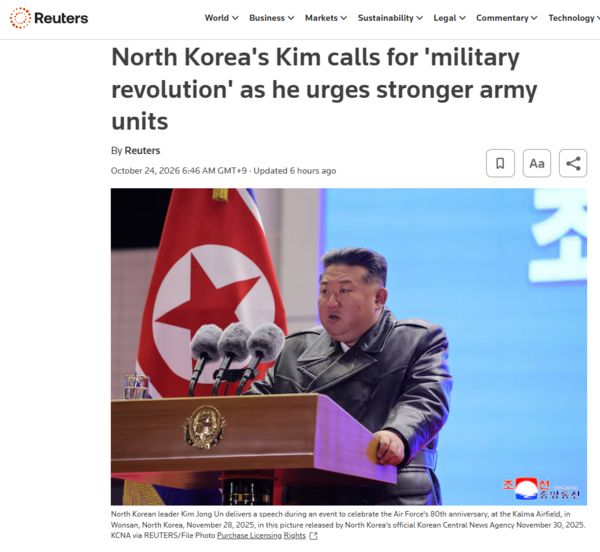
Reuters, citing the Korean Central News Agency (KCNA) on October 24, reported that "Kim Jong Un guided a conference of Korean People's Army company commanders in Pyongyang from the 22nd to the 23rd," adding that "the North Korean side described this event as the first military-wide gathering held since the 9th Congress of the Workers' Party in February." According to Reuters, Kim ordered the companies to be strengthened into elite combat units. This latest public activity directly contradicts online claims of a power vacuum caused by the leader's death.
According to the Reuters report, Kim delivered a speech on "Building a Strong Military in the New Era and the Tasks of Company Commanders," calling for ideological eliteness, the establishment of military discipline, improved unit management, and better living conditions for soldiers. The core message was reinforcing the accountability of frontline commanders. A company serves as the basic combat unit directly managing the training and daily lives of soldiers. Thus, this gathering can be interpreted as imposing responsibility for combat readiness and organizational control on lower-level commanders tasked with implementing military policy in the field.
Kim previously convened division- and brigade-level commanders across the military on May 17 of this year to outline directions for reinforcing frontline units and restructuring military organization. This company commanders' conference can likewise be viewed as part of an ongoing emphasis on frontline unit combat readiness and commander accountability.
[Cerebral Hemorrhage, Treatment in China, and Succession… The Narrative Grew, but Evidence Remained Nonexistent]
The UK edition of the International Business Times introduced claims by Chinese dissident Xie Wanjun on the 20th as the origin of the death rumors. He claimed Kim lost consciousness from a cerebral hemorrhage, was transferred to a hospital in Beijing, and died. He also asserted that 9,000 Chinese troops were dispatched to Pyongyang and that Kim Yo Jong took power, but no independently verified evidence supported these assertions.
When specific details—such as diagnoses, hospital names, and troop counts—are introduced, rumors can easily appear to be internal intelligence. However, narrative specificity is not synonymous with information credibility. Without medical records, credible eyewitness testimonies, or troop movement data, multiplying details does not equate to multiplying evidence. Rather, each individual claim requires separate verification.
On the 20th, North Korean state media released photographs showing Kim visiting a clothing and footwear exhibition in Pyongyang the previous day alongside his wife, Ri Sol Ju, and his daughter, Ju-ae. While this material alone cannot fully determine his overall health condition, it clearly contradicts the death rumors. If ungrounded possibilities of "body doubles" or "manipulation" are reflexively raised every time photographs are published, one must ask what evidence would ever suffice to revise such claims.
The NIS also reportedly briefed ruling and opposition lawmakers on the National Assembly's Intelligence Committee on the 23rd, stating that the death rumors were false. Earlier on September 30, it was reported to have assessed that while Kim belongs to a high-risk group for cardiovascular disease due to severe obesity in the 140-kilogram range, there were no clear signs of health abnormalities at the time. The existence of health risk factors and the claim of actual death from a cerebral hemorrhage are fundamentally different matters.
[Seizing Absolute Power Just by Visiting the Frontline?… Who is Controlling Power in Pyongyang?]
Interpretations linking Kim Yo Jong's inspection of areas near the Military Demarcation Line to power succession were particularly unconvincing. The Associated Press reported that "Kim Yo Jong visited the front line and announced plans to resume loudspeaker broadcasts against South Korea." What was verified were her frontline presence and threatening messages toward the South; that does not prove Kim Jong Un's death or Kim Yo Jong's succession to supreme power.
Common-sense situational analysis also raises doubts. Had Kim Jong Un died suddenly and Kim Yo Jong assumed power, her immediate and foremost priority would have been securing stable control over Pyongyang's party, military, security organs, and central chain of command. Securing the leadership's loyalty and preventing gaps in the command structure would have been paramount. In such a high-stakes moment of taking over power, why would she leave the capital and travel down near the Demilitarized Zone?
Certainly, a frontline visit alone does not definitively prove that everything inside Pyongyang is normal. However, reversing the logic to frame it as "evidence of seizing full control" is even more untenable. Asserting a succession requires separate substantiation, such as shifts in official titles and protocol, the exercise of supreme decision-making authority, or pledges of loyalty from core institutions. Public activity in inter-Korean affairs is fundamentally distinct from taking over supreme authority across the state, party, and military.
Therefore, domestic media outlets introducing these interpretations should have first examined this gap. They should have scrutinized whether Kim Yo Jong's inspection substantiated the death rumors, or whether those who already believed the rumors retrofitted succession meanings onto her visit. Interpreting facts to fit a hypothesis rather than testing a hypothesis through facts reverses the proper sequence of analysis.
[Trends in Neighboring Countries Are Circumstantial… The Core of the Verdict is the Absence of Evidence]
The primary reason Why Times did not accept the death rumors was the lack of evidence commensurate with the gravity of the claim. A contingency regarding Kim Jong Un affects North Korea's command structure, succession dynamics, and regional security. Consequently, the initial claimant's access to information and subsequent circumstantial developments required rigorous verification.
Public responses from China, the United States, Japan, and South Korea were also points of reference. However, China did not institute emergency duties, nor did the United States Forces Korea alter its internal readiness posture. The accurate assessment was simply that no evidence substantiating the death rumors had emerged, while subsequent public appearances and evaluations by South Korean intelligence agencies contradicted the claims.
[Why Times Insight | Analysis Hooked by Rumors: What Did the Media Verify?]
The most critical pitfall in this situation is the tendency to layer claims of a power seizure atop unfounded death rumors, and subsequently build projections of a Korean Peninsula contingency on top of that. If the starting point is unverified, the foundation remains fragile no matter how sophisticated the subsequent analysis appears. Chaining multiple layers of speculation together does not transform them into reliable intelligence.
In particular, Kim Yo Jong's frontline inspection serves as a case study questioning the fundamentals of analysis. If one hypothesizes that a high-stakes power succession was underway, one should first explain how public movement outside the capital aligns with that hypothesis. Skipping that inquiry to present her trip as a sign of seizing absolute power does not verify observed facts; it merely lends credence to rumors.
One cannot criticize the entire domestic press corps using a single brush. Reports that introduced the rumor while actively verifying it must be distinguished from those that amplified and reproduced it as fact. However, if headlines strongly imply death or succession while relegating "unconfirmed" qualifiers only to the very end of an article, it can hardly be considered responsible journalism. The verification level of information must be evident in the initial headlines and thumbnails readers encounter.
The fact that foreign media outlets cited a claim also does not validate the original assertion. When multiple outlets draw from the same social media post, only the volume of reporting increases. The number of articles is not the number of pieces of evidence. What must be scrutinized is not how many outlets covered a story, but whether independent sources of evidence actually exist.
The reason Why Times did not accept the death rumors was not that a North Korean contingency is impossible; it was because insufficient evidence existed to warrant such a momentous conclusion. Should new evidence emerge, assessments can change. However, certainty should not be peddled where evidence is absent. The credibility of situation analysis stems not from the speed of reaching dramatic conclusions first, but from guarding the boundary between verified facts and speculation.
-중국 푸단대학교 한국연구원 객좌교수
-전 EDUIN News 대표
-전 OUR NEWS 대표
-제17대 대통령직인수위원회 정책기획팀장
-전 대통령실 홍보기획비서관
-사단법인 한국가정상담연구소 이사장
-저서: 북한급변사태와 한반도통일, 2012 다시우파다, 선거마케팅, 한국의 정치광고, 국회의원 선거매뉴얼 등 50여권