
Update2026.10.24 (토)


[Nvidia Chips, Dismissed by Beijing as "Unnecessary," Are Now Inside a Frenzied Black Market]
Despite Washington’s sweeping semiconductor blockades, the Chinese government has steadfastly claimed that it can survive the AI race entirely on homegrown technology. The Xi Jinping leadership has continuously framed U.S. export controls as a golden opportunity for technological self-reliance, heavily propagandizing the triumphs of its "semiconductor drive" spearheaded by Huawei and SMIC. However, the Chinese market tells a completely different story. The price of Nvidia’s latest AI servers has skyrocketed twofold in a mere six months, and military-affiliated universities have been caught scrambling to secure these cutting-edge chips. Prices do not lie. The chasm between China’s myth of semiconductor independence and market reality is becoming unmistakably clear.
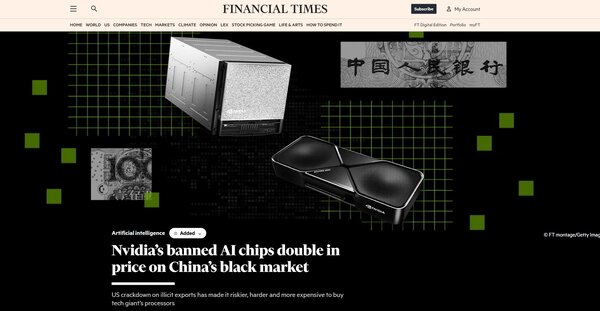
On June 24, the UK's Financial Times (FT) reported, citing multiple Chinese chip traders, that "black market prices for Nvidia AI chips in China have more than doubled over the past six months." The report added that "the price of Nvidia’s flagship server, the DGX B300, soared from 4 million yuan to over 8 million yuan (approximately $1.1 million) during this period." This system, which packs eight Blackwell GPUs, carries an official U.S. retail price of around $400,000, meaning it is changing hands at double its sticker price on the Chinese black market.
The reason behind this price explosion is basic economics: demand is overflowing while supply is effectively choked off. Due to U.S. export restrictions, Chinese firms cannot procure Nvidia's latest offerings through legitimate channels. Consequently, a massive black market driven by illicit gray-market imports, leasing schemes, and third-party reselling has emerged. This sends an unequivocal signal. Chinese corporations and research institutions are willing to brave Washington’s regulatory wrath just to lay their hands on Nvidia hardware, and their desperation is fully reflected in the price. In short, the market itself is proving what the core, indispensable asset of the Chinese AI industry truly is.
[Government Issues Bans, Yet Military-Affiliated Universities Scramble for Supplies]
Intriguingly, this on-the-ground reality directly collides with Beijing’s official position. Since last year, Chinese authorities have consistently signaled domestic firms to curb their purchases of Nvidia chips. Specifically, Beijing effectively barred the use of Nvidia’s H20 chips in government agencies and national security sectors, instructing businesses to prioritize domestic alternatives before considering American AI silicon.
Major Big Tech players like Tencent, ByteDance, and Alibaba have faced intense pressure to scale back their reliance on U.S.-designed AI processors. Some state-run media outlets went as far as claiming that Nvidia products harbor "backdoor" risks capable of leaking critical data back to the United States.
Yet, actual behavior on the ground told a completely different story. As previously reported by this outlet, a Bloomberg investigation revealed that universities belonging to the "Seven Sons of National Defense"—institutions deeply intertwined with the People’s Liberation Army (PLA)—were actively trying to secure Nvidia's state-of-the-art H200 chips. Institutions such as Beihang University and Northwestern Polytechnical University are entities already blacklisted under U.S. sanctions.
While the Chinese government publicly sounds the alarm on Nvidia products for national security reasons, the very military-linked entities at the vanguard of defense research have been utilizing the leasing market to surreptitiously acquire the latest Nvidia processors.
This is more than a mere contradiction. It is proof positive that the Chinese leadership itself is well aware of Nvidia's absolute necessity in cutting-edge AI advancement and military research. Publicly, they boast that "American chips are unneeded," but inside the actual research labs, Nvidia remains the first door they knock on.
["Overtaking Intel" Propaganda Clashes with Cold Reality]
This contradiction is no historical accident. Observers have recently renewed criticisms that China’s heavily trumpeted milestones in semiconductor self-reliance are largely inflated.
On June 17, U.S.-based semiconductor research firm SemiAnalysis published an architectural teardown of the Kirin 9030 processor, which powers Huawei’s latest Mate 80 Pro Max smartphone.
Chinese state media extensively ran headlines claiming that "SMIC has overtaken Intel," pointing to selective metrics from the chip produced via SMIC’s N+3 node. Some overseas media outlets also bit the bait, focusing heavily on these assertions.
However, the broader semiconductor industry offered a much more sober evaluation. Industry experts gauge competitiveness not by specific wiring pitches, but by transistor density—how many transistors can be packed into a single chip. By this standard, SMIC’s N+3 process is practically equivalent to TSMC’s older 6-nanometer (nm) node.
In stark contrast, Intel’s 18A, Samsung Electronics’ 3nm, and TSMC’s latest 3nm and 2nm nodes deliver vastly superior transistor densities. The consensus among analysts is that SMIC still lags behind the world’s top-tier foundries by a technical gap of at least four to five years.
Real-world performance tells a similar story. The peak-performance CPU cores of the Kirin 9030 fall significantly short of Apple’s M1 chip released way back in 2020, and its graphics processing power lags substantially behind the latest offerings from Qualcomm and MediaTek.
Market research firm TechInsights similarly concluded, "SMIC's N+3 is closer to an extension of its pre-existing 7nm node, leaving a substantial gap between it and the advanced nodes of TSMC and Samsung."
Ultimately, China’s narrative of "technological leapfrogging" is merely the result of cherry-picking specific data points. In terms of true industrial competitiveness, the consensus is clear: Beijing remains a distant follower.
[A Technical Vacuum Unfilled by a $115 Billion Money Cannon]
An even bigger headache for Beijing is economic viability. While TSMC, Samsung, and Intel leverage Extreme Ultraviolet (EUV) lithography systems to manufacture advanced nodes, SMIC is blocked from acquiring these machines due to U.S. export controls. As a result, SMIC must resort to multi-patterning techniques using older Deep Ultraviolet (DUV) machines—a brute-force method requiring chips to be exposed multiple times. This approach inevitably causes production costs to skyrocket and yields to plummet.
Semiconductor analysts estimate that DUV-based 7nm manufacturing costs can run 40% to 50% higher than EUV-based processes. Because this structure yields fewer viable chips at a premium cost, experts warn that the model is unsustainable without massive, continuous government lifelines.
Over the past few years, Beijing has funneled over $115 billion into cultivating its domestic semiconductor ecosystem. Yet, the collective global market share of major Chinese foundries actually slipped from 9.6% to 8.6%.
The profitability chasm is equally telling. SMIC’s net profit margin has cratered to the 6% range, whereas TSMC comfortably sustains margins around 40%. Despite absorbing astronomical state subsidies, China's global competitiveness has failed to show meaningful structural improvement.
[What the Black Market Details About China’s AI Landscape]
When the dust settles, the picture becomes clear. The Chinese leadership insists that its semiconductor sector is rapidly catching up to U.S. technology and that its AI industry can thrive independently. The market, however, has delivered a completely opposite verdict.
If China’s semiconductor independence were truly as successful as state propaganda claims, there would be absolutely no reason for an underground black market to exist, let alone one where Nvidia AI servers fetch double their retail value. There would be zero incentive for military-linked universities to take massive political and legal risks to smuggle these chips.
At the end of the day, AI competitiveness is determined by raw compute power, not political slogans. The world’s premier AI models are overwhelmingly trained on Nvidia GPUs, and Chinese corporations are no exception to this rule. Even if domestic Chinese chips have made incremental strides, the market's cold assessment is that they remain far from viable substitutes for Nvidia.
Ultimately, the sky-high black market prices point to a singular truth: China remains desperately dependent on advanced American AI silicon. The hyper-inflated prices for Nvidia chips in China’s underground channels serve as the most honest index of the gaping chasm between Beijing's "self-reliance" rhetoric and its actual technical reality.
Propaganda can be enforced within national borders, but the market remains entirely immune to state narratives. Right now, China’s black market is proving through hard numbers that "China cannot survive without Nvidia"—and that reality is the truest metric of where Beijing's semiconductor ambitions actually stand.


-중국 푸단대학교 한국연구원 객좌교수
-전 EDUIN News 대표
-전 OUR NEWS 대표
-제17대 대통령직인수위원회 정책기획팀장
-전 대통령실 홍보기획비서관
-사단법인 한국가정상담연구소 이사장
-저서: 북한급변사태와 한반도통일, 2012 다시우파다, 선거마케팅, 한국의 정치광고, 국회의원 선거매뉴얼 등 50여권