
Update2026.10.24 (토)

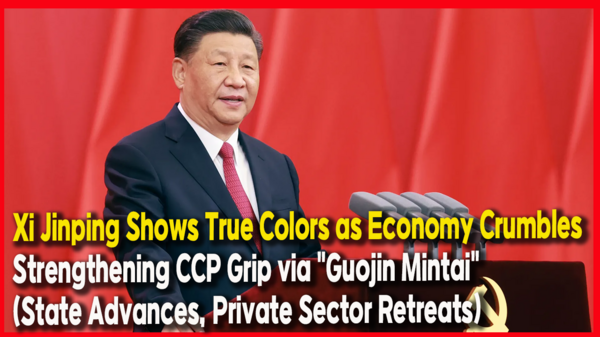
[The CCP Resurrects the History of 1950s Nationalization]
The Chinese Communist Party (CCP) has recently series of retrospectives highlighting the socialist transformation and nationalization history of the 1950s, drawing intense scrutiny over its underlying motives. Barely more than a year ago, President Xi Jinping explicitly promised to protect private enterprises and personally encouraged entrepreneurs. However, the messaging currently coming out of party mouthpieces has undergone a stark shift. As the economic crisis deepens, an atmosphere emphasizing the state’s role and regulatory control is clearly re-emerging.
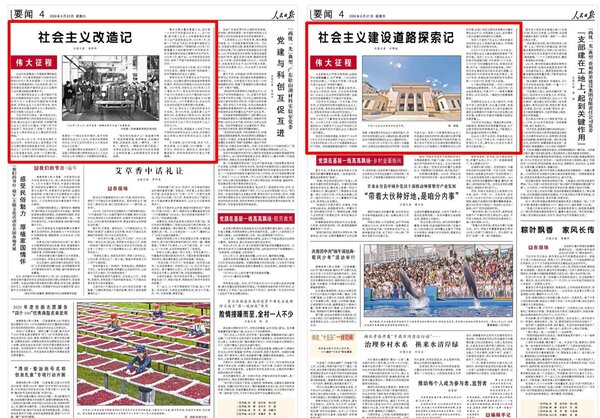
On June 21, People’s Daily, the flagship newspaper of the CCP, published articles titled "Record of Socialist Transformation" and "Record of Exploring the Path of Socialist Construction" in its "Great Journey" column, raising eyebrows regarding its true intent.
Prior to this, on June 19, the state-run Xinhua News Agency released an article headlined "The Three Major Transformations: An Unprecedented and Profound Social Change." The piece shed a positive light on the 1950s "joint state-private ownership" (Gongsi Heying) policy, during which China converted private capitalist commerce and industry into state ownership.
What warrants close attention is that this series of articles cannot be dismissed as mere historical reflection. The fact that two major party mouthpieces—Xinhua and People's Daily—consecutively published series praises for the 1950s socialist transformation within a span of three days carries significant implications. While some analysts view this as a propaganda campaign ahead of the CCP's 105th anniversary, it cannot be regarded as a simple anniversary event, given how it aligns with the cumulative pressures felt by local governance in recent years.
[Just a Year Ago, Xi Jinping Promised to "Protect the Private Economy"!]
The core issue is that this current trajectory directly clashes with the policy line that Xi Jinping himself proclaimed just over a year ago. In February 2025, Xi promised that the state would not pursue Guojin Mintai (State Advances, Private Sector Retreats) to push out private firms. The recent historical retrospectives by Xinhua and People’s Daily are problematic because they point in the exact opposite direction of that promise—a trend where the state expands its footprint in the economic sphere, thereby narrowing the playing field for private enterprises.
The South China Morning Post (SCMP) noted, "In February last year, Xi Jinping hosted a symposium in Beijing, inviting China’s leading entrepreneurs, including Alibaba founder Jack Ma, Tencent founder Pony Ma, Xiaomi founder Lei Jun, and Huawei founder Ren Zhengfei." The report added, "At the time, Xi vowed that the government’s policy toward the private economy would remain unwavering, stating that 'now is the time for private enterprises and entrepreneurs to display their capabilities.'"
Indeed, immediately following the meeting, the National Development and Reform Commission (NDRC) pushed to revise the negative list to ease regulations on private and foreign capital, and legislation to promote the private economy was drafted. Back then, both domestic and international observers anticipated that Xi might be softening his long-standing crackdown on Big Tech and pressure on private enterprises.
[Reality Was Different… Growing Anxiety Among Private Firms]
However, the reality experienced by entrepreneurs on the ground was starkly different. The Peterson Institute for International Economics (PIIE) pointed out, "Over a four-month period from April to July last year, a succession of prominent private Chinese entrepreneurs committed suicide." The institute highlighted that "the damage was heavily concentrated in sectors like elevators, furniture, and interior design, which are severely impacted by the real estate slump."
Rather than being dismissed as isolated incidents, these cases were viewed as symbolic of the widespread anxiety gripping the Chinese private sector. A more profound issue is that the greatest risk perceived by business leaders is not the economic downturn itself, but rather policy unpredictability.
The U.S. foreign policy magazine Foreign Affairs observed, "Since the suspension of Ant Group's IPO, Chinese companies have been operating under immense uncertainty, never knowing when or how regulations might change." For businesses, predictability is far more crucial than government subsidies, and it is precisely this trust that is fracturing.
[Tighter Control Driven by Local Government Fiscal Crises]
Movements by local governments across China mirror this trend. In recent years, the term "deep-sea fishing-style enforcement" (Yuanyang Bubao) has gained widespread traction in China. This refers to a phenomenon where local governments target, investigate, and seize assets or impose heavy fines on entrepreneurs located outside their jurisdictional boundaries.
In June, controversy escalated in Miyang County, Henan Province, over allegations that authorities lured truck drivers into a specific area before seizing and auctioning off their cargo. The backdrop to these predatory practices is the severe fiscal distress facing local governments. As revenue from land-use rights sales plunged due to the property market crash, local authorities have increasingly relied on non-tax revenue sources, such as fines and asset seizures.
The problem is that this pressure goes beyond mere revenue generation; it directly ties into public sentiment management. With rising unemployment and falling incomes, maintaining social stability has become an increasingly urgent task for local governments.
[Economic Crisis is Fueling Tighter Control]
Indeed, key indicators surrounding the Chinese economy remain bleak. Bloomberg reported, "China’s new home prices fell by 0.2% in May compared to the previous month, with the pace of decline actually accelerating," adding that "second-hand home prices also recorded their sharpest drop in three months."
The labor market is equally unstable. According to Trading Economics, "China’s unemployment rate in May stood at 5.1%, but the youth unemployment rate is significantly higher." The data showed that "the unemployment rate for youth aged 16–24 hit 16.3%, while the 25–29 age bracket stood at 7.4%." To make matters worse, a record 12.7 million college graduates are set to enter the job market this summer.
The real estate market is also plagued by forecasts of a prolonged stagnation. S&P Global projected that "new home prices in China will drop further this year," and multiple institutions estimate that it will take at least one to two years for the market to recover due to the severe oversupply. Ultimately, the structural reality dictates that as economic hardships worsen, the incentive for both the central and local governments to tighten control naturally grows.
[Not Full-Scale Nationalization, But Tighter Control is Unmistakable]
Even so, it is difficult to assume that China will abruptly revert to a 1950s-style, all-out nationalized system. According to analyses by the Centre for Economic Policy Research (CEPR) and PIIE, the influence of private enterprises continues to expand in China’s high-tech sectors. Emerging companies in artificial intelligence (AI) and semiconductors are growing rapidly alongside giants like Tencent, Alibaba, CATL, Xiaomi, and BYD.
China-focused think tanks explain this via a "two-track" strategy. One track involves tightening control over real estate, platform companies, and the financial sector, while the other involves aggressively nurturing strategic industries such as AI, semiconductors, and batteries. In other words, Beijing is not seeking to eradicate the entire private economy; rather, it is deploying a selective control strategy—fostering sectors the state requires while stringently managing areas that demand oversight.
Yet, this is precisely where the greatest contradiction of the Xi Jinping regime comes to light. To win the global high-tech race, China desperately needs the innovation capacity of private firms. However, to maintain regime stability, it simultaneously seeks to reinforce state control. Growth demands the market, but governance demands control.
[Outlook: Ultimately, the Issue is Trust, Not Control]
The recent focus on "socialist transformation" by Xinhua and the People’s Daily is no mere historical commemoration. It serves as a symbolic signal demonstrating Beijing's shifting perception—a tendency to emphasize the role of the state over the market, and the CCP over private enterprises, as economic conditions deteriorate.
The crux of the matter is that what the Chinese economy needs most right now is trust, not control. In an environment where entrepreneurs and investors cannot predict the future, private investment sentiment is unlikely to revive, regardless of how aggressively high-tech industries are nurtured.
Ultimately, the dilemma facing Xi Jinping is clear-cut. While strengthening the CCP’s grip may stabilize the regime, it inevitably saps the vitality of the private sector, which serves as the actual engine of economic growth.
The variable that will dictate the future of the Chinese economy is not a binary choice between nationalization and privatization. Rather, it hinges on where Xi Jinping chooses to place his weight between growth and control—that very choice will decide the trajectory of China's economic future.
-중국 푸단대학교 한국연구원 객좌교수
-전 EDUIN News 대표
-전 OUR NEWS 대표
-제17대 대통령직인수위원회 정책기획팀장
-전 대통령실 홍보기획비서관
-사단법인 한국가정상담연구소 이사장
-저서: 북한급변사태와 한반도통일, 2012 다시우파다, 선거마케팅, 한국의 정치광고, 국회의원 선거매뉴얼 등 50여권