
Update2026.10.24 (토)

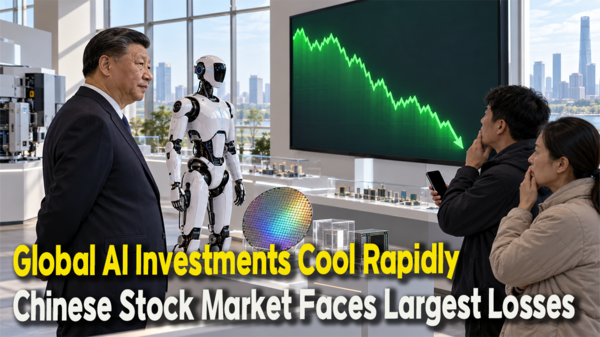
[Bloomberg: “China Takes Biggest Hit as Global AI Investment Wobbles”]
As global enthusiasm for artificial intelligence (AI) investments cools, the heaviest impact is concentrating on Chinese tech stocks. The STAR 50 index—often dubbed China’s Nasdaq—has dropped over 38% in less than four months, while valuations of key semiconductor and robotics hopefuls have plummeted. If the downturn persists, it will tighten financing for advanced tech firms, posing a new burden on Xi Jinping’s drive for tech supremacy.
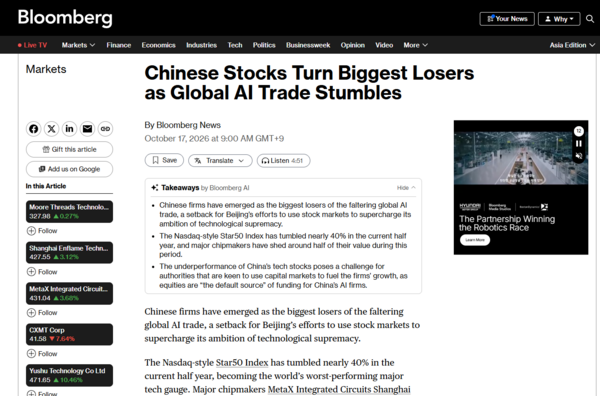
Bloomberg reported on the 17th (local time) that "Chinese companies have emerged as the biggest victims of the weakening global AI investment boom," adding that "the STAR 50, the flagship index of Shanghai’s Science and Technology Innovation Board, fell nearly 40% in the second half of the year, making it the worst performer among major global tech indices. Shenzhen’s growth-heavy ChiNext index also dropped around 36%, demonstrating that tech stocks—which concentrated expectations for AI and advanced manufacturing—took a far heavier blow than the broader Chinese equity market."
The decline did not begin overnight alongside recent instability in U.S. markets. Caixin had already reported on July 31 that "the STAR 50 fell roughly 30% from its early July peak," noting that "at the time, approximately 100 billion yuan drained out of semiconductor and optical communications sectors in just three days. Chinese investors who had heavily allocated to tech stocks during the first-half rally suffered an early shock, and market anxiety has persisted ever since."
Chinese tech stocks were already burdened by stretched valuations. Compounding this were growing doubts over the sustainability of global AI infrastructure spending. A market that absorbed massive expectations during the rally is now unwinding those expectations just as aggressively during the downturn. For investors who viewed the tech rally as a new breakthrough for the Chinese economy, this reversal is particularly painful.
[Semiconductor Valuations Halved… Robotics and Memory Stocks Also Plunge]
The impact on individual corporate valuations is even clearer. MetaX and Moore Threads, once regarded as prime contenders for domestic Chinese AI semiconductors, saw their valuations cut in half during the second half of the year. Memory chipmaker ChangXin Memory Technologies (CXMT) dropped about 27% from its post-listing peak, while robotics manufacturer Unitree tumbled nearly 50% from its August high. Key poster children of China's technological push are facing a simultaneous valuation re-assessment.
Reflected in these companies' prices were expectations that China could bypass U.S. tech controls. However, developing domestic AI chips or demonstrating advanced robots is entirely different from selling them for sustained profits. A business model only takes root when customers integrate these products into actual workflows, make repeat purchases, and cover post-sale maintenance costs.
A sharp stock drop does not automatically equate to technological failure. However, achieving technical breakthroughs is no longer enough to justify inflated valuations. The market is now looking beyond what was built to ask how much can be sold and what profit margins remain. The time has arrived when initial listing hype must translate into next-quarter earnings.
[Surged 75% in Three Months… The Backlash of Expectations on Government Support]
Behind the steep drop lies a sharp first-half surge. According to Bloomberg, the STAR 50 surged about 75% between April and June, fueled by technical breakthroughs and optimism surrounding state support. By late June, its price-to-earnings (P/E) ratio based on forward earnings exceeded 80 times, effectively pricing in massive future successes well in advance.
Sustaining such multiples requires companies to continuously demonstrate rapid growth. Even if revenue increases, growing research and development costs and capital expenditure burdens can squeeze anticipated profits. Price competition or delayed customer acquisition produce the same result. Consequently, stock prices can drop significantly even while underlying technology advances.
Chinese tech stocks carried the added burden of national strategy expectations—the belief that because government-backed industries receive state support, corporate growth and stock appreciation are guaranteed. Yet, an industry’s strategic importance does not ensure individual corporate profitability. Investors weigh whether they can recover their capital rather than whether a firm contributes to national tech self-reliance. This correction can be understood as a decoupling between policy expectations and investment return expectations that were once lumped together.
[The Real Danger Begins After the Stock Price Drops]
The far greater strain on China lies in capital raising. Bloomberg highlighted that Chinese AI-related firms heavily favor equity issuance for financing. Leonid Mironov of Gavekal Capital warned that "a prolonged weakness in tech stocks could complicate fundraising efforts, potentially hindering China’s progress toward its AI objectives."
Falling share prices do not instantly wipe out a company's existing cash reserves. However, securing new capital for subsequent R&D and factory construction becomes significantly more challenging. To raise the same amount of capital, companies must issue more shares, causing greater dilution for existing shareholders. New investors, in turn, demand lower valuations or stricter terms.
If this financing pressure persists, companies are more likely to delay research hiring or facility expansions. Early-stage startups with less cash buffer than tech giants are particularly vulnerable. When R&D demands continuous funding but follow-on investment is delayed, firms may be forced to prioritize immediate cash-generating projects over long-term strategic initiatives.
Ultimately, the core threat is a vicious cycle: falling stock prices increase financing burdens, delayed investments lower growth expectations, and reduced expectations exert further downward pressure on share prices. In advanced industries that require massive upfront capital before yielding returns, the financing environment itself is a core component of competitiveness. This is why prolonged tech stock weakness represents a far bigger issue for Beijing than simple investor losses.
[WSJ’s Warning: Investors Can Lose Even as AI Grows]
Wall Street Journal columnist James Mackintosh pointed out on the 18th that "there is no evidence yet that AI infrastructure investment has avoided the pitfalls seen in historical railway or internet investment cycles." He warned of "the twin risks of rising capital costs disrupting investments alongside the danger of overinvestment building up as construction continues to expand."
This warning applies directly to China. Even if AI spreads throughout the broader economy, it does not guarantee high profits for every related company. If supply expands rapidly and competition intensifies, customers benefit from cheaper products and services, but supplying firms may see returns fall well short of expectations. A clear distinction must be made between the growth of the AI industry and investment returns on AI-related equities.
In upcoming earnings reports from U.S. tech firms, the key focus centers on investment returns rather than capital outlay volume. What matters is how much cash injected into AI returns as actual revenue and profit. If capital expansion continues while cost burdens grow faster, market anxiety will persist. The financial performance and investment plans of U.S. firms will shape evaluations not only for global supply chains, but also for the future earnings potential of Chinese tech enterprises.
[Why Times Insight | Tech Supremacy Built on Stock Prices Hits a Wall]
The sharp drop presents a clear question to Xi Jinping’s leadership: to build a technological powerhouse using private capital, state objectives must align with convincing investment returns. While the government can set the direction of industrial development, it cannot mandate customer purchases or corporate profits.
First, government support cannot replace commercial validation. The necessity for domestic Chinese semiconductors is entirely distinct from whether a specific chipmaker's valuation is justified. The more critical investments in technology self-reliance become, the more imperative it is to allocate finite capital toward genuinely competitive enterprises. Justifying inflated share prices solely through policy importance ultimately passes the burden on to investors.
Second, the timeline for technological catch-up collides with investor patience. Advanced semiconductors and AI require substantial time to deliver results. Investors, conversely, reallocate capital whenever interest rates or earnings outlooks shift. This time mismatch, obscured during bull markets, disrupts R&D and capital expenditure plans during market downturns—demonstrating that the speed of tech supremacy cannot be dictated by political will alone.
Third, if the state steps in where private capital retreats, the fiscal burden of tech supremacy grows. State support can buy time, but if enterprises fail to secure customers and profits within that window, requests for additional subsidies recur. A situation arises where funds required to defend stock prices compete directly with capital needed to enhance technical competitiveness.
Fourth, pursuing tech self-reliance does not isolate firms from global market evaluations. While Chinese companies operate under varying business models, global AI demand outlooks and return expectations influence Chinese tech stocks as well. Political slogans of chasing the U.S. cannot shield firms from global shifts in investment sentiment and profitability scrutiny.
The fact that Chinese tech stocks have emerged as the biggest casualty of the global AI correction highlights how sensitive the financial foundation of China's tech ambition was to market expectations. The barrier facing Xi Jinping extends beyond U.S. technology controls—he must also convince investors who have begun doubting the future profitability of Chinese enterprises. To sustain the dream of becoming a tech superpower, China now needs sustainable corporate profits rather than narrative-driven market valuations.


-중국 푸단대학교 한국연구원 객좌교수
-전 EDUIN News 대표
-전 OUR NEWS 대표
-제17대 대통령직인수위원회 정책기획팀장
-전 대통령실 홍보기획비서관
-사단법인 한국가정상담연구소 이사장
-저서: 북한급변사태와 한반도통일, 2012 다시우파다, 선거마케팅, 한국의 정치광고, 국회의원 선거매뉴얼 등 50여권