
Update2026.10.24 (토)

[Cracks in the Real Economy Revealed by the Latest Financial Indicators]
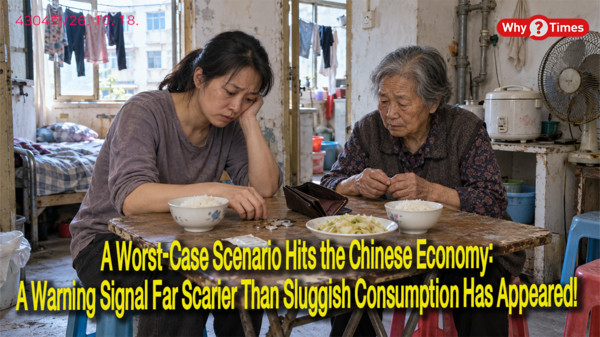
The crisis in the Chinese economy is penetrating deep into the paychecks, living expenses, and debt repayment capacity of its citizens. Cases are surfacing where workers face wage reductions while still employed, and where even minimizing expenses leaves them unable to manage their debt obligations. While the government urges people to boost spending, households are forced to worry first about immediate living costs and job security. The warning lights flashing across the Chinese economy go beyond slowing GDP growth; the public's capacity to consume and their confidence in the future are eroding simultaneously.
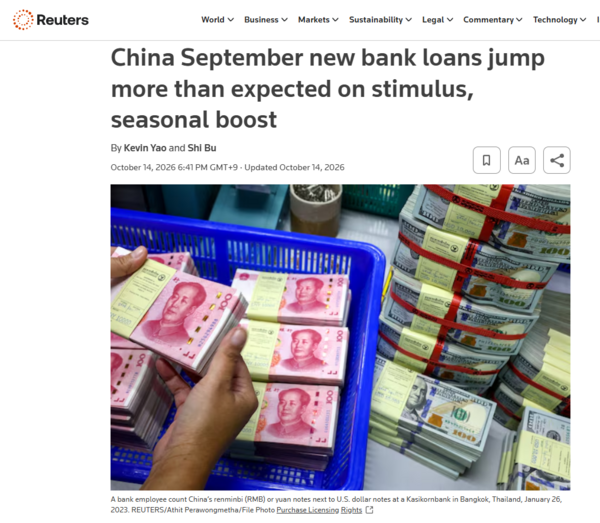
Reuters reported on October 15, “While China's new bank lending surged more than expected in September, the outstanding RMB loan growth rate sank to a record low of 4.8% year-on-year.” The outlet added, “The rebound in new lending was buoyed by policy finance for project investments and corporate funding support, showing that while the government is propping up credit, the property downturn and weak consumer sentiment persist.” This highlights a widening gap between government-generated credit expansion and the recovery felt by ordinary citizens on the ground.
That gap is vividly confirmed in the daily lives of workers. In a July story, Reuters featured Jack Chen, a 27-year-old telecommunications equipment maintenance worker in Jiangsu Province, who struggled with debt repayments after his company cut wages and eliminated his fuel allowance. His burden was around 140,000 yuan—roughly equal to his annual salary—spread across credit cards, online loans, and auto loans. Despite cutting all non-essential spending outside of food, rent, and gasoline, his debt snowballed, and his applications for new loans were rejected.
Having a job no longer guarantees financial stability. When monthly salaries and allowances shrink, loans taken out based on past income levels turn into a crushing burden. Offering slight interest rate cuts to such households while encouraging them to spend will not magically grant them the ability to buy automobiles or home appliances. A vast distance remains between the government's rhetoric of “promoting consumption” and the reality of “this month’s repayment deadline” faced by citizens.
[Accepted a 27% Pay Cut to Avoid Layoffs]
Income pressure is evident in other reporting as well. In March, while assessing the implementation of China's social security reforms, Reuters reported that some companies were lowering wages to alleviate their own cost burdens. Yu, a 26-year-old finance worker interviewed for the report, accepted a 27% drop in take-home pay under the looming threat of layoffs. A policy meant to strengthen the safety net for workers ended up intersecting with wage pressure on the ground.
This does not mean that every Chinese worker experienced an identical pay cut. However, it exposes the underlying pressures hidden behind the aggregate statistic of sluggish consumption. When income drops by more than a quarter, dining out, travel, and durable goods purchases are the first items to be slashed. If there are fixed expenses that cannot be reduced immediately—such as existing debt repayments or rent—the contraction in discretionary spending becomes even steeper. Frugality ceases to be a lifestyle preference and becomes a survival strategy.
Dissatisfaction over labor conditions is also curbing the intent to consume. On September 29, ahead of the National Day holiday, Reuters reported on growing backlash against weekend makeup workday policies and long working hours. Suzy Li, 27, stated in protest against a system that steals her weekends that she would refrain from traveling, ordering food delivery, or taking taxis throughout the holiday period. Diminished purchasing power, combined with frustration over working conditions, is actively suppressing consumer spending.
[Even with Work, Illness and Old Age Bring Anxiety]
The rapid expansion of platform labor, such as delivery driving and ride-hailing, cannot be judged purely by job creation figures. Analyzing China’s gig economy in July, Reuters cited research showing that earnings for ride-hailing drivers declined last year. Out of 12 flexible workers interviewed, only two responded that they voluntarily contributed to social insurance. Though a small sample size, it points to the fundamental fragility of the safety net for informal workers.
For individuals whose monthly income fluctuates wildly and who earn nothing if they fall ill, expanding consumption feels recklessly burdensome. Even if they earn money today, next month remains uncertain, and they must save for medical expenses and retirement on their own. Having work is fundamentally distinct from having a stable foundation for consumption. The more citizens feel they must bear future expenses entirely on their own, the tighter they will squeeze their wallets in the present.
[Pressure on Living Expenses Leads to Delinquency, Delinquency to Tighter Credit Thresholds]
Household distress is inevitably spilling over into the financial sector. According to estimates by Gavekal Dragonomics cited by Reuters, non-performing household loans in China grew by more than 20% last year to a record high of 2.22 trillion yuan. To prevent further bad debt, banks are tightening their screening standards. Thus, while the government encourages borrowing to stimulate consumption, banks are forced to scrutinize borrowers' ability to repay first.
Relatively affluent households avoid taking on new debt to prepare for an uncertain future. Conversely, households desperate for cash find it increasingly difficult to borrow due to income and credit issues. When the pool of people unwilling to borrow grows alongside the pool of people unable to borrow, the effectiveness of interest rate cuts is severely diluted. This is because the root of the problem lies beyond borrowing costs—it resides in baseline income and repayment capacity.
Capital Economics also pointed to weak household borrowing as a primary drag in its October 14 analysis of China's slowing credit growth, noting that demand for both consumer loans and mortgages remains fragile. This demonstrates that the hardships faced by individual workers are not isolated personal misfortunes, but a systemic issue constraining the recovery of domestic demand.
[Government Tasked with Supporting Citizens Faces Its Own Interest Burden]
As household conditions deteriorate, the role of government becomes paramount. However, the government itself is struggling under the weight of past debt servicing costs. This year’s central government budget for interest expenditure rose by 6.7% to 873.99 billion yuan (approximately 174.88 trillion KRW), while general public budget revenue growth for the central government stagnated at a mere 1.8%. Furthermore, local government revenue from state-owned land use rights sales and government-managed funds dropped by 8.2% last year. Precisely when the need to support citizens' livelihoods is rising, fiscal room is coming under severe pressure.
This does not mean the government’s capacity to offer support has evaporated entirely. Rather, it means that where to allocate funds has become immeasurably more critical. Injecting capital solely into new production facilities and industrial projects cannot relieve the anxiety of households facing reduced paychecks and looming debt deadlines. Policy performance must be evaluated not merely by investment volume, but by its direct impact on household income and livelihood stability.
[Why Times Insight] China’s Economy Can Recover Only When Citizens' Paychecks Recover
To grasp the real crisis in the Chinese economy, one must look past factory output and export totals and focus on citizens' paychecks. If people have jobs but face pay cuts, if reducing expenses still leaves debt unmanageable, and if having work still leaves them fearful of illness and old age, consumer spending simply cannot recover. The widening rift between the outward appearance of growth and the stability of daily life is what stands in the way of China's economic recovery.
First, the slump in consumption must not be dismissed as a simple preference for frugality.
For individuals worrying about layoffs and wage cuts, saving is a vital strategy for survival. A citizen's bank balance and next month's salary matter far more than government calls to spend. Pushing for consumption without resolving underlying life anxieties ensures that economic policies remain detached from the public's reality.
Second, substituting debt for missing income has clear structural limits.
Borrowing money creates immediate purchasing power, but it creates a mandate to repay principal and interest later. If income fails to grow, spending today merely consumes the capacity to spend tomorrow. The cases of workers facing default risks after wage and allowance cuts vividly illustrate this danger.
Third, the Xi Jinping leadership must answer how much the fruits of industrial development actually reach ordinary citizens.
Expanding high-tech factories and boosting exports alone will not dispel household anxiety. If corporate expansion fails to translate into wage growth, employment security, and improved social safety nets for workers, the foundation of domestic demand will remain critically fragile.
Fourth, delaying default is fundamentally different from achieving economic recovery.
Maturity extensions and policy loans can buy time. However, if household income fails to recover during that borrowed time, the debt repayment crisis will inevitably return. The more fiscal resources are tied up in maintaining past losses, the less capacity remains for funding new jobs and social support.
The true crisis confronting China lies not merely in the output metric that citizens are not spending, but in the hardening of underlying living conditions that make spending nearly impossible. Unless the Xi Jinping leadership shifts its policy priorities away from heavy industrial investment toward boosting household incomes and strengthening the social safety net, China will remain trapped in a cycle where expanding credit fails to revive domestic demand. Whether the Chinese economy can truly recover will be proven only when ordinary citizens can worry less about debt and comfortably sustain their lives on their own paychecks.


-중국 푸단대학교 한국연구원 객좌교수
-전 EDUIN News 대표
-전 OUR NEWS 대표
-제17대 대통령직인수위원회 정책기획팀장
-전 대통령실 홍보기획비서관
-사단법인 한국가정상담연구소 이사장
-저서: 북한급변사태와 한반도통일, 2012 다시우파다, 선거마케팅, 한국의 정치광고, 국회의원 선거매뉴얼 등 50여권