
Update2026.10.24 (토)

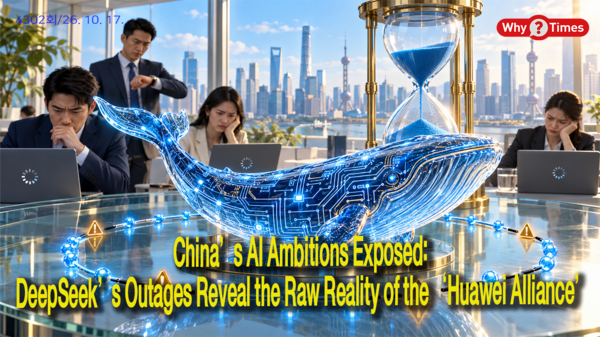
[DeepSeek Crashes at the Start of the Workday; Service Restored Only After Lunch]
DeepSeek, the flagship model of China’s artificial intelligence push, has suffered yet another major outage during peak morning work hours on a weekday. Despite partnering with Huawei to build an independent ecosystem aimed at shedding reliance on Nvidia, the firm exposed critical vulnerabilities in basic infrastructure and operational reliability. Repeated service disruptions are a structural flaw that flashy model announcements and massive venture funding rounds can no longer mask. The battlefield for evaluating Chinese AI competitiveness is shifting from controlled benchmark demonstrations to real-world operational environments.
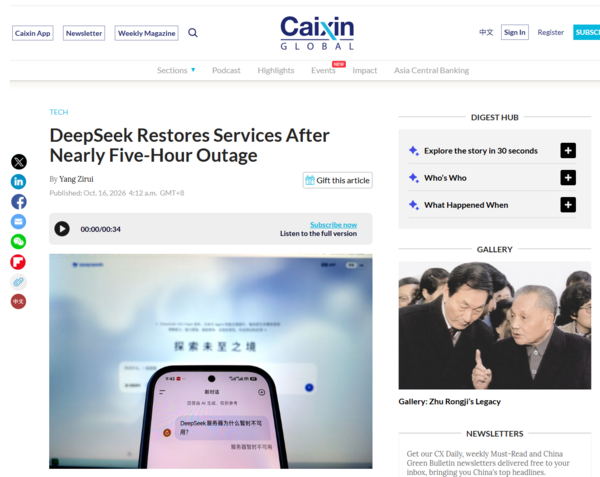
On October 16, the prominent Chinese financial outlet Caixin (English edition) reported that “DeepSeek suffered a service disruption lasting nearly five hours yesterday, impacting its website, mobile app, and developer API services.” Caixin noted that “the outage began at 8:11 AM Beijing time, with conversational features halting entirely by 9:08 AM. Full service was not restored until 1:04 PM.” This meant Chinese enterprise users faced continuous disruption from the moment they arrived at work through the end of their lunch hour.
According to Caixin, the official incident log listed the primary conversational service as well as the APIs for V4 Pro and V4.1 Flash as affected. Because APIs serve as the vital bridge connecting corporate systems and external developers to DeepSeek, the incident was far more than an inconvenience for casual users—it directly disrupted third-party business services relying on the platform. Although the company claimed to have identified the root cause at 9:06 AM, it took an additional four hours to issue a final notice confirming full restoration.
Reporting on the aftermath, the South China Morning Post (SCMP) added that “DeepSeek issued an apology alongside an announcement that it would compensate users with credits equal to their API expenditure over the past seven days.” Under this scheme, API usage fees incurred between October 8 and October 14 will be refunded and applied as deductions against future API billing.
[Over 44 Incidents Recorded This Year: Mounting Distrust Over Constant Outages]
The more alarming issue is the chronic recurrence of these failures. Citing statistics compiled by China’s ifeng.com, media reports revealed that DeepSeek recorded over 44 service anomalies this year up through October 15. While this tally includes partial slowdowns and response latency alongside full-blown system meltdowns, it highlights a persistent inability to maintain the seamless operational uptime expected by enterprise clients.
Economic Information Daily, an affiliate of Xinhua News Agency, pointed out that “five separate service incidents were recorded in October alone.” The report noted: “On October 8, performance degraded for three minutes, and on October 12, web services suffered a partial outage lasting roughly 11 minutes. While brief delays cannot be weighed equally with prolonged meltdowns, when a five-hour systemic crash strikes amidst recurring anomalies, it raises fundamental questions about whether the operational infrastructure is robust enough.”
Caixin similarly underscored that “enterprise AI derives its core value from availability when needed. No matter how brilliant the outputs or how competitive the pricing, if connection drops mid-task, clients are forced to switch to alternatives or redo their work entirely. When outages become routine, users stop evaluating how well the AI performs and start checking whether it will connect at all today.” Operational instability is actively eroding technological achievements.
[“Eliminating Single Points of Failure”: Challenges Exposed in the Apology]
In its official apology, DeepSeek stated it would “conduct a comprehensive overhaul of service stability and identify and eliminate 'single points of failure' (SPOFs).” The stated objective is to “mitigate the risk of localized glitches cascading into full-system shutdowns.” However, the public notice lacked specific details regarding which hardware or software components failed, or why recovery required several hours.
As a result, it is premature to attribute this specific failure directly to flaws in Huawei chips or a shortage of compute clusters. Nevertheless, operational accountability remains unavoidable. If computing resources were insufficient, it reflects a failure in supply-and-demand management; if resources were adequate, it points to flaws in system architecture and failover engineering. In either case, it raises serious questions about whether the service is mature enough to power enterprise workflows.
[Declaring Tech Self-Reliance with Huawei: Stable Supply Remains a Separate Test]
Concerns over compute supply have a clear historical context. On April 24, SCMP reported that “DeepSeek acknowledged throughput constraints on its V4 model, stating that capacity bottlenecks would persist until Huawei’s Ascend 950PR Supernodes ship at scale in the second half of the year.” This highlighted an early gap between the ability to design sophisticated models and the capacity to serve a vast user base reliably.
While that explanation reflected conditions earlier in the year, it underscores a fundamental principle: launching proprietary models is meaningless unless backed by sufficient, resilient hardware infrastructure. The success of technological self-reliance cannot be judged solely by press releases celebrating the pairing of domestic models with domestic chips; it must be proven by whether the ecosystem can stably support real-world demand.
On September 30, DeepSeek and Huawei expanded their partnership by releasing joint compute and communication software stacks optimized for the Ascend platform—an attempt to broaden the foundation for efficiently utilizing domestic hardware. However, releasing software development toolkits and maintaining large-scale, fault-tolerant commercial operations are vastly different milestones. For corporate clients, nationalistic branding takes a back seat to whether the platform is dependable enough for daily operations.
[Capital Is Pouring In, but Trust Cannot Be Bought with Money Alone]
Investor enthusiasm surrounding the company remains high. On October 6, Reuters reported that “DeepSeek is expected to raise over 80 billion yuan in a new funding round,” referencing Bloomberg reports that “the final transaction size could reach 100 billion yuan.” Yet, massive capital injections do not serve as a guarantee of service quality. Expanding data center capacity is a fundamentally different challenge from operating that infrastructure as a resilient, fault-tolerant system.
To retain customer trust, DeepSeek must deliver operational performance commensurate with its massive valuations. What matters now is whether promised stability audits translate into a measurable reduction in downtime, and whether post-incident reporting and recovery protocols improve. Corporate clients do not need promises of mega data centers in the future; they need absolute certainty that today's automated workflows will execute without interruption.
[Why Times Insight | China’s True AI Capabilities Are Exposed in 'Moments of Need']
The key takeaway from the DeepSeek crisis is not that Chinese AI lacks foundational intelligence, but that severe vulnerabilities emerge when attempting to translate impressive benchmarks into mission-critical economic services. Solving complex logic problems and guaranteeing reliable daily service to millions of users are two capabilities that must be developed in tandem. DeepSeek’s chronic outages pressingly question how far China's AI drive has actually progressed on this second requirement.
First, the value proposition of 'cheap and smart AI' is discounted the moment service halts. Enterprises do not merely calculate API usage fees; they factor in the costs of operational delays, employee downtime, and maintaining redundant backup systems. If a low-cost platform requires companies to keep expensive alternative systems on standby for frequent crashes, net savings evaporate. To convert temporary interest driven by low prices into long-term enterprise contracts, DeepSeek must stop offloading the cost of infrastructure uncertainty onto its customers.
Second, technological self-reliance must be judged by system resilience rather than component origin. Pairing domestic Chinese chips with proprietary software is an important milestone. However, true self-reliance becomes a competitive advantage only when backed by adequate hardware procurement, load balancing, and high availability during failures. If reducing dependence on foreign technology leads to degraded reliability for end users, those disruptions must be counted as a cost of the self-reliance transition. State-backed slogans cannot substitute for enterprise quality standards.
Third, transparency in root-cause analysis is an integral component of technological trust. Enterprise clients must understand precisely what occurred and what residual risks remain in their integration pipelines. Offering vague promises of recovery and prevention without detailed post-mortems prevents businesses from properly assessing risk. For enterprise adoption, post-incident response is just as critical as preventing the incident itself. DeepSeek must move beyond announcing that a cause was found and provide transparent disclosures regarding impact scope and architectural remedies.
Fourth, massive capital inflows and rapid scaling do not automatically solve operational incompetence. As infrastructure expands and client volumes grow, systemic complexity increases exponentially. Expanding scale without fixing underlying operational vulnerabilities only heightens the risk of larger, more catastrophic crashes. As investment capital floods in, analysts and clients alike must look beyond new model launches and compute clusters to examine how recovery mechanisms, red-teaming, and site reliability engineering (SRE) capabilities are being upgraded.
Ultimately, the true scorecard for China's AI ambition will not be written in flashy model release notes, but in operational metrics: how much downtime is reduced, how quickly systems recover, and how confidently enterprises can delegate critical workloads to the platform. Slogans proclaiming to overtake the United States have been loud and assertive. Yet, when faced with the most basic test—delivering uninterrupted service to working professionals arriving at their desks—DeepSeek faltered once again. The fragile underbelly of China's AI sector is revealed far more vividly on a 'Server Unavailable' screen than on any launch event stage.

-중국 푸단대학교 한국연구원 객좌교수
-전 EDUIN News 대표
-전 OUR NEWS 대표
-제17대 대통령직인수위원회 정책기획팀장
-전 대통령실 홍보기획비서관
-사단법인 한국가정상담연구소 이사장
-저서: 북한급변사태와 한반도통일, 2012 다시우파다, 선거마케팅, 한국의 정치광고, 국회의원 선거매뉴얼 등 50여권