Update2026.10.24 (토)

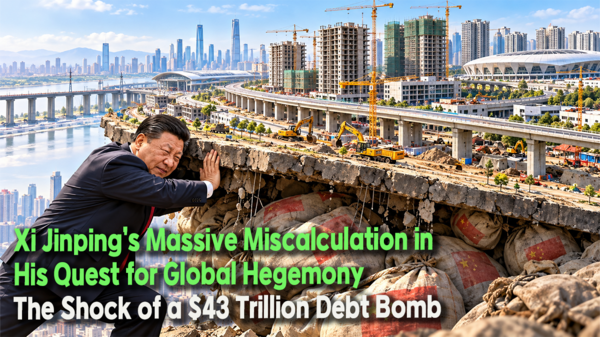
[$43 Trillion Increase Since Xi Took Power… How Did China End Up Buried in Debt?]
Xi Jinping’s ambition to build a superpower surpassing the United States is pushing the Chinese economy into an abysmal pit of debt. Since Xi assumed power, non-financial sector credit in China has surged by over $43 trillion, plunging the entire economy into a dangerous debt cycle. Factories and real estate developments, flooded with massive capital, have yielded overcapacity and bad loans. Attempts to offset this through exports have triggered trade barriers from the U.S. and Europe. Even more alarming is that Xi shows no intention of altering the state-led growth strategy that brought about this crisis.
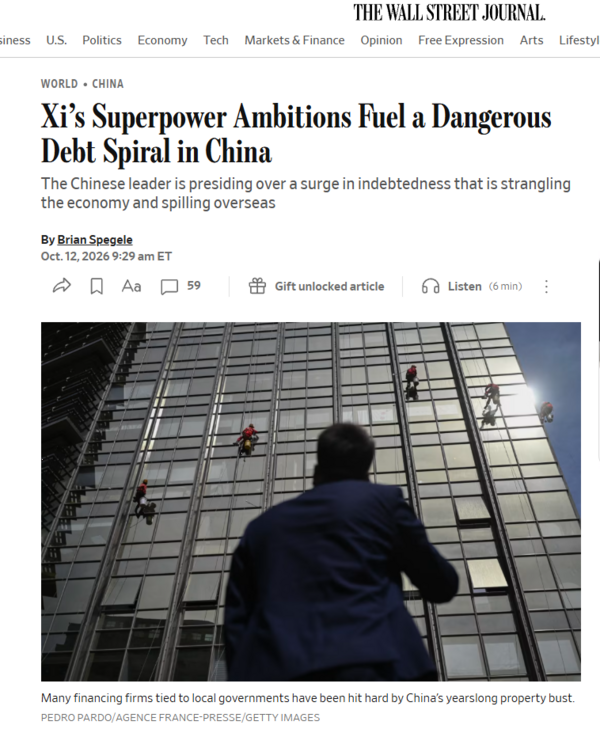
The Wall Street Journal (WSJ) reported on the 12th (local time), "Chinese leader Xi Jinping’s superpower ambitions are driving China into a dangerous debt spiral," shocking observers. According to data from the Bank for International Settlements (BIS), since Xi took power in late 2012, credit extended to non-financial sectors—including the government, corporations, and households—has increased by over $43 trillion (approx. 57,728 trillion KRW), which translates to an astronomical 300 trillion yuan. This figure represents solely the debt added during Xi's tenure, rather than total outstanding debt.
The WSJ added, "Even more alarming is the velocity of debt growth. Last year, China’s non-financial sector credit exceeded 300% of its Gross Domestic Product (GDP), a staggering 60-percentage-point increase compared to late 2019." The report highlighted that "if the value added by China's economy in a year is 100, the total debt carried by its government, corporations, and households exceeds 300."
Mark Williams, Chief Asia Economist at Capital Economics in the UK, noted, "China’s debt ratio has risen by more than 120 percentage points relative to GDP over the past 15 years," adding that "this demonstrates how rapidly China has relied on debt to sustain economic growth."
[Where Did All That Money Go?… The Debt Trap Left Behind by Factories and Apartments]
The fundamental issue is that the borrowed capital failed to generate sufficient returns. The WSJ pointed out that "massive funds were poured into constructing factories and housing in areas lacking market demand." It further noted, "Local governments expanded projects to meet growth targets and maintain employment, while corporations leveraged government subsidies and bank loans to expand production facilities."
The WSJ continued, "However, as the real estate market collapsed and domestic demand weakened, the situation reversed. Apartments remained unsold, factories operated well below capacity, and companies slashed prices to survive. This cutthroat competition squeezed profits and wages. A cycle became entrenched: borrowing to build factories, and borrowing again due to inadequate profits."
This debt-dependent growth model predated Xi’s rise to power. However, under his regime, the investment-driven growth strategy remained fundamentally unchanged. As state support expanded for high-tech and strategic industries, resolving the overinvestment problem grew significantly more difficult.
[Hidden Local Government Debt… Far Worse Than Official Statistics Suggest]
The Chinese government emphasizes that central government debt levels are lower than those of the United States. However, the real danger is concentrated in local governments and Local Government Financing Vehicles (LGFVs). LGFVs are entities established by local governments to raise funds for roads, industrial parks, and real estate developments.
The core issue is that many of these companies cannot service their debt using their own revenues. With local government revenues from land sales declining, the repayment burden has intensified.
According to the International Monetary Fund’s (IMF) assessment of the Chinese economy released in February this year, expanded government debt—which includes LGFV debt—was estimated at 126.6% of GDP for 2025. The IMF projects this ratio will rise to 135.3% in 2026 and reach 153.7% by 2030. Compared to the general government debt ratio of 68.4% projected for the same year, this underscores a vast debt burden hidden from official figures.
[Even Failing Companies Must Be Saved… The Severe Dilemma Facing Chinese Banks]
China’s debt problem is uniquely perilous because liquidating distressed companies is difficult. Even low-profitability firms can avoid immediate bankruptcy if they can borrow money at low interest rates from state banks. According to the WSJ, the average borrowing rate for listed manufacturing companies in China last year was only around 2.4%.
However, low interest rates merely extend existing debt without restoring core corporate profitability. Conversely, stopping loans risks driving bankruptcies and unemployment while forcing banks to absorb massive losses. Continuing to lend simply accumulates bad debts.
Camille Boullenois, Deputy Director at the Rhodium Group in the U.S., pointed out, "The Chinese government is unprepared to absorb the massive losses required to reform the existing system." She warned that "the financial system could gradually deteriorate, weakening its ability to support economic growth." The true danger for China may not be a sudden banking collapse, but rather the entire financial system losing vitality over a prolonged period while sustaining distressed firms.
[China’s Debt Bomb Shakes Global Trade Markets]
China's debt crisis is no longer an isolated issue. Heavily indebted companies are pushing unsold domestic inventory—such as automobiles, solar panels, and electronics—into overseas markets, exacerbating global trade conflicts.
According to the General Administration of Customs of China, China recorded a record-high goods trade surplus of approximately $1.189 trillion in 2025. Exports reached $3.77 trillion while imports remained at $2.58 trillion. This reflects a deepening imbalance: Chinese goods flood global markets, but China itself fails to import sufficient goods from other nations.
This phenomenon illustrates how Chinese companies are attempting to offset weak domestic demand through overseas sales. While the entire trade surplus cannot be attributed solely to dumping—as corporate competitiveness and global supply chain shifts also play a role—it is evident that low-cost exports fueled by state subsidies and overcapacity are stoking trade friction with the U.S. and Europe.
Ultimately, China faces a dilemma: it must increase production and exports to service its debt, but expanding exports heightens trade resistance abroad. The industrial dominance strategy pursued by Xi Jinping has paradoxically impaired Chinese firms' access to global markets.
[Factories Over Consumption… Why Won't Xi Shift Economic Policies?]
More concerning is the weakening momentum of China's overall economic growth. China’s second-quarter GDP growth slowed to 4.3%, down significantly from 5.0% in the first quarter. Amid a persistent real estate slump and weak consumer demand, economic reliance on exports to sustain growth has deepened structural imbalances.
According to the WSJ, economists argue that to break free from the debt spiral, China must abandon its growth model reliant on investment and exports, and instead boost household consumption. Currently, household consumption accounts for only about 40% of China's GDP—far below the U.S. level of approximately 70%.
However, transitioning to a consumption-driven economy requires strengthening household income and social safety nets, diverting resources away from state-dominated strategic industries directly to the public. This would necessitate a recalibration of Xi's state-led industrial priorities.
The WSJ reports that Chinese leadership views the current era as a decisive window to ascend as a superpower on par with the U.S. Consequently, Beijing believes it cannot slow investments in core fields like semiconductors, AI, space, and energy.
Jacob Gunter, Lead Analyst for Economy and Industry at the Mercator Institute for China Studies (MERICS) in Germany, warned that "China’s current model is reaching its limits." He noted, "Local governments subsidize unprofitable firms to keep them alive, but because these firms generate no real profit, they fail to contribute meaningful tax revenue."
Thus, local governments spend money to keep firms afloat, accumulating additional debt in the process. Yet, Beijing continues to buy time with liquidity injections and debt extensions rather than implementing fundamental policy overhauls.
[Why Times Insight | Xi Jinping’s True Failure Lies in Governance Philosophy, Not Economics]
Xi Jinping’s greatest miscalculation was believing that creating a powerful state is identical to building a prosperous citizenry. He assumed that if the state selected industries, state banks allocated capital, and local governments competitively built factories, China could surpass the United States. However, prioritizing Party objectives over market profitability burdened the Chinese economy with insurmountable debt.
Structural Trap: China has moved beyond borrowing to grow; it now borrows simply to maintain its existing economic structure. Restructuring distressed firms triggers unemployment and financial distress, while continued support inflates total debt—a dilemma with no easy resolution.
Geopolitical Paradox: Xi's hegemony strategy is narrowing China's economic escape routes. Weak domestic demand forces reliance on exports, but overcapacity sparks trade barriers in the West. The more aggressively China pursues superpower status, the more hostile its international economic environment becomes.
Ideological Conflict: Economic reform conflicts with Xi’s style of governance. Shifting to a consumption-led economy requires the Party to relinquish control over resource allocation. Reorienting the political system to serve consumer welfare rather than political control remains unviable under the current leadership. Ultimately, economic recovery demands governance reform that Xi is unwilling to accept.
It cannot be definitively stated that China will collapse in an immediate financial crisis. However, a more perilous scenario is a slow, chronic loss of economic vitality. Xi Jinping's ambition to create a global hegemon is undermining China's foundation for growth. The paradox that the greatest obstacle to the "Chinese Dream" is Xi Jinping’s own economic policy is becoming a reality.
Would you like me to adjust the tone, format, or specific terminology (such as financial or policy terms) for a specific publication or audience?


-중국 푸단대학교 한국연구원 객좌교수
-전 EDUIN News 대표
-전 OUR NEWS 대표
-제17대 대통령직인수위원회 정책기획팀장
-전 대통령실 홍보기획비서관
-사단법인 한국가정상담연구소 이사장
-저서: 북한급변사태와 한반도통일, 2012 다시우파다, 선거마케팅, 한국의 정치광고, 국회의원 선거매뉴얼 등 50여권