
Update2026.10.24 (토)

[Even peak season vanishes… Chinese domestic auto market drops for 12 consecutive months]
The automotive industry—cultivated through the full mobilization of national resources by Chinese President Xi Jinping—is confronting a severe crisis. As vehicle sales plunge sharply in the domestic market, overseas markets that once sustained the growth of Chinese automakers are now blocked by formidable trade barriers. On top of this, the Chinese government's decision to cut value-added tax (VAT) rebates on EV exports has sounded the alarm on corporate profitability. As five simultaneous pressures crash in—domestic stagnation, export restrictions, reduced policy support, cutthroat price wars, and doubts over technology and quality reliability—the fundamental growth model of China’s auto industry is put to the test.
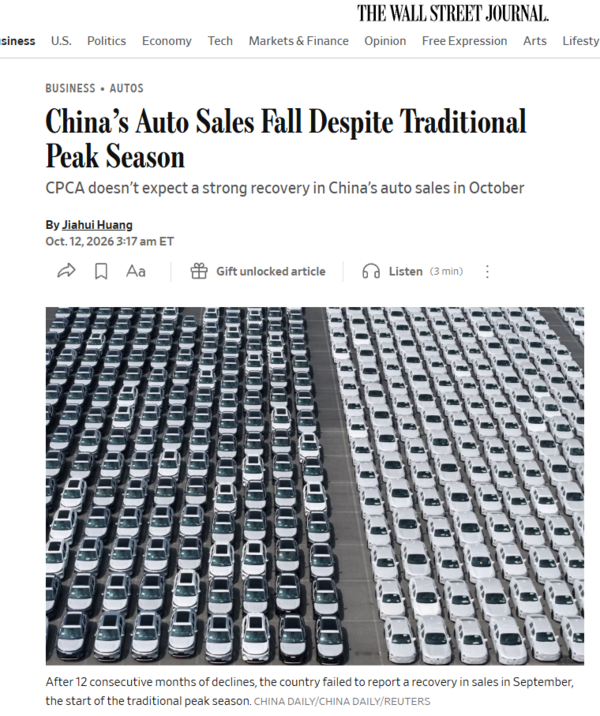
The Wall Street Journal (WSJ) reported on October 13 that "the Chinese auto market failed to rebound even during September, traditionally a peak sales season, leading passenger car sales to fall for the 12th consecutive month." The report cited data released by the China Passenger Car Association (CPCA) on October 12 showing that "domestic retail sales of passenger cars in September totaled 1.618 million units, plummeting 28% year-on-year. Cumulative sales from January to September also fell 21.7% to 13.334 million units." The primary peak season, referred to by the Chinese auto industry as "Golden September, Silver October" (金九銀十), has essentially vanished.
WSJ added, "Even more shocking is that New Energy Vehicles (NEVs)—intensively fostered by Beijing—were no exception. Domestic retail sales of NEVs in September fell 16.7% year-on-year to about 1.08 million units, while gasoline car sales fell even faster. As a result, the market share of NEVs reached a record high of 67%, not because EV sales surged, but because gasoline car sales cratered at a much faster pace."
WSJ analyzed that "while front-loaded demand from last year's trade-in subsidies, reduced support this year, and high fuel prices contributed to the slump, the burden on automakers is worsening as consumer sentiment falters. The automotive industry, built as a core growth engine for China’s economy, has hit a wall formed by shrinking domestic consumer demand."
[Failing domestic sales drive reliance overseas… Chinese cars desperate to export]
A strange paradox is emerging in China's automotive industry: while domestic sales are plummeting, exports are surging exponentially. According to the CPCA, passenger car exports in September reached 917,000 units, up 73.7% year-on-year. Exports accounted for 36% of total passenger vehicle manufacturer sales. NEV exports, in particular, surged 163.5% to 558,000 units.
The issue is that expanding export volumes does not necessarily translate into improved profitability. Chinese automakers must maintain massive production capacity, forcing them to sell more vehicles abroad as domestic demand shrinks. However, if price wars intensify overseas, profit margins may fail to grow despite higher sales volumes. Consequently, while exports serve as a vital lifeline for China's auto industry, they simultaneously represent a new risk factor by escalating reliance on foreign markets.
[Europe blocks even the hybrid bypass route… A fatal blow to Chinese vehicle exports]
A major policy shift has occurred in the European market, a key destination for Chinese vehicle exports. Reuters reported on October 9 that "China and the EU have reached a trade agreement that could slash Chinese hybrid vehicle exports by more than half." EU Trade Commissioner Maroš Šefčovič stated after negotiations in Beijing with Chinese Commerce Minister Wang Wentao that "an agreement was reached to regulate China's hybrid car exports, which is expected to reduce imports by millions of units over four years."
According to Reuters, this agreement is pivotal because it directly destabilizes the European expansion strategy of Chinese automakers. When the EU imposed countervailing duties on Chinese battery electric vehicles (BEVs), Chinese manufacturers expanded exports of hybrid vehicles, which carried lower tariff burdens. Now, hybrid cars have also been targeted for import restrictions. The Associated Press (AP) reported on October 13 that "the EU's annual import quota for Chinese hybrid vehicles is likely to be set at around 350,000 units." Given that Chinese vehicle exports to Europe were projected at 800,000 units this year, capping imports at under half that figure deals a staggering blow to the Chinese auto industry.
More notably, European perception of China is undergoing a fundamental shift. According to the Financial Times (FT), the EU has determined that China's overcapacity and subsidy policies place an unsustainable strain on European manufacturing and employment. Calls for stronger trade defense measures are growing louder in both Germany and France. While Chinese automakers can respond by constructing local manufacturing plants in Europe, doing so involves massive additional investments and cost burdens. This is likely to widen the gap between well-capitalized major manufacturers and smaller, cash-strapped players.
[Beijing cuts export support… Auto manufacturers face profitability emergency]
As Europe raises import barriers, the Chinese government has also decided to curtail support for auto exports. Reuters reported on October 12 that "China's Ministry of Finance decided to lower the VAT rebate rate on NEV exports from 13% to 9%, effective April 1, 2027." Reuters explained that "this measure will reduce the tax refunds companies receive during export, putting further strain on corporate profitability."
Beijing's policy shift can be interpreted as an effort to curb excessive domestic price wars and ease international trade friction. However, for automakers, the situation is increasingly complex. Vehicles are not selling domestically, foreign import regulations are tightening, and government tax incentives supporting exports are being dialed back. As a result, Chinese automakers face an environment where exporting more yields diminishing financial returns.
[The final test: Technology and quality… Another vulnerability for Chinese vehicles]
As the limits of price competition become clear, trust in technology and quality is becoming paramount for Chinese automakers. A recent controversy surrounding broken brake pedals on the Stelato V800—a luxury vehicle jointly developed by Huawei and JAC Motors—highlighted these vulnerabilities once again. Allegations arose that pedal mounts broke on three vehicles during emergency braking tests, triggering debates over basic safety verification and quality control.
Of course, safety concerns surrounding a specific model cannot be generalized to suggest a total lack of technological competence across the entire Chinese automotive industry. Chinese companies have built strong competitiveness in battery tech, EV powertrains, and manufacturing costs. However, as discounting overseas becomes difficult and local production burdens rise, quality, safety, and brand trust will inevitably become the decisive competitive factors. Chinese automakers must prove they can win over global consumers based on merit rather than cheap price tags.
[Why Times Insight | The true crisis of Xi Jinping's auto ambitions is just beginning]
The five crises confronting China's automotive industry are not isolated events; they are interconnected. As domestic sales slumped, firms expanded exports. As exports surged, Europe tightened regulations to protect its domestic industry. Simultaneously, Beijing cut tax rebates, putting fresh pressure on corporate profits. The core growth formula that sustained China's auto industry—mass production coupled with aggressive export expansion—is facing a fundamental reckoning.
First, the Chinese auto industry is falling into a structural trap where it can neither easily scale back nor continue expanding production. The automotive sector represents a massive industrial ecosystem tied to local government tax revenue, employment, component suppliers, and financial institutions. Cutting production risks destabilizing local economies, while maintaining current production levels perpetuates oversupply and price wars. The sheer scale of the automotive industry built under Xi Jinping makes structural reorganization exceptionally difficult.
Second, relying on overseas markets to absorb excess capacity has hit a hard limit. Following the United States, Europe is intensifying restrictions on Chinese vehicles. While Chinese firms have the option to build local factories abroad, not all companies possess the capital to do so. Consequently, the Chinese auto industry is likely to face mounting consolidation pressure, favoring major conglomerates while forcing smaller players into restructuring or failure.
Third, the ultimate survival of Chinese automakers will depend on profitability and quality rather than sales volume. Possessing the world's largest production capacity alone does not guarantee long-term competitiveness. Only companies capable of generating profits without relying on state subsidies and rock-bottom price wars—and those that earn consumer trust through safety and quality—will survive.
This shift presents both opportunities and threats for the global auto industry. Restrictions on Chinese vehicle imports into Europe could create a more favorable competitive environment for international rivals in European markets. Conversely, if Chinese automakers blocked in Europe divert their export focus toward Southeast Asia, Latin America, and the Middle East, global competition in those emerging markets will become vastly more intense.
Ultimately, the true crisis facing Xi Jinping's automotive drive is not a matter of how many cars China can sell. It is a question of how many Chinese automakers can actually survive without relying on state subsidies and ruinous price competition. The real battle for survival in China’s auto industry has only just begun.

-중국 푸단대학교 한국연구원 객좌교수
-전 EDUIN News 대표
-전 OUR NEWS 대표
-제17대 대통령직인수위원회 정책기획팀장
-전 대통령실 홍보기획비서관
-사단법인 한국가정상담연구소 이사장
-저서: 북한급변사태와 한반도통일, 2012 다시우파다, 선거마케팅, 한국의 정치광고, 국회의원 선거매뉴얼 등 50여권