
Update2026.10.24 (토)

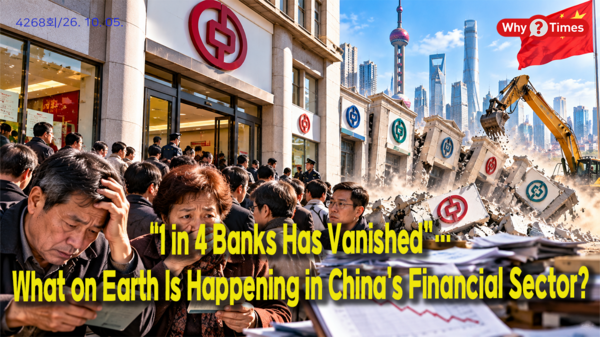
[670 Institutions in a Single Year… 1 in 4 Banks Disappears]
Banks in China are vanishing at a frightening speed. In the past year alone, more than 670 banking institutions closed their doors or were absorbed by larger rivals, causing 23% of all banking corporate entities in the country to disappear in just four years. While Chinese authorities frame this as structural reform to bolster the financial system, removing bank signage does not magically erase non-performing loans and accumulated debts. Furthermore, the International Monetary Fund (IMF) warned that systemic risks are higher now than in 2017, emphasizing that simply merging weak banks will fail to solve the underlying core issues. What exactly is taking place inside China’s financial sector?
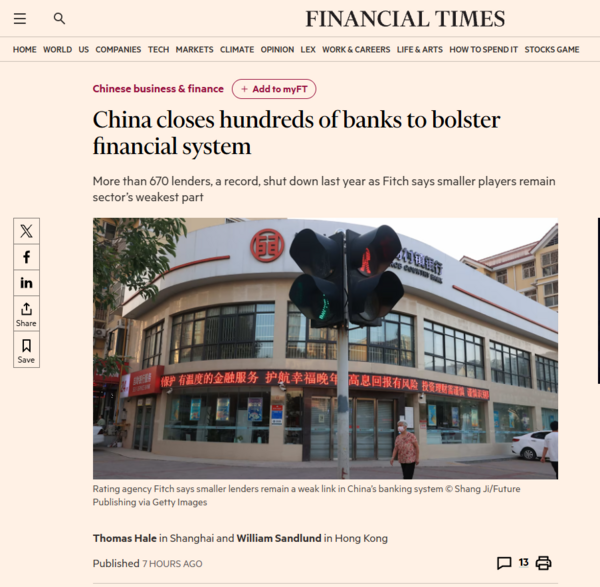
The Financial Times (FT), citing official data from China’s National Financial Regulatory Administration (NFRA), reported that "an unprecedented wave of bank restructuring is sweeping China's financial sector," with "over 670 banking institutions closed or absorbed by other financial entities last year—a record high." The vast majority of these were small, rural financial institutions.
The FT added that a Fitch Ratings analysis of NFRA data showed the number of banking entities in China fell 23% over a four-year period to 3,139 by 2025. In literal terms, nearly 1 out of every 4 banks disappeared in four short years.
China holds one of the largest financial systems in the world, with total banking assets hovering around $64 trillion. In such a massive system, the simultaneous disappearance of hundreds of institutions is not a mere consolidation of branch networks; it represents a fundamental redrawing of China's financial landscape.
[Why Is This Happening Right Now?]
At the root of China’s financial turmoil is the prolonged downturn in the property market that began in 2021. During the real estate boom, China’s regional banks channeled vast sums of capital to real estate developers, homebuyers, local businesses, and Local Government Financing Vehicles (LGFVs). However, as land sales and property prices collapsed, the cycle inverted. Developers faced acute liquidity crises, while local government revenues shrank dramatically. Compounded by deflationary pressures and low interest rates, banks are caught in a double bind: rising non-performing loan risks paired with shrinking net interest margins (NIM).
Fitch’s analysis cited by the FT paints a stark picture: "Small Chinese banks, particularly those based in rural areas and small cities, remain the most vulnerable link in China’s banking system due to poor asset quality, weak capitalization, and flawed governance structures." Crucially, rural and regional bank assets account for over a quarter of total Chinese banking assets, meaning this crisis cannot be dismissed as a minor fringe issue.
[IMF Issues Warning… “Financial Risks in China Are Rising”]
Importantly, the IMF has already sounded alarms regarding China's financial stability. In its Financial System Stability Assessment, the IMF noted that financial stability risks in China are "elevated and rising" compared to its 2017 assessment. The IMF specifically highlighted real estate exposure and LGFV debt as primary vulnerabilities. The combination of a property slump and fiscal stress on heavily indebted local financing vehicles has begun impacting financial institutions, with small and medium-sized banks bearing the brunt of the shock.
In response, Beijing has aggressively deployed mergers and acquisitions. Jason Bedford, a senior visiting fellow at the National University of Singapore's East Asian Institute, explained to the FT that these consolidations aim to simplify regulatory oversight and eliminate liquidity panic among small lenders, calling the current scale of consolidation "unprecedented."
[The Core Issue: Banks Vanish, But the Debts Remain]
Understanding this distinction is vital to evaluating the ongoing consolidation wave. Consider a scenario where Rural Bank A becomes insolvent and is absorbed by Bank B. Bank A ceases to exist as a corporate entity, its signs are taken down, and official statistics register one fewer weak lender. However, the bad loans and liabilities accumulated by Bank A do not dissolve into thin air.
As the FT notes, when a bank is dissolved, its obligations are transferred to the acquiring institution. Therefore, bank mergers do not reduce total systemic risk; they merely alter where the risk resides. Reducing the number of operating banks is straightforward, but unless the macroeconomy recovers, toxic assets continue to sit on the balance sheets of surviving lenders.
[IMF’s Chilling Alert… “Losses Could Be Hidden”]
This context underlines the IMF’s critical assessment. The IMF pointed out that while official non-performing loan (NPL) ratios at Chinese banks appear relatively stable, the underlying realities tell a different story. Relying on bad-debt write-offs, transfers to Asset Management Companies (AMCs), debt forbearance, and implicit government guarantees risks delaying the recognition of credit losses.
The IMF went a step further, warning that merging vulnerable banks does not resolve their fundamental weaknesses. Continued reliance on stopgap or partial fixes risks distorting capital allocation, mispricing risk, and allowing hidden losses to accumulate incrementally over time. Merging institutions and eliminating toxic assets are entirely different matters.
[The Baoshang Bank Nightmare: A Familiar Precedent]
China's regulatory anxiety surrounding small bank liquidity stems from past precedent—specifically, the 2019 collapse of Baoshang Bank in Inner Mongolia. As default risks escalated, regulators were forced to initiate a direct takeover, sparking widespread market anxiety regarding regional bank credit risks. Bedford characterized the Baoshang Bank takeover as a "Rubicon moment" for China’s banking industry.
In the aftermath, Beijing accelerated plans to merge small rural banks into larger regional institutions. In Inner Mongolia, a massive restructuring centered around Inner Mongolia Rural Commercial Bank reduced the number of local lenders from well over 100 down to just 12. Today’s rapid consolidation is driven largely by Beijing's determination to prevent another Baoshang-style crisis.
[The Return of Direct Takeovers After 7 Years]
A telling development unfolded in July when Chinese authorities took over Wuhan-based Z-Bank (Wuhan Zhongbang Bank) and absorbed it into Hankou Bank. According to the FT, Z-Bank held assets of approximately 124 billion yuan ($17 billion) at the end of 2024. A regulatory takeover of this nature had not been seen since Baoshang Bank, making it a highly significant event.
Moody's noted that this episode highlights the severe pressures facing vulnerable regional institutions and predicted that Chinese regulators will continue utilizing forced mergers to contain local financial risks.
[Capital Injections Extended to State-Owned Giants]
The pressure is not confined to rural lenders. The FT highlighted that Net Interest Margins (NIM) across China’s major state-owned banks have also been squeezed in recent years. Low interest rate policies have driven down lending yields, while deposit costs have failed to decline at an equivalent pace, compressing bank profitability.
In response, Chinese authorities announced approximately $54 billion in capital injections for major insurers and state lenders like Industrial and Commercial Bank of China (ICBC) and Agricultural Bank of China. This follows a prior initiative to inject nearly $70 billion into China's four largest state-owned banks. While these mega-lenders are not facing immediate insolvency, the steady accumulation of systemic bad debt remains an undeniable concern.
[The Root Cause Remains Real Estate]
The origin of these cascading challenges leads back to the ongoing real estate downturn. During China’s high-growth era, property developers bought land and built homes, citizens took out mortgages, local governments relied on land sales for fiscal revenue, and regional banks financed the entire ecosystem. This massive virtuous cycle operated on the assumption that real estate prices would appreciate indefinitely.
When the property market stalled, the entire chain inverted. Developers lost repayment capacity, local government land sales revenue collapsed, and falling home prices led households to deleverage and reduce mortgage borrowing. As the IMF emphasized, the property slump and LGFV debt overhang continue to exert tangible drag on the broader financial system.
[Why Times Insight]
The mass consolidation of Chinese banks is not definitive proof of an imminent financial collapse. However, preventing financial panic and eliminating bad debt are entirely different challenges. Administrative orders can remove bank signs and dissolve corporate entities, but they cannot erase accumulated debt. When a failing bank is merged into another, its assets and liabilities transfer directly to the acquiring institution. Thus, what is unfolding across China's banking sector is better described as a "redistribution and relocation of risk" rather than the "elimination of debt."
The origin of this risk is what warrants close observation. The vulnerabilities of small Chinese banks are not isolated cases of poor local management; they are deeply tied to the real estate slump and local government debt challenges that have persisted since 2021. Without a sustained recovery in property markets and local government finances, merging banks cannot improve the underlying creditworthiness of their asset bases.
This reality reinforces the IMF's explicit warnings: financial stability risks are rising, and implicit guarantees and debt deferrals risk masking credit losses. Merging weak lenders into larger entities fails to solve structural vulnerabilities. If rural bank risks are continuously absorbed by regional lenders, supported by local governments, and ultimately backed by state financial institutions and central resources, systemic risk does not disappear—it is merely poured into a larger container.
The true significance of 670 banks vanishing in a single year lies not in the headline number, but in why Beijing was forced to eliminate so many institutions at once. While 1 in 4 bank signs has disappeared, the underlying debt remains intact. The defining question facing China's financial system is straightforward: "Who will ultimately bear the burden of this debt?"

-중국 푸단대학교 한국연구원 객좌교수
-전 EDUIN News 대표
-전 OUR NEWS 대표
-제17대 대통령직인수위원회 정책기획팀장
-전 대통령실 홍보기획비서관
-사단법인 한국가정상담연구소 이사장
-저서: 북한급변사태와 한반도통일, 2012 다시우파다, 선거마케팅, 한국의 정치광고, 국회의원 선거매뉴얼 등 50여권