
Update2026.10.24 (토)

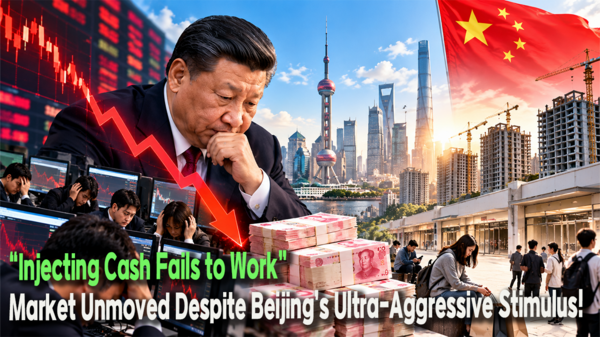
[China’s Stock Market Collapsed First—Just Before the Stimulus Was Unveiled]
An ominous scene is unfolding in the Chinese economy. Although Beijing pulled out its largest stimulus package since September 2024 to avert an economic slowdown, the market’s response was cold. The CSI 300 Index—which had plummeted 2.2% the previous day to hit a 13-month low—managed to rebound by a mere 0.1% on the following day.
The more significant issue is not that the Chinese government is withholding money, but rather that even when it releases liquidity, households, corporations, and investors show little inclination to move. With youth unemployment reaching 18.9%, coupled with a prolonged real estate slump and sluggish domestic demand, analysts note that China’s economic woes have transcended a simple 'liquidity shortage' into a broader crisis of confidence among economic agents.
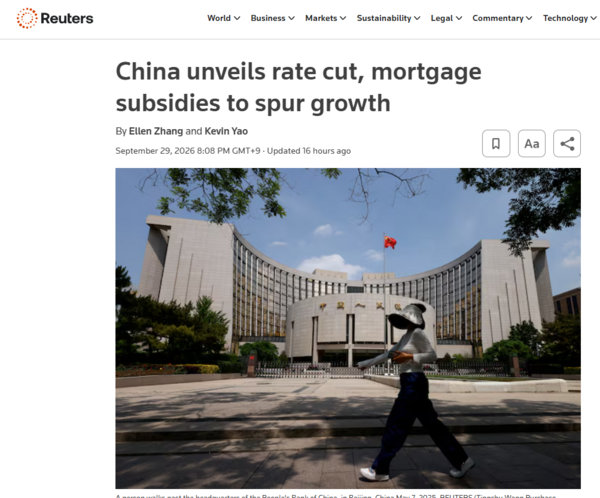
Reuters reported on the 30th that “an ominous scene played out in the Chinese stock market on the 28th, just a day before Beijing brought out its stimulus card again: the blue-chip CSI 300 Index plunged 2.2% in a single day to hit its lowest level in 13 months, while the tech-heavy STAR 50 Index tumbled 4.1%.” It added, “A confluence of rising global oil prices, elevated U.S. Treasury yields, and pre-Golden Week holiday risk aversion hit the market all at once.”
Hong Kong’s South China Morning Post (SCMP) also noted regarding this development: “Tech stocks, which had previously anchored the Chinese stock market, were particularly shaken.” The report explained, “Concerns grew over domestic semiconductor firms amid rumors that Chinese companies might be permitted to purchase Nvidia chips, while sentiment around AI stocks worsened following moves in the U.S. Congress to exclude Chinese optical transceivers from sensitive government systems.”
The SCMP added, “The broader Chinese economy itself was a problem,” noting that “while exports are holding up relatively well, the recovery in domestic demand remains sluggish and the real estate slump persists.”
[Beijing Finally Took Action… Mobilizing Everything from PSL to Mortgage Subsidies]
The very next day, the Chinese government moved. According to Reuters, the People’s Bank of China (PBOC) lowered the interest rate on the Pledged Supplementary Lending (PSL) facility—which provides long-term, low-cost funds to policy banks—by 0.25 percentage points to 1.5%. Scope for support was expanded to include water conservancy, power grids, computing, telecommunications, urban underground pipe networks, and logistics infrastructure. Credit quotas were also significantly boosted: re-lending quotas for scientific innovation and technological upgrading were expanded by 200 billion yuan, with additional re-lending limits set at 500 billion yuan for agriculture and small-to-medium enterprises (SMEs) and 300 billion yuan for private enterprises.
Particularly eye-catching were the real estate measures. Starting October 1, the government will subsidize mortgage interest by 1 percentage point annually for up to 5 years for first-time homebuyers taking out new commercial mortgages. Eligible loans are capped at 1 million yuan per household. This marks the first time China has directly subsidized mortgage interest on a nationwide scale. Ultimately, Beijing’s intent is to channel capital directly into the weakest links of the Chinese economy—spanning real estate, infrastructure, advanced technology, private firms, and SMEs.
[Yet, the Market's Answer Was a Mere ‘0.1%’ Uptick]
The real problem emerged afterward. Despite the government announcing additional economic support measures, the CSI 300 Index rose by a mere 0.1% on the 29th. The Shanghai Composite Index similarly edged up by only 0.2%. Furthermore, combined trading turnover across the Shanghai and Shenzhen exchanges fell to 1.41 trillion yuan, reaching its lowest level since July of last year. This signifies that even after confirming Beijing’s commitment to stimulus, the market hesitated to actively buy risky assets.
To be sure, some individual equities reacted to hopes of housing market support—such as property developer Vanke, which surged 10%. However, considering that the CSI 300 had plunged 2.2% just the day before, a 0.1% gain recovered only a fraction of the previous drop. The market clearly did not view these measures as a 'game changer' capable of reversing the trajectory of the Chinese economy in one sweep.
[Why Does the Economy Fail to Move Even When Liquidity Is Injected?]
Here lies the more fundamental issue facing the Chinese economy. In the past, Chinese economic stimulus followed a relatively straightforward mechanism: inject money into banks, have local governments build infrastructure, and supply credit to the real estate market. This boosted investment and employment, which in turn revived consumer spending.
Today, the dynamics have changed. Prolonged real estate distress has eroded household wealth effects, and anxiety over future income makes consumers hesitant to spend. On the corporate side, if businesses lack confidence in domestic demand recovery, overflowing bank liquidity provides no incentive to expand capital expenditure.
Ultimately, the issue is not whether the government can supply money, but how many economic actors are willing to borrow that money to purchase homes, build factories, and spend. This explains why the market no longer cheers as it once did, even when China turns back to policy financing and infrastructure investment cards.
[Nearly 1 in 5 Young People Cannot Find a Job]
In the labor market, the chill felt in the real economy is even sharper. The youth unemployment rate for ages 16–24 (excluding students) rose from 17.9% in July to 18.9% in August—the highest level since the current statistical methodology was introduced. China's college graduates reached a record high of approximately 12.7 million this year. Yet, with firms’ hiring capacity weakened by sluggish domestic demand, concerns are compounding that the spread of AI could replace entry-level tasks traditionally handled by new hires.
China previously halted the publication of youth unemployment figures in June 2023 after the rate under the old methodology reached 21.3%. It resumed releases late that year under a revised method that excludes current students. Thus, today's 18.9% cannot be directly compared to the previous 21.3%. However, even under the new metric, it is undeniable that youth employment conditions have once again reached a severe crisis point.
[That Does Not Mean the Entire Chinese Economy Is Collapsing]
It would be inaccurate, however, to conclude that the Chinese economy is deteriorating across all sectors simultaneously. The official manufacturing PMI for September, released on the 30th, rose to 50.1 from 49.8 in August. By crossing above the 50-mark that separates economic expansion from contraction, manufacturing snapped a two-month streak of contraction. Driving this performance is the global AI investment boom, where demand for advanced manufacturing such as semiconductors and computers continues to support Chinese industrial production and exports.
This highlights the core contrast. Money is flowing through advanced manufacturing, AI, and export sectors, but that warmth is failing to transmit sufficiently into real estate, consumer spending, and youth employment. Reuters similarly analyzed that while the Chinese economy remains heavily dependent on exports and industrial production, domestic demand, investment, and real estate remain weak. China’s economic distress resembles a widening imbalance between booming sectors and failing ones, rather than a 'total systemic collapse.'
[Beijing Reaches into the Pockets of the Wealthy]
Another noteworthy development is the tightening tax enforcement on affluent individuals holding overseas assets and income. Reuters observed: “While the burst of China’s real estate bubble reduced local government land sales revenue by roughly 4.5 trillion yuan annually, assets managed in Hong Kong expanded to $2.9 trillion, a significant portion of which belongs to mainland clients.”
In response, Chinese authorities are applying existing tax laws far more aggressively toward overseas assets, trusts, and offshore income. Taxation on income generated by or transferred from offshore trusts is also being tightened. While this highlights Beijing's fiscal distress as local government finances struggle from the land market slump, it serves as another clear signal of intensifying administrative pressure on capital held abroad by Chinese citizens.
[Why Times Insight | The True Crisis of the Chinese Economy Is 'Confidence,' Not 'Cash']
What demands the most attention regarding this stimulus package is not how many trillions Beijing injected, but why the market failed to react as it did in the past. The Chinese government provided low-cost capital via policy banks, increased re-lending quotas for tech firms and SMEs, and began directly subsidizing mortgage interest for first-time homebuyers. Beijing reactivated the full suite of conventional economic stimulus tools at its disposal.
Yet today’s economic bottleneck in China cannot be cured by liquidity alone. When housing prices decline over a sustained period and youth unemployment persists, households lose confidence in future income and cut back spending. Similarly, unless corporations feel certain that consumer demand will revive, low interest rates alone will not prompt them to invest aggressively. If banks have funds but lack willing borrowers, the effectiveness of monetary policy remains severely constrained.
To be sure, the entire Chinese economy is not falling apart. AI, high-tech manufacturing, and exports remain sturdy pillars. September's manufacturing and services indicators also showed improvement. The problem is that the warmth of that growth fails to spread to real estate, household consumption, and youth employment. Therefore, when assessing China’s economic trajectory going forward, the key metric may not be how many additional trillions of yuan Beijing releases.
The critical questions are these: Are Chinese citizens beginning to buy homes and spend money again? Are corporations investing with trust in the future? And are young people regaining hope for what lies ahead? Money can be generated by the government; interest rates can be lowered, and lending can be expanded. However, household and corporate confidence cannot be manufactured by administrative decree. The most formidable economic problem currently facing Beijing is not a 'shortage of money,' but rather how to restore the broken confidence of economic agents who refuse to move even when money is poured over them.


-중국 푸단대학교 한국연구원 객좌교수
-전 EDUIN News 대표
-전 OUR NEWS 대표
-제17대 대통령직인수위원회 정책기획팀장
-전 대통령실 홍보기획비서관
-사단법인 한국가정상담연구소 이사장
-저서: 북한급변사태와 한반도통일, 2012 다시우파다, 선거마케팅, 한국의 정치광고, 국회의원 선거매뉴얼 등 50여권