
Update2026.10.24 (토)

[Warning from a PBOC Policy Committee Member: “Strong Supply, Weak Demand”]
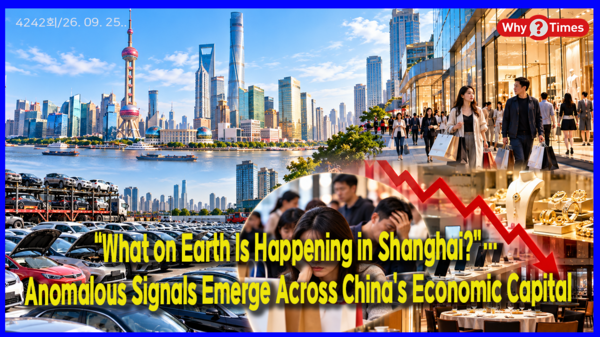
What on earth is happening in Shanghai, the economic capital of China? As even a member of the Monetary Policy Committee of the People's Bank of China (PBOC) warns that the nation's economy has fallen into a structural imbalance of "strong supply and weak demand," Shanghai—China's largest economic metropolis—is where this contradiction manifests most starkly. Although first-half economic growth reached 5.6%, retail sales in August plummeted by 6.7%, and the office vacancy rate reached 22.5%. High-tech industries and production are sprinting forward, but citizens' wallets and employment opportunities fail to keep pace, giving rise to "two parallel economies" operating simultaneously at the very heart of China's economic engine.
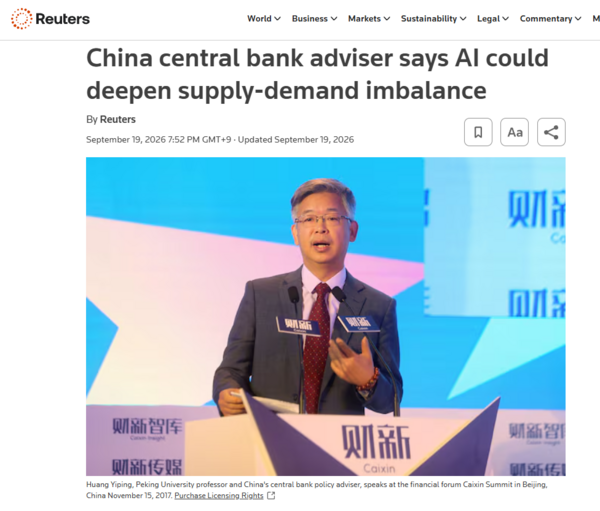
On September 19, Reuters reported that "Huang Yiping, a member of the PBOC Monetary Policy Committee and Dean of the National School of Development at Peking University, warned at an economic forum in Beijing that the Chinese economy faces a structural imbalance of 'strong supply and weak demand'." He cautioned that "the rapid development of advanced technologies, including artificial intelligence (AI), further boosts production capacity; however, if consumption fails to follow suit, this supply-demand mismatch could actually intensify." In short, a warning encapsulating the current reality of the Chinese economy has emerged from within China itself.
Professor Huang asserted that restoring balance to the Chinese economy requires raising household incomes and stimulating consumption, alongside repairing the damaged financial balance sheets of local governments, financial institutions, and corporations. He called for a shift away from an economic structure overly reliant on exports and manufacturing expansion, urging a transition toward strengthening domestic demand instead. It is particularly noteworthy that a member of the PBOC Monetary Policy Committee—a key economic policy advisory body to the Chinese government—publicly raised these issues.
How, then, does the "strong supply, weak demand" dynamic described by Professor Huang manifest in the real economy? The city offering the most dramatic answer is Shanghai.
[What on Earth Is Happening in Shanghai?… August Consumption Plunges 6.7%]
Shanghai represents the single greatest success story of China's reform and opening-up policy. It stands as the nation's core hub for finance, international trade, and foreign multinational headquarters, as well as China's most globalized city. For over three decades, the soaring skyscrapers of Pudong have symbolized the explosive growth of the Chinese economy.
Yet current economic indicators from Shanghai are signaling a clear departure from the past. According to official data released by the Shanghai Municipal Bureau of Statistics on September 17, total retail sales of consumer goods in August amounted to 128.281 billion yuan, marking a steep 6.7% decline year-on-year. While retail sales had grown by 0.7% in the first half of the year, growth slipped to -0.2% for the January–July period and expanded its contraction to -1.0% for January–August.
Category-specific figures are even more striking. Auto sales in August crashed by 38.8% year-on-year. Cultural and office supplies fell by 19.4%, communication equipment declined by 14.4%, and gold, silver, and jewelry dropped by 8.7%. Catering and dining revenue also shrank by 2.1%. Conversely, food sales rose by 2.9% and cosmetics increased by 2.6%. This reveals that consumer spending has not collapsed uniformly across the board; rather, contraction is concentrated heavily in automobiles and high-value discretionary spending.
That such a phenomenon is unfolding in Shanghai—one of China's wealthiest cities—is not something to be taken lightly. Shifts in Shanghai's consumer behavior serve as a vital window into the economic confidence of the Chinese middle class.
[The Glitzy Skyscrapers Remain… But Over One-Fifth of Offices Sit Empty]
Anomalous signals in Shanghai are appearing not only in street-level retail, but also inside its iconic skyscrapers. According to global real estate consultancy Cushman & Wakefield, the office vacancy rate in Shanghai reached 22.5% in the second quarter of the year. Measured by floor space, more than one-fifth of the city's total commercial office supply sits unoccupied. Average monthly rents also fell to 195.2 yuan per square meter.
To be sure, corporate activity has not vanished entirely. Net absorption in the second quarter grew to 233,311 square meters, with technology, media, and telecommunications (TMT) firms driving leasing demand. However, amid a continuous influx of new supply, corporate cost-cutting measures and relocation strategies have converged to keep vacancy rates elevated and rents depressed.
Consequently, characterizing Shanghai as a city where "all companies are fleeing" would be inaccurate. Nevertheless, it is impossible to ignore the reality that landlords in China's top economic hub must lower rents to retain corporate tenants while vast swathes of commercial space remain vacant. Shanghai's grand skyline remains intact, but what has shifted is the economic temperature within those towers.
[Not Just Shanghai… Factories Spin While Wallets Stay Shut]
The trends observed in Shanghai connect directly to structural vulnerabilities across the wider Chinese economy. In the August economic dataset released by China's National Bureau of Statistics on September 15, industrial production expanded by 5.2% year-on-year. In contrast, retail sales grew by a mere 0.4%. Fixed-asset investment for the January–August period contracted by 7.2% year-on-year. Put simply, while factory output grew by 5.2%, consumer spending barely moved at 0.4%.
This aligns directly with the structural contradiction of "strong supply, weak demand" pointed out by PBOC Monetary Policy Committee member Huang Yiping on September 19. As massive capital flows into advanced manufacturing and AI, production capacity expands continuously. Yet if household income and consumption fail to match that pace, expanding output cannot translate into a virtuous cycle of domestic growth.
[Youth Unemployment at 18.9%… Why Wallets Cannot Open]
Another primary driver preventing consumption from recovering is the employment landscape. According to National Bureau of Statistics data released on September 17, youth unemployment (ages 16–24, excluding students) hit 18.9% in August. This represents a 1.0 percentage point increase in a single month from July's 17.9%, marking the highest level recorded since August 2025. Unemployment for those aged 25–29 also rose from 7.2% to 7.5%.
Youth job insecurity conflicts directly with China's desired transition toward a consumption-driven economy. Without stable employment, young adults are far more likely to defer long-term life decisions such as marriage, home purchases, and vehicle acquisitions. As anxieties regarding future income deepen among younger demographics, households tend to prioritize saving over spending, regardless of official government stimulus calls.
[Yet Shanghai Grew 5.6%… The Curious Paradox]
Herein lies the central paradox of Shanghai's current economy. According to the Shanghai Municipal Bureau of Statistics, Shanghai's GDP reached 2.7886 trillion yuan in the first half of the year, growing 5.6% year-on-year. How could the local economy expand by 5.6% when retail spending is so depressed and office vacancy rates hover at 22.5%?
The answer lies in the reality that two distinct economic tracks are operating simultaneously within Shanghai. Financial sector output grew by 10.2% in the first half, while information technology, software, and IT services surged by 9.1%. Advanced manufacturing is similarly driving top-line growth. Unlike the nationwide contraction, fixed-asset investment in Shanghai actually increased by 4.8% during the January–August period.
Conversely, everyday consumer spending is moving in the opposite direction. Retail sales growth decelerated from +0.7% in the first half to -1.0% for the January–August period, suffering a 6.7% plunge in the month of August alone. Ultimately, figures like +5.6% GDP growth, -6.7% retail consumption, and a 22.5% office vacancy rate are not mutually exclusive or contradictory. Rather, they serve as three distinct metrics exposing the widening gulf in Shanghai between "the state-directed priority economy" and "the economy experienced by ordinary citizens in daily life."
[Could Pouring Money into AI Worsen the Problem?]
It is precisely at this juncture that Professor Huang's September 19 warning becomes vital once more. The Chinese leadership is aggressively nurturing so-called "New Quality Productive Forces"—such as AI, semiconductors, electric vehicles (EVs), and robotics—as its next-generation growth engines. Indeed, rapid development in these sectors continues to anchor China's overall industrial output and export performance.
However, Professor Huang raised the possibility that while the proliferation of AI enhances productivity, it may simultaneously exacerbate China's existing supply-demand imbalance. This is because production capacity risks expanding even further while consumer demand remains structurally underpowered. Consequently, the solution proposed by Professor Huang was not further production expansion, but rather boosting household incomes, encouraging consumer spending, and transitioning the economy away from export dependence toward internal demand. He also stressed the need to restore the financial health of local governments, financial institutions, and corporations to revitalize overall economic activity. This underscores that the core issue facing the Chinese economy is not simply a matter of target GDP percentages.
[Why Times Insight — Warning Bells Echoing from Shanghai]
The reason to closely monitor Shanghai extends far beyond high office vacancy rates or steep drops in auto sales. For decades, Shanghai served as the premier showcase for China's reform and opening-up policy. It was the definitive symbol of how Chinese economic growth could translate corporate expansion into jobs, rising incomes, appreciating real estate values, and booming consumption.
Today, however, two entirely different economic realities are unfolding side by side within Shanghai. Finance, IT, and high-tech manufacturing continue to expand; investment is growing and first-half GDP rose by 5.6%. Yet August consumption crashed by 6.7%, office vacancies hover at 22.5%, and youth unemployment nationwide has climbed to 18.9%.
These metrics do not necessarily point to an immediate political crisis or regime instability. However, if employment prospects, income growth, asset values, and future expectations remain subdued over an extended period, economic discontent and the burden of managing social stability will inevitably mount.
What matters most is not the headline growth rate, but the transmission mechanism of that growth. Simply pouring state capital into AI, semiconductors, and electric vehicles so that companies produce more goods does not automatically translate into open consumer wallets. A healthy economic cycle requires new industries to generate high-quality jobs and household income, which must then flow back into organic consumption.
The weakening of this vital link represents the most critical warning signal emanating from Shanghai today. Furthermore, this assessment comes not merely from external critics, but from a member of the PBOC's own Monetary Policy Committee, who explicitly highlighted the structural contradiction of "strong supply, weak demand" and called for raising household incomes and consumption. Therefore, the anomalous signals in Shanghai cannot be dismissed as a routine cyclical downturn in a single city.
When the link between "a growing macroeconomy" and "the economy lived by ordinary people" begins to fray even in China's wealthiest, most internationalized, and reform-benefited city, the Chinese leadership faces a challenge far deeper than achieving a target growth number.
What on earth is happening in Shanghai? The answer lies not in a single empty office building, but in the vast chasm that has opened between the economy the state is building and the economy the Chinese people are living. Shanghai stands today as the clearest warning light illuminating that divide.


-중국 푸단대학교 한국연구원 객좌교수
-전 EDUIN News 대표
-전 OUR NEWS 대표
-제17대 대통령직인수위원회 정책기획팀장
-전 대통령실 홍보기획비서관
-사단법인 한국가정상담연구소 이사장
-저서: 북한급변사태와 한반도통일, 2012 다시우파다, 선거마케팅, 한국의 정치광고, 국회의원 선거매뉴얼 등 50여권