
Update2026.10.24 (토)

[Latest Alarm Bell… Are Vanke’s Bad Loans Being Hidden from the Books?]
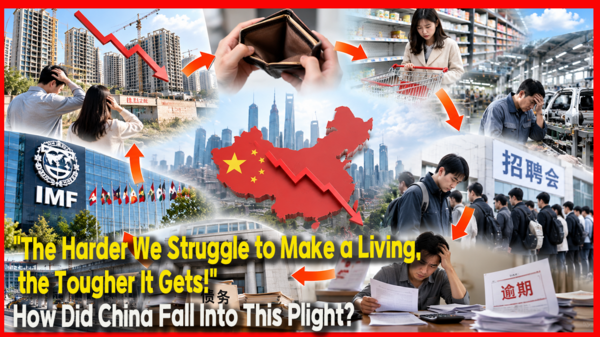
A strange paradox is unfolding in China. University graduates struggle to find jobs, while middle-class homeowners who bought property through loans are trapped in a double whammy of tumbling housing prices and heavy debt service obligations. China’s traditional "formula for success"—the belief that studying hard, landing a good job, and buying a home will lead to a better life—is shaking at its core. Recent economic indicators show that this is not merely a matter of negative public sentiment, but a structural crisis where real estate, employment, debt, and consumption are tangled in a destructive feedback loop.

Citing multiple sources on September 22 (local time), Reuters drew keen attention by reporting that "Chinese financial regulators have issued informal guidance to major banks, particularly state-owned lenders, instructing them not to classify overdue loans of major property developer Vanke as non-performing assets and to extend their maturity dates." The report added that "some banks were also requested to delay interest collection." This served as a symbolic reminder that China’s real estate crisis is far from over.
Reuters further noted that "following a record loss of 88.6 billion yuan last year, Vanke recorded a net loss of 14.95 billion yuan in the first half of this year," adding that "as of late June, its total liabilities stood at 351 billion yuan, with approximately 72% consisting of bank loans."
This incident is critical because it is not confined to a single company. With the real estate slump dragging on for over five years, it signifies that authorities are directly intervening to prevent overdue loans of a flagship developer from triggering systemic financial contagion. The IMF also warned that China’s prolonged real estate adjustment and local government debt risk dampening domestic demand and entrenching deflationary pressures. Ultimately, the vicious cycle linking falling home prices → developer defaults → deteriorating local finances → mounting banking sector burdens remains unbroken.
[Factories Grew 5.2%, but Consumption Gained a Mere 0.4%]
A more fundamental issue is the extreme imbalance between production and consumption in the Chinese economy. According to Reuters, industrial production in August grew by 5.2% year-on-year. This was an acceleration from July’s 4.5% and surpassed the market expectation of 4.8%. However, retail sales in the same month edged up by a mere 0.4%, decelerating further from 0.6% in July. Fixed-asset investment from January to August also contracted by 7.2% year-on-year. It presents a distorted picture where factories continue to churn out goods, yet Chinese consumers refuse to open their wallets.
Eventually, a key figure in China's monetary policymaking publicly pointed out this imbalance. Huang Yiping, a member of the Monetary Policy Committee of the People's Bank of China, warned on September 19 that "the Chinese economy faces an imbalance of 'strong supply and weak demand,' which could be exacerbated by the proliferation of AI." He noted that "unless household incomes are raised and the financial health of distressed local governments, enterprises, and financial institutions is restored, the impact of stimulus measures will remain limited." This indicates that even internal policy circles in China have begun acknowledging that the economy's primary challenge is not a lack of production, but rather 'households lacking both money and confidence to spend.'
[Youth Unemployment Hits 18.9%… "Nowhere to Go Even After Graduation"]
This economic pain is felt most acutely by the younger generation. According to China's National Bureau of Statistics, the urban youth unemployment rate for the 16–24 age group (excluding students) surged to 18.9% in August. This represents a 1.0 percentage point increase in just one month from 17.9% in July, marking the highest level in a year since August 2025. The unemployment rate for the 25–29 age group also climbed from 7.2% to 7.5%, whereas that for the 30–59 group remained steady at 3.9%. This underscores that China's employment shock is concentrated heavily among the younger demographics.
The core problem is that these young people are not just unemployed individuals; they represent the key demographic meant to drive future demand for consumption, housing, and marriage. Without a stable job, obtaining a mortgage is impossible; without confidence in future income, buying a car is out of the question. Marriage and childbirth are naturally postponed. Consequently, the youth employment crisis is cascading into broader real estate, consumption, and demographic challenges.
[Debt Trap… Up to "100 Million People" Facing Repayment Difficulties]
When employment destabilizes, household debt repayment capacity is the first to collapse. In June, Bloomberg reported—citing analyses by Gavekal Dragonomics and other research firms—that "up to approximately 100 million consumers in China may be struggling with debt service obligations." Analyzing bank financial data, Gavekal estimated that non-performing household debt in China has ballooned to at least 2.22 trillion yuan.
A distinction must be made here: "100 million" is not an official figure published by the Chinese government regarding defaulted individuals. Rather, it is a broad estimation by private institutions based on banking metrics and household debt conditions. Nevertheless, it carries profound significance as it highlights the alarming extent to which household debt burdens are curbing consumption recovery.
According to IMF data, China's household debt stands at around 60% of GDP. When job losses or pay cuts occur, mortgage payments, credit card balances, and consumer loan repayments are immediately jeopardized. As defaults begin, financial institutions curb new lending, causing households to pull back further on spending. No matter how aggressively the government calls for consumption expansion, households will hesitate to spend as long as their future income remains uncertain.
[Not Just Households… Local Governments Are Bound by Debt Too]
The debt problem does not end with individuals. Massive liabilities accumulated by Local Government Financing Vehicles (LGFVs)—which Chinese local authorities have used to fund infrastructure and real estate developments—continue to loom large. According to the augmented government debt estimates in the IMF's latest report on China, LGFV debt is estimated to exceed 50% of GDP. Broadly defined "augmented government debt," which includes LGFVs and government-guided funds alongside official local government debt, vastly exceeds official government debt figures. The IMF advised that to stabilize debt in the long run, China must restructure unsustainable LGFV obligations and reduce off-balance-sheet and quasi-fiscal investments. What is clear is that the old growth model—where local governments expanded through land sales and LGFV borrowings during the real estate boom—is no longer sustainable. Policy missteps under the Xi Jinping administration led to a steep property downturn, bringing down local governments first and subsequently exposing the entire Chinese economy to systemic vulnerability.
[Buying a Home Means Debt, Getting a Job Brings Anxiety… The Formula for Success Is Inverted]
This is precisely where widespread societal frustration in China takes root. In the past, purchasing a home was the most reliable vehicle for wealth accumulation. Attaining a university degree offered a high probability of securing a better job than one's parents, and moving to urban centers meant higher income. What drove Chinese society for decades post-reform and opening up was the fundamental belief that "working hard today ensures a better life tomorrow."
Today, the dynamics have fundamentally shifted. Those who took out loans to buy homes must navigate declining property values alongside continuous debt servicing. While university graduates are entering the market in record numbers, youth unemployment has climbed to 18.9%. Faced with uncertain future earnings, people cut back on consumption and delay marriage and family planning.
The burden is particularly severe for the "Balinghou" (born in the 1980s) generation. Having matured into the backbone of society during China's rapid growth and real estate boom, those in their late 30s to mid-40s are now simultaneously juggling mortgages, elderly parent care, and children's education costs. Compounded by China's long-debated "35-year-old employment barrier," middle-aged workers who lose their jobs find it exceedingly difficult to regain their previous income levels.
[Vicious Cycle… From Home Prices to Jobs, and Back to Consumption]
Ultimately, the phenomena unraveling in China's economy are not isolated crises. They form a single chained reaction: Property Decline → Household Asset Shrinkage → Consumption Contraction → Reduced Corporate Revenues → Worsening Employment → Income Reduction → Rising Loan Defaults → Further Consumption Contraction. This is aggravated by local government debt burdens resulting from plummeting land sale revenues. As local authorities cut back on investments, job creation slows, further eroding household income and consumption.
The IMF similarly identified a deeper-than-expected real estate slump and high debt levels as China's primary domestic risks, warning that these issues could worsen domestic demand weakness, deepen deflation, and increase reliance on exports. The IMF explicitly stated that transitioning to a consumption-led growth model should be the top priority for China's economic policy.
[Why Times Insight]
If one were to summarize the current situation in China in a single phrase, it would be the "betrayal of effort." Since the era of reform and opening up, the single most powerful driver of Chinese society was the expectation that "effort enables upward mobility." Graduating from university, landing a job in the city, and taking out a loan to buy a home was the standardized path to success.
However, that formula is now being inverted. Since 2020, Chinese leadership rolled out a series of regulatory measures: the "Three Red Lines" to curb excessive leverage among property developers, crackdowns on platform tech companies, regulations on private tutoring, and prolonged Zero-COVID policies. While each policy had its respective objective—debt containment, anti-monopoly, reducing education costs, or epidemic control—sectors with high shares of private employment, such as real estate, tech platforms, and education, suffered consecutive shocks in a short span.
Subsequently, Beijing has been aggressively pushing advanced manufacturing—such as AI, semiconductors, electric vehicles, and robotics—as new engines of growth. The 5.2% industrial production growth in August indicates that this supply-side growth strategy has yielded certain results. Yet, retail sales grew by a mere 0.4% in the same month. The gap between these two figures offers the most accurate portrait of the Chinese economy today: factories are running, but citizens' wallets remain closed.
Even Huang Yiping, a member of the PBOC Monetary Policy Committee, pointed out the "strong supply, weak demand" structural mismatch on September 19, emphasizing the need to boost household incomes. The IMF likewise urges a transition away from the legacy growth model tilted toward industrial policy and investment toward a consumption-centered economy.
Ultimately, the next battlefield for China's economy is not about how many more factories can be built. As long as young people lack stable employment, the middle class remains bogged down by falling property values and persistent debt, and local governments are forced to focus solely on debt restructuring, a transition toward a consumption-led economy will be difficult to achieve.
The Vanke crisis on September 22 epitomizes this dilemma. Instructing banks not to immediately classify overdue loans as non-performing assets may buy temporary time. However, it will not restore the Chinese public's faith in their future income.
"If you work hard today, tomorrow will be better than today." The weakening of this very core belief—which once underpined China's rapid rise—constitutes the most fundamental crisis facing the Chinese economy today.


-중국 푸단대학교 한국연구원 객좌교수
-전 EDUIN News 대표
-전 OUR NEWS 대표
-제17대 대통령직인수위원회 정책기획팀장
-전 대통령실 홍보기획비서관
-사단법인 한국가정상담연구소 이사장
-저서: 북한급변사태와 한반도통일, 2012 다시우파다, 선거마케팅, 한국의 정치광고, 국회의원 선거매뉴얼 등 50여권