
Update2026.10.24 (토)

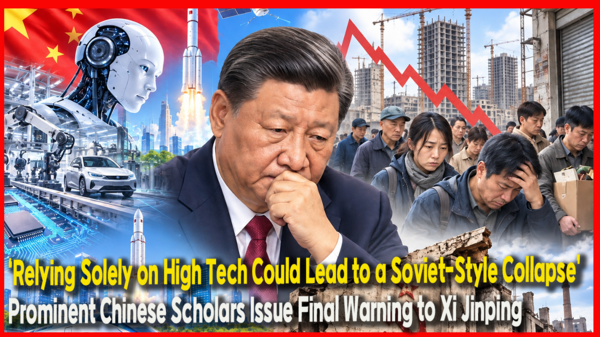
[NYT Raises the Question: “As AI Races Ahead, Why Is the Economy Falling Behind?”]
While China is fiercely chasing the United States in artificial intelligence (AI) and advanced manufacturing, the broader domestic economy—which directly affects the everyday lives of Chinese citizens—is struggling to recover. As a result, even internal Chinese economists are issuing consecutive warnings that "high technology alone cannot revive China's massive economy."
What is particularly notable is that prominent Chinese sociologist Sun Liping has cited the historical precedent of the former Soviet Union. The Soviet Union once rivaled and even surpassed the U.S. in certain scientific and technological domains, matching a significant portion of its economy, yet ultimately failed to prevent the stagnation and collapse of its centralized economic system. As Chinese President Xi Jinping prepares for an upcoming visit to the U.S., a fundamental question looms: Can catching up with America in AI actually fill the wallets of ordinary Chinese citizens?
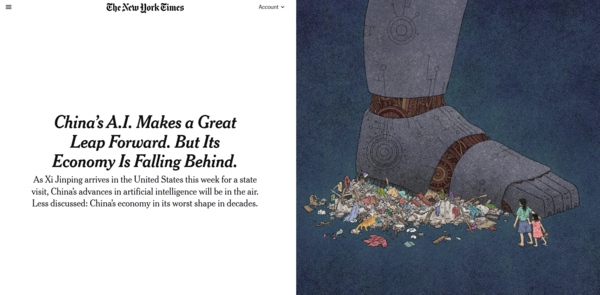
In a column published on September 20, The New York Times (NYT) columnist Li Yuan noted that under Xi Jinping’s leadership, China has made substantial progress in key technologies like AI, yet the Chinese economy is enduring one of its most challenging periods in decades. The crucial point is that these two developments are not independent of one another. The NYT highlighted arguments from Chinese economists pointing out that while the government funnels massive resources into AI and high-tech sectors, policies designed to boost domestic consumption and employment remain severely lacking.
According to Reuters, economic momentum in China is cooling rapidly. In August, the urban youth unemployment rate (ages 16–24, excluding students) rose to 18.9%, reaching its highest level in a year. This marks a full 1 percentage point increase from 17.9% in July. The unemployment rate for those aged 25–29 also ticked up from 7.2% to 7.5%. Despite heavy state promotion of high-tech industries, the job market felt by the younger generation continues to deteriorate.
Consumption and investment indicators are equally concerning. Data from China’s National Bureau of Statistics shows that while industrial output grew by 5.2% year-on-year in August, retail sales rose by a paltry 0.4%. Fixed-asset investment declined by 7.2% in the January–August period, with real estate development investment plunging 19.9%. Sales value of newly constructed commercial housing dropped by 13.0% over the same timeframe. A structural mismatch is becoming increasingly stark: factory capacity and high-tech production continue to expand, but domestic demand and private investment fail to absorb the output.
[Internal Warning from PBOC Advisor: “AI Could Exacerbate Structural Imbalances”]
This context lends significant weight to a warning issued on September 19 by Huang Yiping, a member of the Monetary Policy Committee of the People's Bank of China (PBOC). Speaking at an economic forum in Beijing, Huang cautioned that the rapid adoption of AI could deepen China's long-standing structural imbalance of "strong supply and weak demand".
His proposed remedy was equally noteworthy. Huang stated that China's current imperative is not simply to continue expanding production capacity, but rather to revitalize consumption, raise household incomes, and repair the financial health of distressed local governments, financial institutions, and corporate balance sheets. He warned that no matter how much AI boosts productivity, if there are not enough consumers to buy the goods, the gap between production and aggregate demand will only widen.
[“Every Yuan Spent on AI Is a Yuan Not Spent on Consumption or Employment”]
This is precisely the core issue raised by domestic Chinese economists. Tsinghua University professor Li Daokui, a former adviser to the PBOC, warned that the broader Chinese economy is cooling down too rapidly and that a few fast-growing high-tech sectors alone cannot drag the rest of the economy out of stagnation.
Xu Chenggang, an expert on the Chinese economy at Stanford University, raised an even more direct concern. He noted that while China's centralized control over its financial system allows it to mobilize policy resources more easily than other nations, state funds are not infinite. When the state directs more resources into AI and state-owned high-tech enterprises, fewer fiscal funds remain to support consumption, job creation, and household income growth.
Furthermore, AI differs structurally from labor-intensive infrastructure projects like railways, roads, or housing development, which generate large-scale employment in short timeframes. Instead, AI and automation risk replacing existing jobs. With youth unemployment already at 18.9%, over-allocating national resources toward building out AI production capacity—at the expense of employment and consumption—creates a paradoxical situation where technology advances, but the civilian economy freezes over.
[Heavy Capital Inflow into AI as Local Government Revenue Dries Up]
An even larger concern is that Beijing is funneling immense resources into new growth industries precisely when its traditional fiscal foundation is eroding. According to data released by China's Ministry of Finance on September 18, local government revenues from state-owned land-use rights transfers tumbled 28.6% year-on-year in the January–August period to 1.3753 trillion yuan. Self-generated revenue from local government-managed funds also fell by 22.9%. This underscores that the real estate downturn is no longer just a crisis for property developers, but a direct hit to the primary fiscal foundation of local governments.
Expenditures funded by land sales fell by 18.5%. Historically, local governments sold land to fund site development and infrastructure, which in turn drove broader economic activity. With the property market slump, this virtuous cycle has broken down. Overall government fund revenues nationwide fell by 19% in the January–August period.
Meanwhile, mandatory expenditures continue to escalate. Social security and employment outlays grew by 6.5%, healthcare spending rose by 9.2%, and debt interest payments climbed by 5.4%. Conversely, spending on culture, tourism, and sports dropped by 7.2%, energy conservation and environmental protection declined by 12.3%, agriculture and water conservancy fell by 6%, and transportation outlays decreased by 2.9%. This shift demonstrates that fiscal policy is being squeezed into servicing social welfare, healthcare, and legacy debt obligations rather than making new growth-oriented investments.
[The Most Uncomfortable Word Raised by a Chinese Scholar: ‘Soviet Union’]
It is against this backdrop that Beijing sociologist Sun Liping raised a historical analogy that is deeply uncomfortable for top leadership: the Soviet Union. Sun's core argument is straightforward: being a high-tech power is not synonymous with having a prosperous citizenry. The former Soviet Union once matched a substantial portion of the U.S. economy and rivaled or surpassed America in space, military, and scientific technology. Yet technological prowess alone could not stave off the systemic stagnation and eventual collapse of its central command economy.
Sun's question for present-day China carries the same underlying logic. China possesses the capacity to produce increasingly sophisticated, high-tech products on a massive scale. But who will purchase them? If buyers lack the means, products sit unsold. Unsold goods yield no corporate profit. Without growing profits, wages and employment cannot expand. Without income growth, consumer spending contracts further. The core issue facing China is not a lack of manufacturing tech, but a breakdown in the economic cycle connecting production, corporate profits, employment, household income, and consumption.
[The Core Challenge: Not ‘Technology’, but the Wallets of 1.4 Billion People]
Therefore, framing China's economic troubles simply as "overinvesting in AI" is incomplete. Enhancing competitiveness in AI, robotics, batteries, and advanced manufacturing remains a valid long-term strategy. The real issue is whether Beijing is building an economic structure capable of translating technological success into higher household incomes and robust domestic consumption.
Data from the National Bureau of Statistics illustrates this contradiction: in August, while total industrial output grew 5.2% and high-tech manufacturing surged 16.7%, retail sales grew by a mere 0.4%. High-tech sectors are sprinting ahead while ordinary citizens tighten their purses—a stark numeric representation of China's current structural imbalance.
Moreover, relying exclusively on export markets is becoming increasingly difficult. Amid growing trade pressure from the U.S. and Europe over industrial overcapacity, a failure to revive domestic demand means that expanding advanced manufacturing capacity will likely exacerbate supply-demand imbalances. This is why PBOC adviser Huang Yiping did not oppose AI development itself, but rather warned that uncoordinated AI expansion risks intensifying China's chronic "strong supply, weak demand" mismatch.
[Why Times Insight]
President Xi Jinping is scheduled to conduct a state visit to the United States from September 23 to 25 for a summit with President Donald Trump. Heading into the summit, the PBOC eased its intervention against yuan appreciation, allowing the Chinese currency to rise to its highest level in roughly three and a half years. The two leaders are expected to discuss key bilateral issues, including trade, AI, and technology transfer.
While global attention in Washington will focus on U.S.-China trade friction, AI dominance, and tech competition, President Xi’s most formidable challenge may reside back home. Catching up with the U.S. in AI and reopening the wallets of 1.4 billion Chinese consumers are two fundamentally different problems.
China's advanced industrial competitiveness should not be underestimated, and its progress in AI, robotics, batteries, and high-end manufacturing is undeniable. However, achieving world-class state technology is distinct from ensuring that the value created flows into household income, job creation, and personal consumption.
This is why Sun Liping's reference to the Soviet Union carries such weight. It serves as a stark reminder that China risks repeating the experience of a state that was technologically formidable yet economically stagnant.
Ultimately, Beijing faces a clear choice: Will China be content merely as the world's leading producer of AI and high-tech hardware, or will it construct an economic model that channels technological wealth into sustainable household income and domestic demand? No matter how many AI data centers or automated factories are built, China's foundational economic challenges will remain unresolved unless supported by corporate profits, rising wages, and healthy consumer spending.
China's struggle is not an inability to build AI. It is that even as it leads the world in producing advanced technologies, the wallets of the Chinese people remain closed. Whether the leadership in Beijing will heed this warning remains an open question.


-중국 푸단대학교 한국연구원 객좌교수
-전 EDUIN News 대표
-전 OUR NEWS 대표
-제17대 대통령직인수위원회 정책기획팀장
-전 대통령실 홍보기획비서관
-사단법인 한국가정상담연구소 이사장
-저서: 북한급변사태와 한반도통일, 2012 다시우파다, 선거마케팅, 한국의 정치광고, 국회의원 선거매뉴얼 등 50여권