Update2026.10.24 (토)


[“Has China Caught Up with the US?” Financial Statements Reveal a Very Different Picture]
Following DeepSeek’s major splash in the global AI market, assessments poured in asserting that Chinese artificial intelligence was rapidly closing in on the United States. Chinese AI models have indeed rapidly improved performance, offered significantly lower prices than their American counterparts, and attracted global users through an open-weight strategy. However, when examining actual monetization, a completely different narrative emerges: the total annual recurring revenue (ARR) of China’s leading AI models amounts to barely 10% of the combined revenue generated by OpenAI and Anthropic alone.
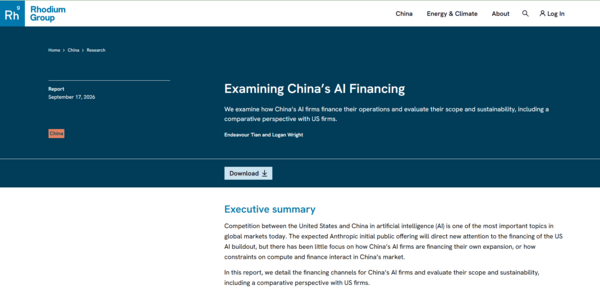
In a report titled Examining China’s AI Financing released on September 17, US market research firm Rhodium Group analyzed the commercial AI operations of China’s frontier AI labs and major tech platforms. Based on the latest available data, the total ARR across all Chinese AI models stood at approximately $10.7 billion. In contrast, the combined ARR recently reported for OpenAI and Anthropic reached roughly $105 billion. Even when aggregated, the entire Chinese AI model ecosystem generates only about one-tenth of the revenue produced by the top two US players.
ARR serves as a benchmark for gauging the current operational scale of high-growth companies by annualizing recent revenue streams. While Rhodium acknowledged that ARR is not an absolute metric for corporate performance comparisons, the substantial gap remains telling—especially considering the sharp surge in Chinese AI providers' ARR this year. Rhodium concluded that Chinese AI firms still lag significantly behind their US competitors in revenue generation and profitability metrics.
Notably, the growth rate of Chinese vendors remains formidable. Zhipu AI’s Model-as-a-Service (MaaS) ARR surged nearly twentyfold from $74 million in January to $1.6 billion in August, while MiniMax expanded its ARR fourfold between February and August. Chinese AI is not failing to expand; rather, the key takeaway from the report is that despite breathtaking growth, the monetization gap with leading US entities remains nearly tenfold.
[DeepSeek Shook the World, but Technical Shock and Business Viability Are Two Different Things]
This revenue gap does not imply that Chinese AI technology is merely one-tenth as capable as that of the US. Reuters Breakingviews noted that top Chinese AI models are rapidly narrowing the performance gap with cutting-edge US counterparts, highlighting that Chinese firms achieved competitive capabilities despite utilizing far less capital and operating under restricted access to advanced semiconductors. Undervaluing China's technical catch-up would be a mistake.
This distinction is crucial. Over the past year, global media attention focused heavily on benchmark scores, low development costs, and cheap usage fees offered by Chinese AI models like DeepSeek. This created an impression that the Chinese AI industry had reached near-parity with the US. However, building an efficient model cheaply and generating massive revenue or sustained cash flow from that model represent two entirely different capabilities. The Rhodium report highlights precisely this gap between technical catch-up and commercial viability.
[Low Pricing Drives High User Volume, but Fails to Drive Profits]
Why is revenue generation lagging despite a surge in user engagement? Paradoxically, one primary factor is the aggressive low-pricing strategy previously viewed as China's core competitive advantage. Citing data from AI model evaluation platform Artificial Analysis, Rhodium noted that even after recent price hikes, premier Chinese models generally charge between $0.04 and $0.50 per task, with top-tier offerings capped around $0.50 to $1.00. In comparison, Anthropic’s high-end Claude models cost $2 to $4, while advanced GPT models run between $1 and $2. Consequently, equivalent usage yields far higher top-line revenue for US firms.
The open-weight approach is similarly a double-edged sword. While open-sourcing models enabled rapid global dissemination, third-party cloud providers offering API services using these open-weight models are not obligated to remit royalties to the original Chinese developers. As a result, developers such as Moonshot AI and Alibaba are attempting to establish revenue-sharing models with major enterprise clients. Expanding model influence does not automatically translate into developer revenue.
ByteDance’s AI chatbot, Doubao, illustrates this issue starkly. According to domestic Chinese media reports cited by Rhodium, while Doubao boasts over 200 million daily active users, its daily revenue remains under 1 million yuan. In contrast, Doubao’s sister platform Douyin generates over 1 billion yuan in daily revenue through advertising, leveraging 750 to 800 million daily users. A massive user base of 200 million does not inherently translate into top-line profitability.
[Valuation Disconnect: DeepSeek’s Multiple Reaches 163x ARR]
Despite lagging in absolute revenue, several Chinese AI startups trade at significantly higher enterprise value-to-revenue multiples than US firms. Rhodium estimates that while OpenAI and Anthropic trade at enterprise value-to-ARR multiples of roughly 34x and 21x respectively, Zhipu AI stands at 46x, Moonshot AI at 50x, and DeepSeek at an estimated 163x.
This indicates that lower revenue has not depressed enterprise valuations proportionally. Rhodium noted that while absolute valuations for Chinese frontier labs remain below those of OpenAI or Anthropic, their valuation-to-revenue multiples appear stretched—particularly for Moonshot and DeepSeek. Moonshot’s reported valuation skyrocketed from $4 billion in late 2025 to $50 billion by August 2026, demonstrating that current valuations reflect speculative future growth rather than present top-line fundamentals.
[The Real Challenge Begins Now: AI Demands Astronomical Capital Expenditure]
The broader issue is that AI competition extends far beyond software engineering; it requires continuous capital deployment into data centers, specialized AI chips, power supply, and high-speed network infrastructure. Rhodium estimates China’s AI infrastructure investment currently ranges between 15% and 20% of US levels. Capital expenditure in Chinese AI hardware is projected to rise 103% year-over-year to 932 billion yuan (approx. $139 billion) this year, eventually surpassing 1.2 trillion yuan (approx. $193 billion) by 2027.
Meanwhile, underlying cash generation is tightening. Free cash flow for China’s top three hyperscalers—Alibaba, Tencent, and Baidu—swung from 170 billion yuan in 2025 to a negative 16 billion yuan in the first half of this year. While US Big Tech faces similar cash-flow pressure from AI investments, US firms retain access to vast corporate bond and private credit markets. In contrast, China’s AI ecosystem remains heavily reliant on domestic equity issuance and bank debt.
Consequently, Chinese AI developers face a second challenge alongside technical capability: securing ongoing funding to sustain operations. Rhodium emphasized that operating cash flows from current AI services are insufficient to fund planned capital investments. With revenue and profitability lagging behind US peers, future scaling will depend heavily on domestic stock market stability and access to external capital.
[State Backing Brings Capital, but Resources Are Not Unlimited]
State support remains substantial. Equity investments in China’s AI sector reached a record 282 billion yuan through August 21, with government guidance funds and direct state investment platforms accounting for roughly 25%. In AI semiconductor and server sectors, state-linked capital backed over 60% of funding since 2023 (47% from government funds and 14% from state-owned banks).
However, state backing cannot indefinitely finance the entire AI ecosystem. Rhodium projected that government industrial funds will prioritize strategic hardware—such as semiconductors and server infrastructure—rather than software-focused frontier AI labs. If domestic equity markets soften while startup valuations remain elevated, securing additional private financing will become increasingly difficult. Ultimately, long-term sustainability hinges on generating organic revenue and positive operating cash flows.
[Domestic Realism: "Not Yet on Par with US Cutting Edge"]
Concurrently, realistic assessments are emerging within China's tech industry. Speaking at the Huawei Connect event in Shanghai on September 17, Huawei Rotating Chairman Eric Xu acknowledged that Chinese AI models have not yet matched the capabilities of top-tier US systems. He noted that US tech leaders continue to advance rapidly by deploying massive computing clusters, emphasizing that domestic Chinese providers must accelerate their development.
Nevertheless, China’s competitive threat remains significant. Driven by aggressive low pricing and open-weight models, Chinese AI is rapidly penetrating global markets, prompting US policymakers to view Chinese AI expansion as a strategic priority. Heading into the US-China summit scheduled for September 24 in Washington, AI capabilities have emerged as a central agenda item, while Western commercial interest in low-cost, open-weight Chinese models continues to grow.
[Why Times Insight — Distinguish Benchmarks from Commercial Competitiveness]
The core takeaway from the Rhodium Group report is not that Chinese AI is an illusion. On the contrary, Chinese firms have demonstrated efficient technical catch-up, advancing competitive models with limited capital under constrained access to advanced hardware. However, single benchmark scores, download counts, and raw active user metrics do not automatically reflect comprehensive commercial strength.
Overstating Chinese AI capabilities is as problematic as dismissing the sector based solely on current revenue figures. The empirical reality is clear: China is rapidly narrowing the technological and user-adoption gap, but a substantial divide persists in monetizing that technology through high-margin enterprise accounts, recurring contract revenue, and self-sustaining cash flows.
Evaluating the US-China AI landscape requires looking beyond headlines claiming a domestic Chinese model has surpassed GPT on specific benchmarks. Broader assessments must analyze paying client conversion, enterprise retention rates, operating margins, and the underlying cash flow necessary to fund long-term compute costs. The revenue ratio of $10.7 billion versus $105 billion is not a reflection of technological capability, but rather a metric highlighting the commercialization gap underlying China's rapid technical progress.

-중국 푸단대학교 한국연구원 객좌교수
-전 EDUIN News 대표
-전 OUR NEWS 대표
-제17대 대통령직인수위원회 정책기획팀장
-전 대통령실 홍보기획비서관
-사단법인 한국가정상담연구소 이사장
-저서: 북한급변사태와 한반도통일, 2012 다시우파다, 선거마케팅, 한국의 정치광고, 국회의원 선거매뉴얼 등 50여권