
Update2026.10.24 (토)

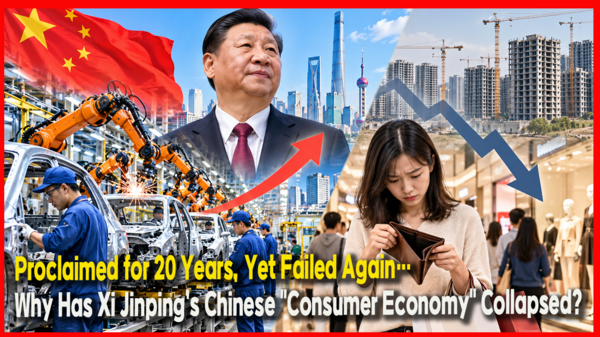
[Worst Economic Indicators: Factories Jump 5.2%, but Consumption Crawls at 0.4%]
Nearly 20 years have passed since China first proclaimed its goal of transitioning to a "consumption-driven economy," yet its scorecard is looking increasingly dismal. Industrial production grew by 5.2% year-on-year in August, but retail sales edged up by a mere 0.4%. Amid a prolonged real estate slump, severe employment difficulties, and overwhelming anxiety about the future, Chinese households remain tight-fisted despite repeated government calls to boost domestic demand. The pressing question facing the Chinese economy is no longer "how to stimulate consumption," but rather why it has failed to transition into a consumer economy over the past 20 years despite knowing both the root causes and the remedies.
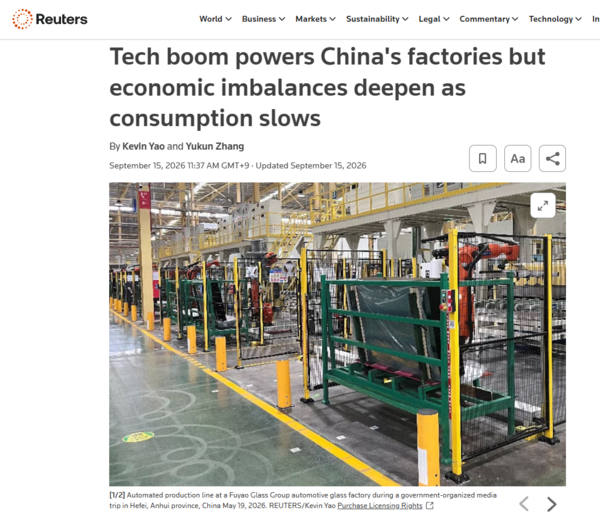
On September 16, Reuters reported: “China’s economic data for August, released yesterday, starkly reveals the internal contradictions of its current economy. Growth in industrial production accelerated from 4.5% in July to 5.2% in August, beating the market expectation of 4.8%. In contrast, retail sales growth slowed further from 0.6% in July to 0.4% in August—half of the 0.8% forecasted by the market. Meanwhile, fixed-asset investment fell 7.2% year-to-date through August, and real estate development investment plunged by 19.9%.” In short, China’s problem is not a shortage of factories to manufacture goods, but that Chinese consumers are refusing to open their wallets to buy them.
[CCP in Crisis: People’s Daily Addresses the Economic Crisis for Four Consecutive Days!]
In this context, an unusual sequence of events at the People’s Daily, the official newspaper of the Chinese Communist Party (CCP), caught widespread attention last month. From August 22 to 25, economic commentaries authored under the pen name "Zhong Caiwen" (鐘才文) were published on page two for four consecutive days. The first article emphasized the "resilience and vitality of the Chinese economy," followed by pieces analyzing global economic contributions and key statistical indicators, before concluding with proposed policy directions for the second half of the year. People's Daily Online dubbed this sequence the "Zhong Caiwen Four-Part Series" (四连发) and noted that this policy signaling demonstrated "the leadership’s heavy emphasis on managing expectations."
To be sure, this series should not be interpreted as an official declaration of an "economic crisis" by the Chinese leadership. The formal messaging of "Zhong Caiwen" was aimed at reassuring the public that the Chinese economy remains resilient and that its long-term development trajectory is intact. However, the third commentary directly acknowledged that the economy is facing a structural imbalance where "supply is strong while demand is weak" (供强需弱). Ultimately, the very fact that the CCP felt compelled to manage economic sentiment through its flagship journal for four straight days underscores how critical the domestic demand deficit has become as a policy priority.
[20 Years of "Boosting Domestic Demand"... Why Are They Still Repeating the Same Slogan?]
China’s emphasis on a domestic demand-driven economy is hardly new. Back in 2007, then-Premier Wen Jiabao diagnosed the Chinese economy’s fundamental flaws as being "unstable, unbalanced, uncoordinated, and unsustainable." Even then, the core solution was to reduce over-reliance on investment and exports while restructuring the economy toward consumption. This demonstrates that the Chinese leadership recognized today's exact challenges nearly two decades ago.
The same prescriptions were repeatedly issued during the Xi Jinping era. In 2020, Beijing formally launched its "Dual Circulation" (雙循環) strategy, which designated domestic production, distribution, and consumption as the primary driver while keeping the economy linked with international markets. Yet, in 2026, China is once again raising the expansion of domestic demand as a central policy goal. The fact that the transition to a consumer economy remains unfinished—despite nearly 20 years of awareness and repeated policy announcements—highlights the deep structural gridlock within the Chinese economy.
[Real Estate and Job Crisis Close the Wallets of the Chinese People]
Why, then, do the Chinese authorities' persistent calls for consumer spending continue to fall flat? The answer is straightforward: the CCP's stubborn policy missteps. Furthermore, the "Xi Jinping Fallibility Complex"—the rigid doctrine within the CCP that Xi Jinping is incapable of making mistakes, preventing any admission of failed policies—has driven the Chinese economy into this corner.
The foremost policy that devastated the economic landscape was Xi’s approach to the real estate sector. The real estate slump is the most direct cause stifling consumption. According to Reuters, investment in real estate development collapsed by 19.9% from January to August. In a country where residential property accounts for the vast majority of household wealth, a real estate downturn is not merely a slump in the construction sector. When housing prices drop, households feel poorer even if their income remains unchanged, prompting them to cut back on discretionary spending such as automobiles, travel, and dining out. The World Bank has similarly warned that a protracted property slump alongside a weakening labor market will continue to depress consumption.
Employment anxiety is equally acute. Reuters noted: "China’s youth unemployment rate for ages 16–24 (excluding students) surged to 17.9% in July—a 3 percentage point jump from 14.9% in June and the highest level in 11 months. The unemployment rate for ages 25–29 also rose to 7.2%." When the younger generation—who should be driving future consumption—is forced to worry about basic job security rather than buying cars, taking trips, or purchasing homes, a recovery in domestic demand is virtually impossible.
[Fewer People Willing to Spend Even on Credit]
An even more alarming signal is emerging from the credit market. Reuters reported: "New bank loans in China stood at just 60 billion yuan in August, falling far short of the market forecast of 400 billion yuan. Household loans fell for the sixth consecutive month, contracting by 202.9 billion yuan in August alone. Analysts point to weakening demand for mortgages due to the real estate crisis, as well as a broader loss of appetite among households to borrow for spending." This indicates that Chinese citizens are choosing to hoard cash for future uncertainty rather than spend today.
Even China’s central bank has begun acknowledging this shift. Reuters cited Pan Gongsheng, Governor of the People's Bank of China, as stating on September 16 that as credit demand from real estate and local government sectors drops without being fully replaced by new industries, slower loan growth will become China’s economic "new normal."
[Hefei Grew 6.8% via State Support, but Consumption Edged Up Only 0.6%]
The stark contradictions of the Chinese economy are vividly illustrated by the city of Hefei, which has been hailed as a model success story for advanced manufacturing. According to Reuters, heavily backed by government resources poured into electric vehicles (EVs), semiconductors, and display industries, Hefei's economy grew by 6.8% in the first half of this year, with factory output surging 25.6% and exports skyrocketing 51.9%. However, retail sales growth in the city during the same period was a meager 0.6%. The gap between output growth and consumption growth reached a record high of 25 percentage points.
Reuters observed: "Hefei is a microcosm of the entire Chinese economy today. The central government can select strategic industries, local governments can provide land, and state capital can inject massive funding. This playbook has proven exceptionally powerful in building world-class manufacturing hubs for EVs, batteries, and semiconductors." However, Fred Neumann, Chief Asia Economist at HSBC quoted by Reuters, pointed out: "Hefei's fundamental issue is that its high-tech success does not trickle down to the broader economy, particularly into consumption." While the state can build factories, that success does not automatically flow into household income and consumer spending.
[Not Ignorant of the Cause: Why Has It Gone Uncorrected for 20 Years?]
Importantly, Beijing is fully aware of the root causes behind sluggish consumption. The final commentary by "Zhong Caiwen" in the People's Daily called for "concrete measures to expand domestic demand, enhance residents' capacity and willingness to consume, and raise incomes." It also urged research into "the impact of AI developments on employment to formulate appropriate responses." Ultimately, Beijing understands that the prerequisites for consumption are income, employment, and a sense of future security. In other words, the diagnostic prescription already exists. China's real dilemma is not a lack of solutions, but that implementing them requires fundamentally altering the resource allocation and growth model that powered the country up to this point.
[Why Times Insight]
It has been nearly two decades since China declared its ambition to build a consumer-driven economy. In 2007, Premier Wen Jiabao warned that the nation's economic model was unbalanced and unsustainable. During the Xi Jinping era, the "Dual Circulation" strategy was introduced to place domestic consumption at the heart of economic growth. Yet, in 2026, the People’s Daily is once again running a four-day series addressing domestic demand, consumption, income, and employment. While leaders and slogans have shifted over 20 years, the fundamental problem remains unchanged.
The question must therefore be reframed: It is no longer "Why aren't Chinese citizens spending?", but rather "Why has China failed to change despite knowing the reasons for 20 years?" Digging into this question brings one face-to-face with the structural tension between China’s state-led growth model and a household-centered consumer economy. The model of concentrating capital, land, and credit into strategic industries to rapidly expand production capacity was highly effective for manufacturing development. However, as demonstrated by Hefei, the fruits of that growth fail to adequately flow into household income and spending.
The primary agents of a consumer economy are neither the Party, the government, nor state-owned enterprises; they are households. People open their wallets only when they feel secure in their jobs, are not terrified of crashing property values, do not feel compelled to over-save for medical or retirement expenses, and when businesses can invest and hire predictably. This is precisely why the World Bank consistently urges China to strengthen its social safety nets and bolster economic security for households.
This is where Xi Jinping’s regime faces a difficult crossroad. A genuine transition toward a consumer-led economy requires allowing a larger share of economic growth to flow to households rather than remaining concentrated in the hands of the state and Party apparatus. Added to this is the rigidity of policy corrections. How quickly top leadership can pivot away from an industry- and investment-heavy framework that it has promoted for years toward a household-first approach remains a separate political-economic dilemma.
Ultimately, the true task facing the Chinese economy is not expanding production further, but building a structure in which 1.4 billion citizens can trust the future enough to open their wallets. Put simply, without a fundamental shift in the mindset of the Chinese Communist Party, there is no future for the Chinese economy. The remaining question is: Does Xi Jinping truly understand this?


-중국 푸단대학교 한국연구원 객좌교수
-전 EDUIN News 대표
-전 OUR NEWS 대표
-제17대 대통령직인수위원회 정책기획팀장
-전 대통령실 홍보기획비서관
-사단법인 한국가정상담연구소 이사장
-저서: 북한급변사태와 한반도통일, 2012 다시우파다, 선거마케팅, 한국의 정치광고, 국회의원 선거매뉴얼 등 50여권