
Update2026.10.24 (토)

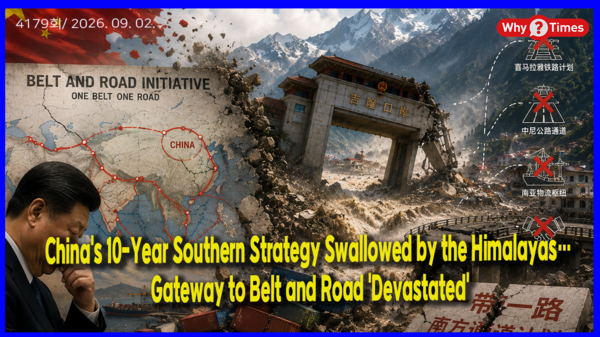
[China's 'Only Path' to the South Asian Gateway Disappears]
A massive torrent of ice, rock, and water originating from the Himalayas swept through Nepal and Tibet, China, with confirmed deaths exceeding 1,000. Yet this major disaster swallowed more than just people and villages. As Jilong Port—which China has nurtured for over a decade as its bridgehead for expanding into South Asia—and its connecting roads were devastated, Xi Jinping's Belt and Road Southern Strategy suffered an unexpected direct blow. For China, which is also pushing forward with the Trans-Himalayan Railway and the world's largest Medog Hydropower Project, this tragedy serves as a massive warning to reassess the geological safety of its colossal infrastructure projects.
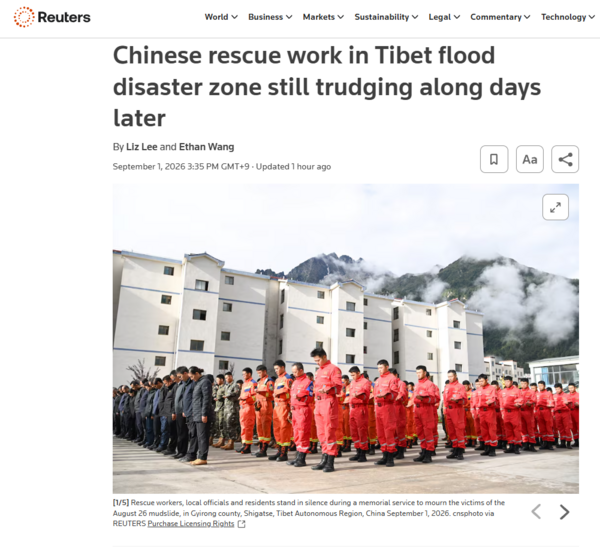
Reuters reported on September 1: "The severity of this disaster is demonstrated most clearly at the Jilong site as of September 1, where National Highway G216—the primary access road connecting to Jilong—has been effectively severed by landslides and flooding, preventing even Chinese rescue teams from properly reaching the most severely hit areas." The outlet added: "Although 158 rescue and recovery personnel and 33 heavy equipment vehicles from the Chinese state-owned enterprise China Anneng were deployed, as of today they are operating road recovery efforts at a point approximately 800 meters away from the core damage area. Restoration of basic infrastructure such as electricity and communications is underway simultaneously, but the issue is that this is not a simple mountain border road; it is the core of China's gateway into South Asia, painstakingly constructed for over a decade."
The scale of the disaster continues to expand over time. AP reported: "As of September 1, the death toll in Nepal alone has risen to 987, with 3,916 missing." AP added: "Combined with the official count of 16 dead on the Chinese Tibet side, the confirmed death toll has already surpassed 1,000." Chinese authorities announced that 546 people are missing in Jilong County, including 261 foreign nationals from 23 countries.
[Jilong Port, Built Over 10 Years, Paralyzed in Minutes]
The disaster began on August 26 in the high-altitude border region between Tibet and Nepal. Bloomberg, citing satellite imagery and expert analysis, noted: "Near a glacier at an altitude of approximately 5,000 meters, rock masses and ice collapsed simultaneously, sending a massive debris flow pouring down the valley." Bloomberg added: "Professor Dan Shugar of the University of Calgary in Canada analyzed it not as a simple glacial collapse, but as a complex disaster where a much larger rock portion of the mountain slope collapsed together. The massive torrent rushed approximately 22 kilometers in a matter of minutes, sweeping away downstream roads, bridges, and buildings."
The area taking a direct hit was Jilong Port, which connects China and Nepal. South China Morning Post (SCMP) reported: "With the destruction of the Miteri Bridge and immigration-related facilities, border transit functions have effectively been paralyzed." SCMP noted: "After Zhangmu Port suffered major damage from the 2015 Nepal earthquake, China intensively developed Jilong as a new core hub for trade with Nepal. Given that trade through Jilong accounted for a significant portion of China-Nepal overland trade until recently, this disaster carries significance far beyond the simple destruction of border facilities."
[What China Built over 10 Years Was Not 'Just One Port']
There is a reason this hits Beijing particularly hard. What Beijing sought to construct through Jilong was not a simple trade corridor, but a strategic corridor running from Tibet through Nepal down into South Asia.
SCMP reported: "The Xi Jinping administration has linked economic development and infrastructure construction in the Tibet border region to national security." The outlet continued: "The vision was to stabilize Tibet by building roads, railways, and ports in border areas and expanding trade, while simultaneously expanding China's economic and political influence into South Asia via Nepal." SCMP analyzed that "with this disaster, Beijing's 'gateway strategy' for Tibet has been exposed not only to geopolitical conflicts but to the immense risk of natural disasters."
Ultimately, what collapsed was not merely a single border checkpoint. It demonstrated how easily the most vulnerable link in the 'Tibet → Jilong → Nepal → South Asia' corridor, built by China for over a decade, can be severed in the face of actual natural disasters.
[A 'Geological Warning' for the Trans-Himalayan Railway]
The larger problem is that China is not stopping there. China is pushing forward with the Trans-Himalayan Railway—connecting Lhasa to Kathmandu via Shigatse and Jilong—as a flagship South Asian project of the Belt and Road Initiative.
However, the project has progressed slower than originally planned due to astronomical construction costs, rugged terrain, and earthquake risks. SCMP noted: "While China and Nepal continue to pursue railway feasibility studies and related cooperative projects, this disaster has brought back to the fore the fundamental issue of geological stability in the Himalayan zone through which the railway must pass." The outlet added: "This is because in the very mountainous region China must cross to reach South Asia, glaciers and rock masses collapsed simultaneously, causing key roads and border facilities to vanish in an instant."
The Guardian also noted: "The damage incurred in Nepal makes this issue even more serious," adding that "approximately 700 MW of local hydropower facilities appear to have been impacted by this disaster, hitting about 10% of Nepal's total power generation capacity, while numerous workers at several hydropower projects remain missing." In short, this disaster demonstrated in real-time how vulnerable large-scale infrastructure built in the Himalayas can be to extreme geological and climate disasters.
[Fearing 'Public Unrest' More Than the Disaster Itself?]
Meanwhile, another unusual scene is unfolding inside China. While a flood of reports detailing damage, missing persons, and survivor testimonies emerges from Nepal, information from the field in Tibet, China, remains extremely restricted.
BBC Beijing Correspondent Laura Bicker, who has reporting experience in Pyongyang, noted: "Contacting sources in Lhasa, the capital of Tibet, is often more difficult than contacting interviewees in Pyongyang." The BBC reported: "Chinese authorities routinely exercise strict control over information related to Tibet, and in this disaster as well, independent on-the-ground reporting is virtually impossible." It was also reported that immediately following the tragedy, directives were issued to grassroots Communist Party organizations to maintain 'social order and public stability' in the disaster area.
Controversy over the extent of the damage continues as well. The Guardian reported: "Tibet-related organizations argue that actual casualties are likely higher than reported by the Chinese government, and Chinese authorities have penalized several netizens on charges of 'spreading false information' for posting content claiming death tolls far higher than official counts." The outlet added: "However, the Chinese government denies allegations of covering up damage, maintaining that rescue operations and the disclosure of disaster information are proceeding normally."
[Wang Yi Calls Nepal to Extinguish 'Defective Warning' Controversy]
China's leadership is also mindful of public opinion in Nepal. Wang Yi, member of the Political Bureau of the CPC Central Committee and Minister of Foreign Affairs, held a phone call with Nepal's Foreign Minister on August 29, emphasizing that China shared disaster area photos, satellite and hydrological data, and early warning information regarding upstream natural dams with Nepal.
This response is interpreted as addressing criticisms that China failed to sufficiently notify Nepal of risks developing upstream. While the Chinese government claims that the early warning system operated normally and provided relevant information to Nepal, further verification is needed to determine the extent to which information delivery actually contributed to resident evacuations and damage reduction during the disaster.
[Why Times Insight: What the Collapse of Jilong Asks the 'Dam of the Century']
Perhaps the weightiest question this tragedy poses to China lies elsewhere. China is pushing forward with the world's largest Medog Hydropower Project at the Great Bend of the Yarlung Zangbo River in southeastern Tibet. The plan aims to produce approximately 300 billion kWh of electricity annually through five cascaded power generation facilities, with an estimated investment scale of around 1.2 trillion yuan. While China is pursuing this as a national strategic project, Indian and international experts have continuously raised concerns regarding earthquakes, landslides, and hydrological safety because the construction area is a geologically dynamic zone where the Indian and Eurasian plates collide.
To be clear: to date, there is no evidence that the Jilong disaster caused direct physical damage to the construction site of the Medog Project. Drawing a direct connection between the two regions to conclusively claim that 'the Medog Dam is now in danger' would be scientifically unreasonable.
However, it is equally difficult to dismiss this disaster as an event completely unrelated to the Medog Project. This is because it confirmed in reality how rapidly large-scale infrastructure such as roads, bridges, and border facilities can be rendered useless when glaciers and rock masses collapse simultaneously in the Himalayas, the world's most dynamic geological zone. Furthermore, actual hydropower facilities in Nepal suffered massive damage due to this disaster.
Therefore, the question China must now answer is not 'whether the Medog Dam was damaged by this disaster.' It is whether extreme scenarios—where earthquakes, glacial collapses, massive landslides, and natural dam failures occur in sequence—have been incorporated into the safety design of a world-record hydropower facility funded by over 1 trillion yuan. China's South Asian gateway in Jilong, built over more than a decade, severed in an instant before the power of nature. The Trans-Himalayan Railway and the 'Dam of the Century' that China ambitiously pursues lie on the very same mountain range.
The tragedy at Jilong is not a declaration that China's Southern Strategy has ended. However, it clearly demonstrated that even a strategic corridor constructed by Beijing over 10 years with capital and technology can be paralyzed in a moment if it fails to control the geological risks of the Himalayas. What China truly wants to hide in this disaster may not merely be the casualty figures, but perhaps this very vulnerability itself.


-중국 푸단대학교 한국연구원 객좌교수
-전 EDUIN News 대표
-전 OUR NEWS 대표
-제17대 대통령직인수위원회 정책기획팀장
-전 대통령실 홍보기획비서관
-사단법인 한국가정상담연구소 이사장
-저서: 북한급변사태와 한반도통일, 2012 다시우파다, 선거마케팅, 한국의 정치광고, 국회의원 선거매뉴얼 등 50여권