
Update2026.10.24 (토)

[China Abuzz Over 'World's First'...]
China has once again startled the world. CXMT (ChangXin Memory Technologies), China's largest DRAM manufacturer, announced that it has mass-produced LPDDR6, a next-generation mobile DRAM, and will feature it for the first time in the world on Xiaomi's new foldable smartphone. However, a closer look at the details tells a different story. While CXMT has undeniably made technical progress, there is a considerable gap between the image created by China—of "surpassing South Korean semiconductors to achieve a world first"—and its actual technological level. Around the same time in the Chinese robotics industry, a senior technology figure formerly with Huawei publicly pointed out that "76% of Chinese robots rely on foreign ROS." This reveals a pervasive pattern of typical Chinese bluffing.
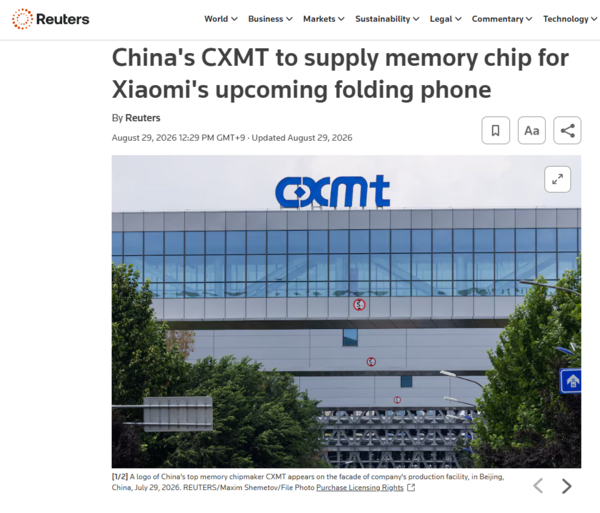
Reuters reported on August 30 that "CXMT announced on its official Weibo account the previous day that it has begun mass production of LPDDR6 memory and that it will be first featured in the Xiaomi 18 Fold scheduled for release in September," adding that "even Xiaomi founder Lei Jun personally stepped forward to celebrate the milestone."
According to Reuters, the announced peak data transfer rate of CXMT's LPDDR6 is 12.8 Gbps (a unit of internet speed capable of transmitting 1 billion bits of data per second), with a maximum capacity of 16 GB. LPDDR6 is a next-generation low-power DRAM that significantly boosts bandwidth and data processing capabilities compared to the previous LPDDR5X.
Reuters evaluated this development, stating that "CXMT's announcement represents an important technological step forward for China's semiconductor industry." Analyses also noted that "in the cutting-edge mobile DRAM market long dominated by Samsung Electronics and SK Hynix, the mere fact that a Chinese firm is supplying a latest-standard product to a commercial device is by no means something to take lightly."
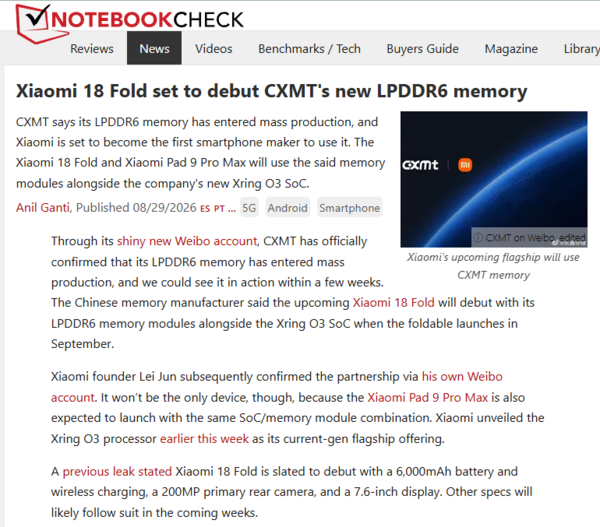
However, the real issues begin here. Notebookcheck, a Germany-based global IT review website specializing in mobile devices such as laptops, smartphones, and tablets, noted: "While the maximum speed of LPDDR6 touted by CXMT is 12.8 Gbps, its operating speed when paired with the Xring O3 processor on the Xiaomi 18 Fold is at the level of 10.667 GT/s (Giga-Transfers per Second, or 1 billion transfers per second)," adding that "the LPDDR6 standard itself spans from 10.667 Gbps up to a peak of 14.4 Gbps, meaning the actual operating speed of the CXMT memory applied to the Xiaomi device falls into the lowest band of the LPDDR6 specification."
Here, an important factual distinction must be made. This alone does not justify claiming that CXMT "announced fake specs of 12.8 Gbps." The maximum speed supported by the memory chip itself can differ from the real-world speed achieved when combined with a memory controller inside a specific smartphone. Therefore, the core of the issue is not 'fake LPDDR6.' It lies in how the Chinese media and industry packaged this announcement.
[Even Stranger: 'Under Customer Validation' Just the Day Before]
There is an even more eye-catching aspect. In its semi-annual report disclosed on August 28, CXMT explained that it was "sending LPDDR6 products to major customers for validation and accelerating mass production." Reports in Chinese financial media confirmed the same detail.
Yet on the very next day, CXMT declared "official mass production of LPDDR6" on its official Weibo account. Of course, because the cutoff date for a company's financial report can differ from the timing of a public announcement, this alone cannot be definitively called a contradiction. However, to date, CXMT has not disclosed core metrics necessary to judge the 'quality of mass production,' such as yield rates or actual production volumes.
Therefore, the most accurate way to state the currently confirmed facts is as follows: It is true that CXMT succeeded in producing LPDDR6. However, there is no basis yet to judge that it has snatched technological leadership in the global memory market away from Samsung Electronics and SK Hynix, and claiming so is essentially a massive exaggeration.
[What China Emphasized Was 'World's First']
In fact, foreign tech media evaluate CXMT's achievement much more cautiously. The area where CXMT clearly stepped ahead was in simultaneously revealing LPDDR6 mass production and a specific commercial smartphone that would feature it. Because SK Hynix had also completed LPDDR6 development and announced plans for mass production in the second half of 2026, interpreting this immediately to mean "China has surpassed South Korea in LPDDR6 technology" is unwarranted, and framing it that way is practically no different from deception.
Furthermore, while CXMT's peak speed stands at 12.8 Gbps, the top end of the LPDDR6 standard reaches 14.4 Gbps. Ultimately, while China planted its flag first on the 'commercial release timeline,' that does not mean it has achieved the 'world's No. 1 position in technological capability.'
[The Exact Same Pattern Emerged in Robotics]
Coincidentally, around the same time, a similar gap between 'flamboyant announcements and actual technological strength' came to light in robotics, another of China's strategic industries. Wang Chenglu, former senior technology expert at Huawei and current CEO of Sun Kaihong, pointed out that "76% of Chinese robots still use foreign ROS (an open-source meta-operating system that facilitates robot software development), and the self-reliance rate for core algorithms falls below 40%."
What Wang particularly took issue with was software. ROS is less of an independent, standalone operating system and closer to a robotic software framework or middleware running on top of Linux. His argument was that "no matter how many robot bodies China produces, it is difficult to say it has fully mastered the core of the software technology stack."
However, because the 76% figure appears to be a quote from existing industry reports rather than a new statistic surveyed by Wang himself, it is more accurate to write that "Wang cited existing statistics to point out" rather than calling it "Wang's survey results."
["Dancing and Kung Fu, But in the Factory..."]
These criticisms align closely with independent Western analyses. Reuters recently conducted an in-depth report on China's humanoid robot industry, observing that "while Chinese robots show impressive capabilities in running, dancing, and performing kung fu, they remain a considerable distance away from possessing the intelligence and versatility needed to replace human workers in actual factories." With the Chinese government pouring over $230 million in support into related industries in the first half of 2026 alone and more than 150 companies jumping into the humanoid race, concerns over overinvestment are rising.
Even Wang Xingxing, founder of Unitree Robotics, a leading Chinese robotics firm, acknowledges this. On August 20, he explained that "currently, robots can perform basic assembly tasks, but they are less efficient than humans and require retraining every time a new task arises," identifying this as a key reason preventing large-scale deployment.
[Hardware Chinese, Brains Still Dependent on Foreign Tech]
That said, one should not underestimate China's robotics industry either. MERICS, one of Europe's most prominent research institutes on Chinese affairs, analyzed that "China has built a formidable manufacturing ecosystem, controlling approximately 63% of global supply chain companies for core humanoid robot components," adding that "the supply chain for batteries, motors, sensors, and actuators accumulated through its EV industry is also a powerful asset."
Yet the weaknesses are equally clear. MERICS analyzed that "foreign companies such as NVIDIA still exert strong influence in AI training, sensing, and control software, while reliance on Japan and Europe remains high for certain advanced components needed in precision robotics."
This represents the two faces of China's current tech rise. While its ability to manufacture bodies and mass-produce has grown aggressively, it remains far from China's propaganda claims of independently mastering cutting-edge technology as a whole.
[Why Is China in Such a Hurry?]
This calls for another look at the CXMT issue. Why did CXMT push 'LPDDR6 mass production' to the forefront before full-scale mass production competition with Samsung Electronics or SK Hynix even began? Why did Chinese media instantly link this to 'world's first commercialization'?
It could be viewed simply as corporate marketing. However, the political environment surrounding China's high-tech industries cannot be ignored. The Xi Jinping leadership defines semiconductors, AI, and robotics not merely as industries, but as strategic sectors that will determine China's survival in its long-term tech war with the US, directing massive capital and policy capabilities into them. MERICS analyzes that in robotics as well, Xi-style 'technological solutionism' is spawning large-scale national policies and investment funds. Under such a system, continuous pressure is placed on companies to demonstrate results showing "how far Chinese technology has advanced."
[Why Times Insight]
What should be noted in the CXMT incident is not that "China failed to make LPDDR6." Rather, the fact that China has caught up to this level is itself something to stay vigilant about. The problem arises at the moment when technological progress becomes tangled with political and promotional packaging.
CXMT did indeed produce LPDDR6, but the image highlighted inside China quickly expanded into "China taking the world's first title by beating Samsung and SK Hynix." Similarly, while its robots run, dance, and fight impressively enough to surprise the world, even the CEO of a leading Chinese company admits that in actual factories, they are less efficient than humans and lack versatility. Therefore, when observing Chinese technology, the most dangerous approaches are either ignoring it unconditionally or taking its announcements at face value.
In particular, before South Korean media blindly transcribe expressions like 'world's first,' 'complete localization,' or 'technological breakthrough' from Chinese companies or state media, there is a need to scrutinize actual production volumes, yield rates, the conditions under which performance figures were obtained, and the origins of core components and software.
China's technological rise is undoubtedly advancing rapidly. However, the technological rise China announces and its actual technological rise are not always the same. And perhaps the most intriguing question in the CXMT case is this: Was their message of 'world's first' really aimed at the world? Or was it directed toward Beijing, which relentlessly demands proof of technological self-reliance?
What is more fundamental is recognizing that China operates under a one-party dictatorship centered around President Xi Jinping. Given that semiconductor and robotics industries are primary interests of President Xi, there is a intense desire to gain recognition from the Xi leadership through provocative terms such as 'world's best' or 'world's first.' In other words, the top priority for Chinese semiconductor and robotics tech firms is how they are perceived by the Xi Jinping leadership. Thus, the audience they market and promote to is not tech experts worldwide, but the Chinese Communist Party leadership. This is why they frequently resort to bluffing with press releases that leap far ahead of reality or facts. It is through this lens that we must understand Xi-style technological advancement.


-중국 푸단대학교 한국연구원 객좌교수
-전 EDUIN News 대표
-전 OUR NEWS 대표
-제17대 대통령직인수위원회 정책기획팀장
-전 대통령실 홍보기획비서관
-사단법인 한국가정상담연구소 이사장
-저서: 북한급변사태와 한반도통일, 2012 다시우파다, 선거마케팅, 한국의 정치광고, 국회의원 선거매뉴얼 등 50여권