
Update2026.10.24 (토)

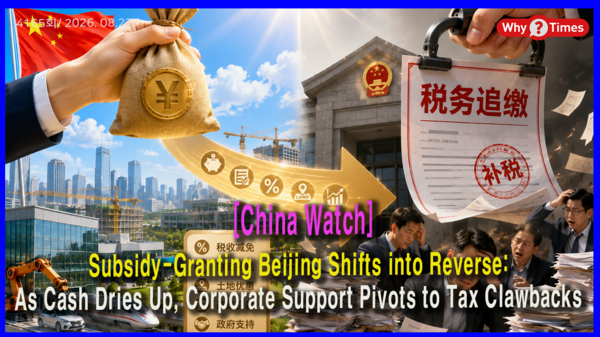
[Government That Gave Money Now Collects It… The Reverse Rotation of the Growth Engine]
The government-backed growth engine that supported the Chinese economy has begun turning in reverse. Local governments that spent decades nurturing enterprises with tax cuts, subsidies, cheap land, and policy financing are now re-examining past tax incentives and sending massive bills to corporations. The situation where the government created growth by providing money to companies has flipped into one where it must extract money from them. This marks a serious danger signal in China's state-led growth model.
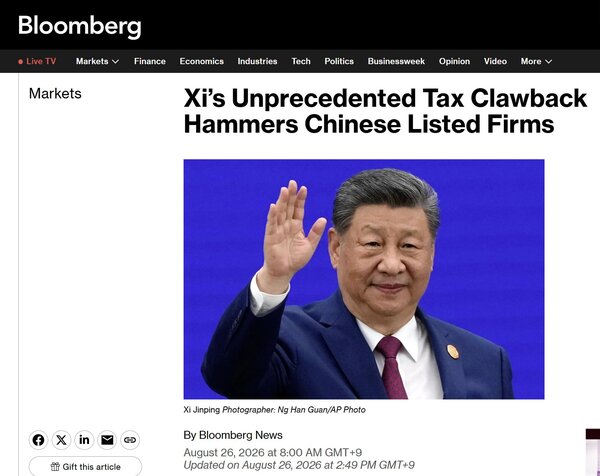
Bloomberg reported on the 26th (local time) that "the Chinese government, which had been offering huge subsidies to companies as a means of driving economic growth, is suddenly presenting unimaginable bills to businesses as government funds dry up." Bloomberg noted, "The reason this situation is alarming is that it is not merely a crackdown on tax evasion."
Bloomberg pointed out, "Local governments in China have long competed to offer preferential corporate tax rates, land supplies, industrial subsidies, and policy loans to attract investment. This was the core mechanism that exponentially expanded manufacturing investment and production capacity, turning China into the 'World's Factory.' However, as local finances supporting that circuit came under pressure, the hand helping businesses began shifting into a hand collecting taxes."
Bloomberg cited a symbolic case: "Heilongjiang Agriculture, a listed subsidiary of the major Chinese agricultural enterprise Beidahuang Group, had not reported a first-half loss in over 20 years since going public, but is expected to turn a loss this year." Bloomberg explained, "This is not due to poor harvests or accounting fraud, but because tax authorities retroactively demanded tax payments, claiming the company was unqualified for certain tax incentives previously applied to land leases."
Bloomberg highlighted, "When the clawback amount reached a staggering 120% of the company's projected net profit for 2025, the market was immediately thrown into shock. Within three days of the announcement, about 20% of its market capitalization evaporated, and the company warned of a first-half loss." The paradox of a company that grew on government support and tax breaks now plunging into a loss as it regurgitates past benefits has become a reality.
[7.7 Billion Yuan from 100 Companies… 14 Years Worth Collected in Just Half a Year]
Even more shocking is that Heilongjiang Agriculture is not an isolated case. Bloomberg revealed, "An analysis of public disclosures by listed Chinese companies showed that in the first half of this year alone, more than 100 listed firms received notices for tax clawbacks and late fees, totaling approximately 7.7 billion yuan ($1.1 billion)." Bloomberg added, "This exceeds the total amount clawed back over the entire 14 years since Xi Jinping took power in 2012, demonstrating how rapidly this movement to secure tax revenues by reversing past corporate support practices is spreading."
This precise number encapsulates today's shifts in the Chinese economy. Reuters noted, "The 'support economy,' which injected money into corporations, is pivoting into a 'reclamation economy' that extracts money from them." Reuters added, "Of course, this does not mean the Chinese government has officially ceased all industrial subsidy payments." Indeed, Beijing continues to channel fiscal resources into strategic industries and consumption. However, as local government revenue streams falter significantly, it is becoming clear that expanding support in the traditional manner is growing increasingly difficult.
[Local Government Revenue Collapse… Land Revenue Plunges 30.8%]
Why is this happening? The most direct cause is the collapse of "land finance," which long sustained Chinese local governments. According to latest data released by China's Ministry of Finance on the 21st, local government fund revenues from January to July fell 24.8% year-on-year. Crucially, revenue from the transfer of state-owned land-use rights plunged by a dramatic 30.8% to 1.1731 trillion yuan. The Chinese-style local growth circuit—selling land to property developers to generate funds, using that cash to build infrastructure, and supporting businesses—is snapping.
The issue goes beyond a decline in land revenue alone. During the same period, national government fund budget revenues decreased by 21.2%, while local government fund expenditures dropped 9.5%. Expenditures linked to land-use right revenues fell 17.4%. This indicates that falling local revenues are translating directly into reduced spending capacity. In an economy accustomed to corporate support and infrastructure investment, this is not merely a fiscal metric; it signifies an eroding growth engine.
However, China's overall national treasury has not run completely dry. From January to July, general public budget revenues actually grew 5.8%, with tax revenues increasing 6.7%. The core issue is not that the central government's coffers in Beijing are empty, but that the traditional revenue sources of local governments—which handled corporate support and infrastructure investment on the frontlines of China's high-speed growth—are severely weakened.
[Funds Dry Up, Yet Cash Must Keep Pouring In]
Herein lies the stark dilemma facing the Xi Jinping administration. Local finances are under pressure, yet revitalizing the economy demands even more government spending. Reuters noted, "China has recently reactivated an 8000 billion yuan (approx. $119 billion) policy financing tool." The goal is to use government funds as seed money for infrastructure and strategic industries to catalyze bank loans and private investment.
The problem is that loosening money supplies no longer moves the economy as effectively as before. Reuters pointed out, "From January to July, China's fixed-asset investment fell 6.7% year-on-year, and second-quarter GDP growth slowed to 4.3% from 5.0% in the first quarter." Reuters added, "Furthermore, the 8000 billion yuan policy financing tool was not fully deployed in the first half due to a lack of suitable investment projects. A 'policy efficiency trap' has emerged: more money is needed, but viable opportunities to generate growth with that money are shrinking."
[Weak Domestic Demand Pushes Volume Abroad… ‘China Shock 2.0’]
With domestic demand failing to offer sufficient support, China's chosen outlet has ultimately been exports. According to the U.S.-China Economic and Security Review Commission (USCC), China's exports in the first quarter surged 14% year-on-year to $977.6 billion. While exports to the U.S. fell 16%, shipments to Southeast Asia surged 20%, Africa 32%, and the EU 21%. Volumes blocked in the U.S. are being redirected into other global markets—the very reason the USCC labels this phenomenon "China Shock 2.0."
Rhodium Group similarly analyzed that "as China's fiscal and financial systems become increasingly inefficient at sustaining domestic growth, the economy has grown far more reliant on exports than before." Rhodium Group added, "In 2025, China's tax and non-tax revenues fell to 15.4% of GDP, significantly below the OECD average of roughly 34%." They noted, "As the government's ability to bolster domestic demand with state funds weakens, the pressure to push produced volumes overseas inevitably intensifies."
[Even the Last Escape Hatch—Exports—Faces U.S. Barriers]
Yet even that escape hatch is narrowing. Reuters reported, "The United States is considering imposing an additional 7.5% tariff on Chinese goods, citing China's overcapacity issues." Reuters highlighted, "This places substantial pressure on Beijing, especially as such measures are being discussed ahead of the upcoming summit between President Trump and President Xi Jinping next month."
Ultimately, the formula that long sustained the Chinese economy is fracturing simultaneously: using local government funds to support companies → companies expanding production → selling surplus volume overseas to drive growth → using that growth to replenish government coffers. However, real estate collapses have weakened the first link—local finances—while domestic demand remains sluggish, and foreign markets—led by the U.S.—are strengthening resistance against the final safety valve.
Therefore, these tax clawbacks targeting listed firms are not merely tax administration news. They signal the onset of a "growth model reversal," where China, having once raised corporations with handouts, must now retrieve past benefits. It remains premature to declare that the Chinese growth engine—fueled by subsidies, tax incentives, land finance, and policy loans—has ground to a complete halt. Yet it is undeniable that the fuel feeding that engine is diminishing, and the power returned as growth from every dollar injected is faltering. This is the true essence of the crisis now facing the Chinese economy.
[Why Times Insight]
What demands attention in this crisis is not whether the Chinese government has halted subsidies entirely overnight. More crucial is that the cost of the model driving the Chinese economy for nearly 40 years—where the government injects cash into companies to engineer growth—can no longer be borne as it was in the past. Land revenues, local governments' core cash cow, have plummeted over 30%, and local authorities that once sheltered companies are now scrutinizing past tax breaks to retrieve funds. This signifies that the growth engine of the Chinese economy has begun rotating in reverse, from "support" to "reclamation."
The more severe problem is that Beijing cannot afford to abandon this growth model either. With consumption and private investment failing to recover adequately, reducing government investment risks chilling the economy even faster. Thus, despite fiscal strains, 8000 billion yuan in policy financing must be injected once more. Ultimately, China is trapped in a self-contradiction: it must reduce support due to a lack of funds, yet it must inject more money because the economy is deteriorating.
Nor is escaping through exports straightforward. As Chinese goods displaced from the U.S. market flood into Southeast Asia, Europe, and Africa, warnings of "China Shock 2.0" are already sounding, and the U.S. is weighing additional tariffs targeting Chinese overcapacity. A paradox unfolds: as China loses internal growth momentum, it must rely more heavily on overseas markets, yet those very markets are closing their doors to Chinese goods.
Thus, the real crisis of the Chinese economy is not whether growth registers at 4% or 5%. It lies in the fact that the virtuous cycle of Chinese-style growth—where the government injects money, companies produce, and the global market buys, feeding back into growth—has begun to break. A government that once handed cash to companies now extracting money from them stands as a symbolic scene of this shift.
To be sure, it is premature to announce the end of China's "subsidy economy." What is clear, however, is that the three essential conditions required to keep that wheel spinning—capital, accessible markets, and policy efficiency—are weakening simultaneously. This is the most dangerous crisis confronting Xi Jinping's economy today.


-중국 푸단대학교 한국연구원 객좌교수
-전 EDUIN News 대표
-전 OUR NEWS 대표
-제17대 대통령직인수위원회 정책기획팀장
-전 대통령실 홍보기획비서관
-사단법인 한국가정상담연구소 이사장
-저서: 북한급변사태와 한반도통일, 2012 다시우파다, 선거마케팅, 한국의 정치광고, 국회의원 선거매뉴얼 등 50여권