
Update2026.10.24 (토)

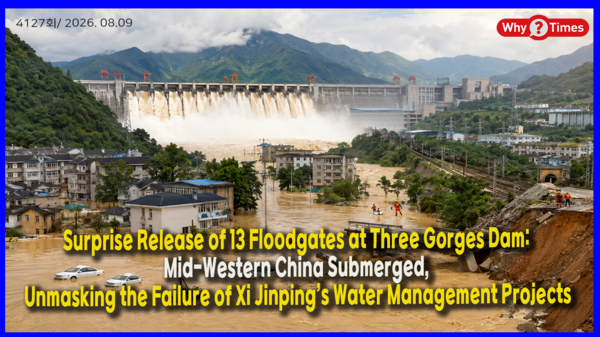
[Shaanxi Disaster: Sudden Opening of 13 Floodgates and the Catastrophe Downstream]
Mid-western China has once again been submerged under muddy torrents. In Shaanxi Province and the Qinling Mountains area, landslides and raging flash floods have swept away houses and bridges. Concurrently, videos showing inundated factories, vehicles, roads, and railways across Hubei and Hunan provinces continue to spread online. Anxiety among residents along the lower reaches of the Yangtze River has intensified following reports that the Three Gorges Dam sequentially opened 13 floodgates between August 4 and 6.
The core issue extends beyond mere heavy rainfall. The massive water management system—comprising the Three Gorges Dam, regional reservoirs, and so-called "Sponge Cities," which China has touted as world-class—has failed to protect urban areas from extreme torrential rains. Critics argue that the simultaneous onset of heavy downpours, landslides, dam and reservoir discharges, and the paralysis of urban drainage networks has starkly exposed the structural limitations of Xi Jinping's state-led water management initiatives.
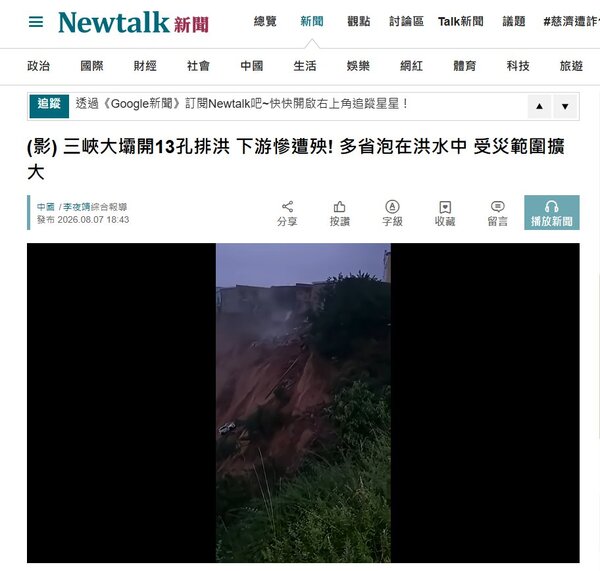
On August 8, Taiwan's independent media outlet NewTalk cited multiple posts on X (formerly Twitter), reporting: "Floods have recently struck various parts of China, submerging numerous cities and severely paralyzing daily life. Torrential rains in the upper reaches prompted the sudden opening of the floodgates at the Three Gorges Dam, triggering flooding in the middle and lower reaches and inflicting severe damage on downstream residents. Simultaneously, critical flooding in several regions of Shaanxi Province flooded homes and washed away roads and bridges, crippling local transportation."
[Chain-Reaction Water Damage in Shaanxi, Hubei, and Hunan: Homes, Bridges, and Transportation Networks Swept Away]
The prominent Sinophone X account Teacher Li is Not Your Teacher reported: "Severe torrential rain hit Shangluo City in Shaanxi Province, causing sudden flash floods and landslides across the city. Some houses were swept away by floodwaters, bridges were destroyed, and mudslides covered roads with mud and sand, bringing transportation near total paralysis in certain areas." Although the Three Gorges Dam and Shaanxi reservoirs belong to different river basins and cannot be linked by a direct causal relationship, the concurrent heavy rainfall and reservoir discharges across multiple regions drastically reduced both the time and space available for residents to evacuate.
Regarding this situation, NewTalk highlighted: "Zhen'an County in Shaanxi Province is also suffering from severe flood damage, with many homes and vehicles submerged in mud. Furthermore, heavy rains in Tongguan County, Shaanxi, triggered landslides that sent building debris and vehicles tumbling down the slopes; the full extent of the damage remains difficult to estimate."
Citing another X post, NewTalk noted: "Even before the water discharge from the Three Gorges Dam began, the surrounding Three Gorges Highway was already flooded. In Yichang City, Hubei Province, several factories and vehicles were swept away by floodwaters, and trains were forced to turn back, unable to push through the rising currents." NewTalk added: "Sudden floods and landslides occurred successively in Shaanxi Province and the Qinling Mountains, with no signs of the flooding abating anywhere."
The report further stated: "While the Three Gorges Dam was discharging water, the Nancin Reservoir in Shangluo City, Shaanxi Province, simultaneously began releasing water. The floods rapidly spread across several provinces, including Shaanxi, Hubei, and Hunan. An increasing number of cities reported being submerged or struck by sudden flash floods and mudslides."
NewTalk observed: "The massive volume of water poured out from these various reservoirs swept through key central regions, including Shaanxi, Hubei, and Hunan, in a destructive chain reaction. Even Zhangjiajie City in Hunan Province—a world-renowned tourist destination—experienced severe urban inundation, leaving the entire downtown area under muddy water. Residents and tourists were forced to evacuate through waist-deep muddy water, creating a desperate scene." As commercial districts and major tourist hubs were submerged, serious doubts were once again raised regarding China's urban drainage and disaster prevention capabilities, which the authorities had long boasted about.
[The Structural Collapse of Xi Jinping’s 3-Trillion-Yuan 'Sponge City' Project]
In relation to these developments, NewTalk pointed out: "Addressing the recent flooding, several X users criticized President Xi Jinping, noting that since taking office, he pushed forward two major initiatives—the Xiong'an New Area and the 'Sponge City' projects—with total investments exceeding 3 trillion yuan (approximately 570 trillion KRW / ~$415 billion USD). However, Xiong'an New Area has turned into a 'ghost town,' and the Sponge City projects have failed to deliver expected results."
A "Sponge City" is an urban planning model designed to absorb, store, and slowly release rainwater using permeable pavements, retention basins, wetlands, and green spaces. While effective at absorbing moderate rainfall and delaying runoff, it is not an all-powerful shield capable of stopping mountain flash floods, river overflows, or extreme downpours that exceed design thresholds.
NewTalk added: "It is truly astonishing that pilot 'Sponge Cities' across several provinces—including Hubei, Shaanxi, Heilongjiang, and Henan—have ended up completely flooded."
As massive torrential rains hit the continent, these large-scale infrastructure projects proved completely ineffective in preventing river overflows and urban flooding. Consequently, fierce criticisms are mounting that vast sums of public funds vanished in vain into a web of local official corruption and vanity projects designed to showcase Communist Party achievements.
Critiquing these government-led water management failures, an X account (Israel War) remarked: "The total investment in the Xiong'an New Area and Sponge City projects pushed under Xi Jinping’s administration is estimated to exceed 3 trillion yuan. Today, Xiong'an New Area has degenerated into an uninhabited 'ghost town,' and pilot Sponge Cities in Hubei, Shaanxi, Heilongjiang, Henan, and elsewhere have been submerged by riverwaters, reducing the policy’s reputation to a mere mockery."
[China Suppresses Disaster Footage While Promoting Water Control Achievements]
An even greater issue lies in information control. Chinese state media outlets are focusing heavily on government rescue efforts and water management achievements rather than reporting the full scope of the disaster. Meanwhile, claims persist that flood footage uploaded to social media and posts criticizing reservoir discharges are being deleted or restricted in search results.
In disaster situations, promptly disseminating accurate information regarding discharge times, water volumes, and predicted flood zones is directly tied to saving lives. When authorities fail to transparently disclose the extent of damage and release details, residents face extreme difficulty in deciding when and where to evacuate. This underscores critics' arguments that establishing transparent information disclosure and reliable warning systems is far more critical than simply constructing massive dams and reservoirs.
China's current compound flood disaster cannot be explained by natural forces alone. Amid increasingly frequent extreme weather driven by climate change, several systemic issues have converged simultaneously: overdevelopment in mountainous areas, expansion of impermeable surfaces, outdated drainage infrastructure, opaque reservoir operations, and local government financial distress. The Chinese Communist Party’s confidence in its ability to control nature through massive engineering projects is now being severely tested by the reality of extreme downpours.
[Why Times Insight]
What was shaken in this major Chinese flood disaster is not merely roads and bridges. Public trust in the state-led water management system—which the CCP has heavily promoted after investing astronomical sums—is floating away alongside the floodwaters.
While the Three Gorges Dam was built for flood control, when vast inflows arrive from upstream, the dam must ultimately discharge water downstream to safeguard its structural integrity and reservoir capacity. Similarly, Sponge Cities merely absorb rainwater temporarily and slow its release rate; they cannot withstand record-breaking torrential rains or overflowing rivers.
The priority should not be boasting as if massive infrastructure projects can prevent every disaster. Genuine disaster prevention requires candidly acknowledging facility limits, transparently communicating discharge timelines, and ensuring residents have sufficient time to evacuate.
Yet, Chinese authorities remain more accustomed to censoring disaster footage and broadcasting rescue achievements than disclosing the root causes of failure. Ultimately, the greatest flaw in Xi Jinping’s water management policy exposed by this flood is not a lack of technology or capital. While massive civil engineering projects abound, China lacks the political capability to operate these systems transparently and admit failure—and that is the fundamental reason the nation finds itself submerged in the same catastrophic floods year after year.


-중국 푸단대학교 한국연구원 객좌교수
-전 EDUIN News 대표
-전 OUR NEWS 대표
-제17대 대통령직인수위원회 정책기획팀장
-전 대통령실 홍보기획비서관
-사단법인 한국가정상담연구소 이사장
-저서: 북한급변사태와 한반도통일, 2012 다시우파다, 선거마케팅, 한국의 정치광고, 국회의원 선거매뉴얼 등 50여권