
Update2026.10.24 (토)

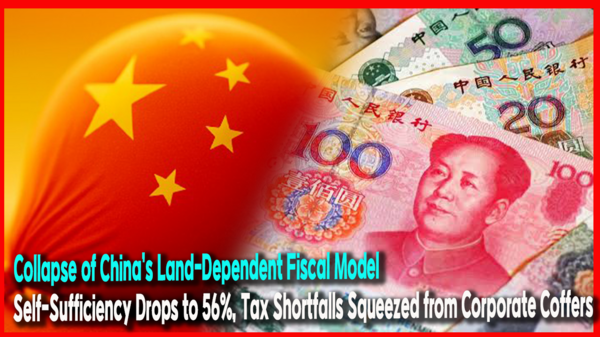
[Land Revenues Plunge 31.5%, PMIs Shrink Across the Board; 80 Listed Companies Hit with 6 Billion Yuan in Back Taxes]
The financial lifelines of China’s local governments are drying up. In the first half of this year, local government revenues reached only 6.8807 trillion yuan against expenditures of 12.2111 trillion yuan. Meanwhile, land sale revenues—which historically offset such shortfalls—plunged by 31.5%. Amid mounting fiscal pressures, roughly 80 listed companies were forced to pay over 6 billion yuan in back taxes and late-payment surcharges over a six-month period.
Compounding the crisis, the manufacturing, non-manufacturing, and composite Purchasing Managers' Indexes (PMI) have all fallen below the critical 50-mark threshold simultaneously. China is now tumbling into a compound crisis where local finances, the property sector, and the real economy are deteriorating in tandem.
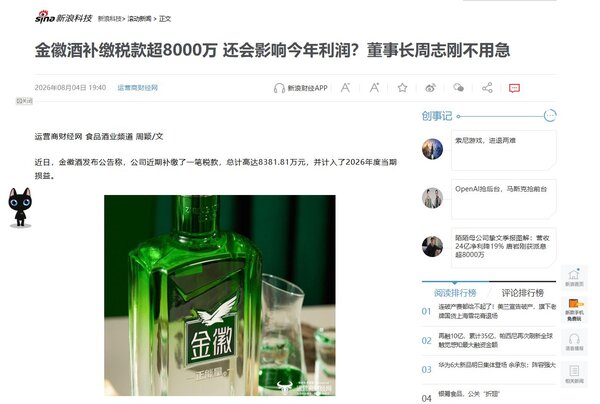
On August 4, Sina Finance, a financial news portal under China’s major platform Sina, reported:
"Gansu-based baijiu producer Jinhui Liquor announced in a regulatory filing on August 4 that it paid 69.85 million yuan in back taxes—including consumption tax, value-added tax, and corporate income tax—plus 13.97 million yuan in late fees, totaling 83.82 million yuan to tax authorities. Unprecedented clawbacks and retroactive tax collection efforts are rapidly escalating across China."
In effect, even though these enterprises had complied with tax laws and paid their dues, local governments unilaterally demanded additional payments, effectively extracting supplemental funds from corporate coffers.
Sina Finance further noted:
"Jinhui Liquor stated that this action does not constitute an administrative penalty and will not severely impact its regular operations. Consequently, it is difficult to outright label individual back-tax demands as illegal extortion. However, given that these aggressive tax collection efforts targeting listed companies are concentrated precisely when local fiscal stress has reached a boiling point, concerns are growing that local authorities are shifting their fiscal deficits onto businesses."
The report emphasized that Jinhui Liquor is not an isolated case:
"By the end of June, around 80 A-share listed companies had issued announcements regarding internal tax audits and retroactive adjustments. The total amount of back taxes and late fees exceeded 6 billion yuan—an amount approaching the full-year figure for 2025. In June alone, 25 companies issued such disclosures, with seven firms—including Beidahuang, Aier Eye Hospital, and Valin Steel—each paying over 100 million yuan."
Commenting on these developments, Gary Ng, Senior Economist for Asia-Pacific at French investment bank Natixis, warned that this sudden surge in retroactive tax demands stems from severe budget deficit pressures. He noted that while the impact is currently concentrated in the A-share market, it risks spreading to Hong Kong-listed companies in the future.
[Local Revenues at 6.88 Trillion Yuan vs. Expenditures of 12.21 Trillion Yuan]
Why are tax collection efforts intensifying at this specific scale and moment? The answer lies in the structural crisis gripping Chinese local finance.
According to Reuters, statistics released by China's Ministry of Finance on July 22 for the first half of 2026 show that nationwide fiscal revenue reached 12.1 trillion yuan (approx. $1.8 trillion), a 4.7% year-on-year increase—accelerating slightly from the 4% growth rate recorded from January to May. Tax revenues rose 5.3%, while non-tax revenues increased 2.3%. On the expenditure side, total fiscal spending grew by 1.5% to reach 14.3 trillion yuan.
Reuters highlighted that the situation is far grimmer when examining local governments in isolation:
"Local general public budget revenues at the primary level stood at 6.8807 trillion yuan, whereas expenditures reached 12.2111 trillion yuan. This yields a fiscal self-sufficiency ratio (own revenues divided by expenditures) of just 56.3%—meaning local revenues cover barely half of their spending needs."
The fallout from these figures was severe enough to prompt the Ministry of Finance to step in with damage control. According to China's financial platform Economic Observer Net (EEO):
"A post claiming 'Unprecedented! Not a single province in China achieved fiscal self-balance in Q1 2026' went viral across social media. Based on budget data from 28 provinces, the post highlighted that every province's fiscal self-sufficiency ratio fell below 100%."
To be sure, a self-sufficiency ratio below 100% does not automatically mean local government bankruptcy. Local spending is supported by central government transfer payments, government managed funds, and state-owned capital operating budgets. China's Ministry of Finance attempted to downplay the concerns, clarifying that local self-raised revenues represent only a portion of total available funds and that self-sufficiency ratios below 100% are a regular structural feature.
However, the core issue is not merely the ratio itself; the true crisis is that the land-based fiscal revenue model, which previously bridged the revenue gap, is collapsing at the same time.
[Property Downturn Triggers a 31.5% Collapse in Land Revenues]
Sina Finance reported that revenues from state-owned land-use right transfers fell to 977.8 billion yuan in the first half of the year, down 31.5% year-on-year. This marks a further deterioration from the 28.7% decline recorded between January and May. Land sales, which historically accounted for over 40% of local government funds and financed infrastructure investment and debt servicing, are shrinking rapidly amid the prolonged real estate slump.
Even Shanghai, China's wealthiest metropolis, is not immune. Sina Finance pointed out:
"Shanghai's Municipal Finance Bureau budgeted its 2026 municipal land transfer revenues at 50 billion yuan, a 26.3% drop from the previous year. When Shanghai—the city with China's strongest fiscal base—slashes its land revenue forecast by more than a quarter in a single year, it proves that the breakdown of land-based finance is no longer confined to underdeveloped regions."
Attempts by local governments to boost non-tax revenue by levying one-off fines and miscellaneous fees on private businesses and self-employed individuals have been largely curtailed by central government oversight. Against this backdrop, tax authorities have leveraged upgraded digital tax auditing software (Golden Tax IV) under the guise of corporate 'self-examinations' to compel listed firms to settle back taxes and surcharges. While specific tax claims vary by company, the timeline—where back-tax demands spiked just as arbitrary administrative fines were cracked down on—is impossible to ignore.
[Transfer Payments and Debt Swaps Hit Hard Limits]
Addressing these shortfalls, Tencent News reported that central government transfers are increasingly forced to plug the gap:
"In 2026, central government transfer payments to local general public budgets reached 10.42 trillion yuan, exceeding 10 trillion yuan for the fourth consecutive year to set an all-time high."
Tencent News observed:
"The challenge is that a substantial portion of these central transfer funds originates from wealthy eastern coastal hubs like Guangdong, Jiangsu, Zhejiang, and Shanghai. Squeezing more tax revenue from businesses and residents in regions hit hard by the property slowdown to fund other provinces is putting immense strain on the overall system."
Furthermore, Tencent News highlighted that roughly 94% of the 6-trillion-yuan special bond quota (allocated for 2024–2026 to swap hidden local debts into official bonds) was already utilized by the end of June:
"Debt swaps do not eliminate underlying debt; they merely refinance high-interest, short-term liabilities into lower-interest, longer-term bonds. While this alleviates immediate repayment pressure, the principal remains. Once the remaining bond quota is exhausted, local governments will have virtually no remaining fiscal buffers."
[PMIs Shrink Simultaneously: The Tax Base Itself Is Freezing]
Even more alarming is that local governments are attempting to extract more revenue at a moment when the real economy is sharply cooling down.
Data released by China's National Bureau of Statistics (NBS) for July showed:
Manufacturing PMI: 49.2
Non-Manufacturing Business Activity Index: 49.0
Composite PMI Output Index: 49.3
All three indexes slipped below the 50-point line that separates economic expansion from contraction. This marks the first concurrent contraction in both manufacturing and non-manufacturing sectors since the pandemic shock of 2022, with the non-manufacturing PMI reaching its lowest point since December 2022.
The construction PMI dropped to 47.0, its lowest reading since record-keeping began. The new order index for construction fell to 40.1, while services new orders stood at 45.2. Although extreme weather events like typhoons played a minor role, weakness across real estate, wholesale, and financial services demonstrates that the slowdown cannot be dismissed as a mere weather disruption.
While high-tech manufacturing (53.3) and equipment manufacturing (51.4) maintained expansion territory, growth in a few policy-supported niches is insufficient to restore the broader tax base required by local governments. China's Q2 economic growth slowed to 4.3%, missing the government's full-year target range of 4.5%–5.0%.
[Why Times Insight]
The real danger facing China's local finances does not reside in a single figure like the 56.3% self-sufficiency ratio. The core problem is that land sale revenues, which previously compensated for revenue shortfalls, have crashed by 31.5%, while reliance on central transfers and debt swaps is reaching absolute physical limits.
The fact that over 80 listed companies were forced to pay upwards of 6 billion yuan in back taxes within just six months signals that local fiscal stress has breached public accounts and is directly burdening corporate balance sheets.
This creates a dangerous feedback loop: pressing enterprises for immediate tax receipts stifles corporate investment and hiring, exacerbating economic slowdown and ultimately eroding the tax base further. If these aggressive tax enforcement practices extend to non-listed, small-to-medium private enterprises, measures meant to replenish local treasuries will end up undermining the microeconomic foundation of the entire Chinese economy.
Chinese local governments are no longer confronting a routine revenue deficit. They stand at a precipice where their legacy growth model—selling land to fund development and using development to service debt—has fundamentally stopped working. The turn toward squeezing corporate coffers confirms that China's fiscal crisis has crossed over from balance sheet figures into the vital organs of the real economy.


-중국 푸단대학교 한국연구원 객좌교수
-전 EDUIN News 대표
-전 OUR NEWS 대표
-제17대 대통령직인수위원회 정책기획팀장
-전 대통령실 홍보기획비서관
-사단법인 한국가정상담연구소 이사장
-저서: 북한급변사태와 한반도통일, 2012 다시우파다, 선거마케팅, 한국의 정치광고, 국회의원 선거매뉴얼 등 50여권