
Update2026.10.24 (토)

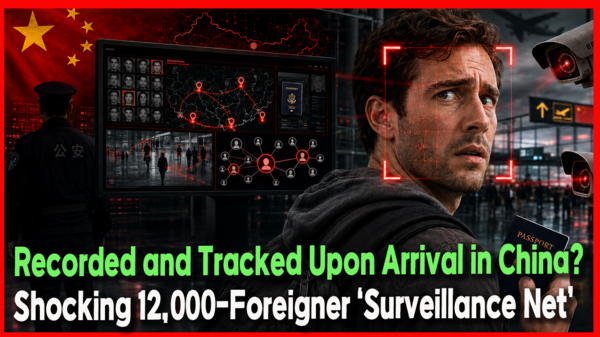
[Passports, Facial Recognition, Movements, and Even Social Networks… The Chinese Police’s Foreign Surveillance System]
Upon entering China, it is not merely foreigners' passports and faces that are recorded. Where they live, whom they travel with, which shopping malls and restaurants they visit, and even their religious affiliations and hospital medical records are integrated into a single public security dashboard. Discovered in Zhangjiakou, Hebei Province, China, this system contained information on approximately 12,000 individuals—primarily foreigners, but also people from Hong Kong and Taiwan, as well as fugitives. While the full operational scope of the system remains unclear, it unambiguously demonstrates that China's massive surveillance net extends beyond its own citizens to foreigners as well.
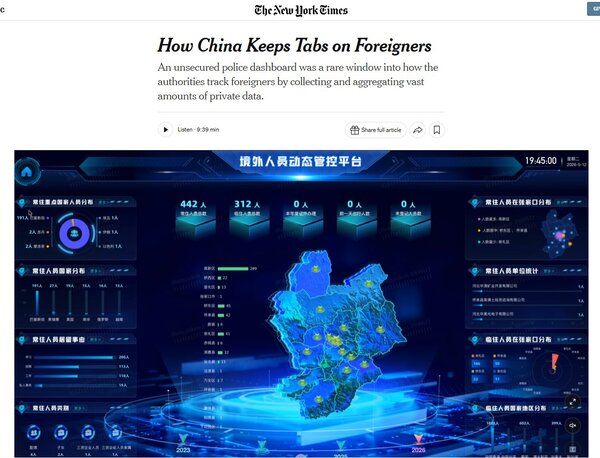
The New York Times (NYT) revealed the existence of the "Overseas Personnel Dynamic Control Platform," which appears to have been built for the Zhangjiakou public security authorities in China.
According to the NYT, the system was first discovered by Mark Hoogwerf, an Amsterdam-based cybersecurity researcher and former foreign correspondent in China. While examining publicly accessible Chinese security systems online earlier this year, Hoogwerf logged into a surveillance dashboard reminiscent of the movie Minority Report. Astonishingly, the login screen was pre-filled with a username and password, requiring no additional authentication. With just a few clicks, sensitive personal data accessible only to Chinese public security authorities—including passport numbers, facial photos, phone numbers, and movement logs—flooded the screen.
Even more startling was what came next. Within the database, Hoogwerf found a photo of his own face taken by Chinese immigration authorities, along with his exact phone number and passport number used while residing in China. "Whoever entered this information must have had access to actual government data," Hoogwerf noted. Recent login logs he accessed showed the names of eight police stations in Zhangjiakou and three in other cities.
[700 Intensely Monitored, 12,000 Registered in the Database]
Two distinct numbers warrant attention here. The system designated roughly 700 foreigners residing long-term in Zhangjiakou as primary management targets. However, the overall database stored profiles of approximately 12,000 individuals—including short-term visitors, foreign journalists, international students, people from Hong Kong and Taiwan, and fugitives. Some of those listed had no record of ever visiting Zhangjiakou.
Therefore, it cannot be definitively concluded that the police actively tracked the real-time movements of all 12,000 individuals. However, for a subset of registered individuals, detailed movement histories gathered via facial recognition cameras were indeed recorded.
The dashboard displayed a timeline of a Mongolian woman departing her residential compound and visiting shopping malls, restaurants, and supermarkets. Camera captures at intersections, markets, school entrances, and religious sites—such as mosques—were also logged into the system.
The data collection went far beyond simple identifying details. Alongside names, dates of birth, nationalities, and passport numbers were addresses, occupations, marital statuses, and religions. The platform was also designed to integrate hotel check-in records, flight and train boarding details, seat numbers, medical history, and even gas bill payments.
This was not a system merely built to verify identity; it was an integrated surveillance net designed to reconstruct where a person lives, whom they meet, and how they behave.
[Mapping Out Who Meets Whom]
A particularly notable feature of this platform is its "social network analysis" capability. Demonstration screens on the system showed three Pakistani men in their 20s automatically tagged as connected individuals when captured on camera together. Going beyond tracking the individual actions of a specific foreigner, it was engineered to automatically map out who a person meets and which groups they associate with.
While it remains unconfirmed whether this feature was fully deployed in daily police operations, the presence of real personal data alongside actual police station login records makes it difficult to dismiss as a mere dummy model.
This poses an even graver threat to foreign journalists operating in China. If a reporter's movement routes as well as the exact times and places they meet sources are accumulated into network maps, the core journalistic principle of source protection completely collapses.
The platform featured dedicated category menus such as "Journalist," "International Student," "Permanent Resident," "Foreign Spouse," "Suspect," "Fugitive," and "Key Figure." This indicates that Chinese authorities view foreigners not as simple visitors or residents, but as potential targets to be categorized and monitored based on perceived risk levels.
[Five Eyes, Hong Kong, and Taiwan Classified Separately]
Political classifications based on nationality were also distinct. Citizens from the United States, the United Kingdom, Canada, Australia, and New Zealand were grouped under the "Five Eyes" intelligence-sharing alliance. Individuals from Egypt, Iran, Israel, Morocco, Pakistan, and Sudan were categorized under "Key Nations."
Separate categories were created for individuals from Hong Kong—site of massive anti-government protests in 2019—and Taiwan, which China claims as its own territory. While nominally a foreign resident management system, its underlying structure directly reflects the national security worldview and political vigilance of the Chinese Communist Party (CCP).
Profiles of Pakistani and Indian students attending Hebei North University in Zhangjiakou contained their religion, marital status, and major, alongside precise timestamps of when they passed by school entrance cameras.
The system also maintained a blacklist of foreigners punished for violating Chinese regulations. Records included cases of individuals fined 1,000 yuan for failing to report a change of address, as well as foreign nationals caught teaching without a permit.
[A 'Surveillance Product' Built by Local Governments and Private Firms]
Citing public procurement documents, the NYT reported that the platform was linked to Origin Dynamics, a Beijing-based robotics and surveillance equipment company. The company has long supplied surveillance equipment and services to public security agencies, with state-owned capital linked to local governments holding a stake in the enterprise.
In 2023, Origin Dynamics filed a patent for a platform titled "Information Interface for Non-Chinese Nationals," which shared virtually identical designs and functionalities with the Zhangjiakou system.
This detail highlights that China's surveillance network is not confined to a single secret project run by the central government. Instead, a vast industrial ecosystem has emerged where local governments commission projects and private companies develop and supply surveillance systems as commercial products.
Cybersecurity expert Greg Walton described this phenomenon as "surveillance proliferation." This means that "with every new surveillance platform added, sensitive personal data is duplicated or misconfigured, expanding the surface area for potential external discovery."
Indeed, despite storing vast amounts of personal data, this platform remained exposed enough to be accessed through simple internet searches. While intruding thoroughly into the privacy of monitored targets, the safeguards to protect the collected data were shockingly lax.
The NYT noted that while the platform was designed to categorize foreign journalists and students and integrate camera, visa, travel, and facial data, its operational status remained unclear. The mixture of actual personal data suggested it may have been a hybrid of an unfinished system and live real-world data.
[A Simple Test Model, or a Precursor to Nationwide Expansion?]
According to data obtained by Hoogwerf, construction of the Zhangjiakou system began around 2021, with updates continuing through April of this year. Some fields remained empty or populated with dummy text.
However, one cannot conclude that the entire system was merely experimental based on this alone. Conversely, given the discovery of passport info, facial photos, travel logs of real people, and login traces from police agencies, it cannot be dismissed as a simple demonstration interface either.
Instead, the Zhangjiakou platform likely represents a transitional phase where real government data was fed into a surveillance system under development. If so, the implications are even more severe, as it is difficult to rule out the possibility that similar systems are being developed or already operated in other Chinese cities.
In fact, in 2021, it was revealed that Henan Province in China had issued a tender for a similar system designed to classify and track foreign journalists according to risk level. This suggests that the Zhangjiakou case is not an isolated, one-off project, but rather a snapshot of a broader policy aimed at managing foreigners as a distinct target of surveillance.
[South Koreans Are By No Means in a Safe Zone]
South Korea was not listed among the explicitly named "Key Nations." However, there is no reason to believe that South Korean residents, corporate executives, foreign students, or correspondents are exempt from monitoring.
Given that the platform was designed to broadly collect foreign nationals' occupations, religions, and movement paths—and specifically featured a dedicated "Journalist" menu—South Korean correspondents could easily become potential management targets. If network analysis tools are actively deployed, the identities of Chinese sources who meet with South Korean journalists could also be exposed.
This means that ordinary daily activities—using a mobile phone, staying at a hotel, riding a train, or visiting shopping malls and universities in China—can all be linked together into a single composite dataset.
Maya Wang, Associate Asia Director at Human Rights Watch, pointed out that while other nations operate surveillance systems, China lacks independent safeguards to check police power abuse. What is more dangerous than the existence of the technology itself is that there is no external way to verify who is designated as a surveillance target, on what grounds, or by whom.
[Why Times Insight]
What was exposed in Zhangjiakou is not merely a database containing info on roughly 12,000 foreigners. It reveals a structure through which the CCP consolidates the identity, movements, lifestyle details, and social connections of foreigners onto a single screen—a setup that local governments and private firms are turning into replicable "surveillance products."
It cannot be definitively stated that all 12,000 individuals were actively tracked in real time. However, the verification of real movement logs, passport details of specific individuals, and public security login records serves as a loud alarm.
What is even more chilling is the probability that Zhangjiakou is not the end, but the beginning. If such a platform was discovered in a single regional city, to what extent have surveillance networks already been established in major metropolitan hubs like Beijing and Shanghai, where foreign populations are concentrated?
Foreigners entering China are no longer mere visitors. Within public security cameras and databases, they are categorized by nationality, occupation, religion, and social ties—potential targets of surveillance who can be converted into "Key Figures" at any moment. China's "Big Brother" is no longer looking only at its own citizens.

-중국 푸단대학교 한국연구원 객좌교수
-전 EDUIN News 대표
-전 OUR NEWS 대표
-제17대 대통령직인수위원회 정책기획팀장
-전 대통령실 홍보기획비서관
-사단법인 한국가정상담연구소 이사장
-저서: 북한급변사태와 한반도통일, 2012 다시우파다, 선거마케팅, 한국의 정치광고, 국회의원 선거매뉴얼 등 50여권