
Update2026.11.17 (화)

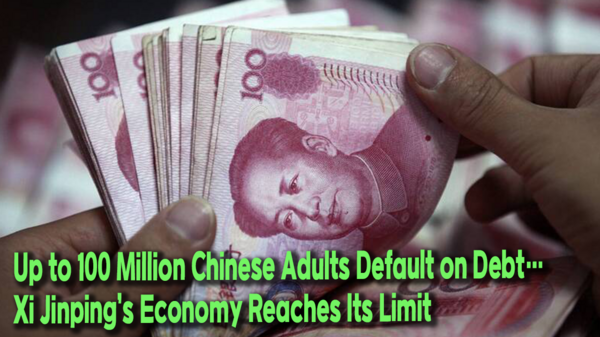
[Household loans post a net drop of 430 billion yuan in a single month… Consumption stimulus hits a wall]
China’s household debt is crossing a critical threshold. Non-performing personal loan packages offloaded by banks and consumer finance companies are breaking records every quarter, and the list of delinquents now includes middle-aged individuals in their 40s and 50s who hold university degrees and work in the public sector. Overseas research firms estimate that up to 100 million adults have failed to repay their debts on time, with household non-performing loans (NPLs) reaching an all-time high of 2.22 trillion yuan (approx. 446 trillion KRW). Even so, Beijing has halted the release of personal delinquency statistics. While banks manage their balance sheets through bulk sales and write-offs of bad debt, a growth rate in the 4% range props up the official narrative of "improvement amid stability." However, household loans shrank by 1.46 trillion yuan in the first ten months of this year alone, and consumption growth remained stuck in the 1% range. The collapse of repayment capacity—driven by simultaneous shocks to jobs, housing prices, and incomes—is spreading to households, the weakest link in the Chinese economy. It is a clear signal that the economic management of Xi Jinping’s regime has reached its limit.
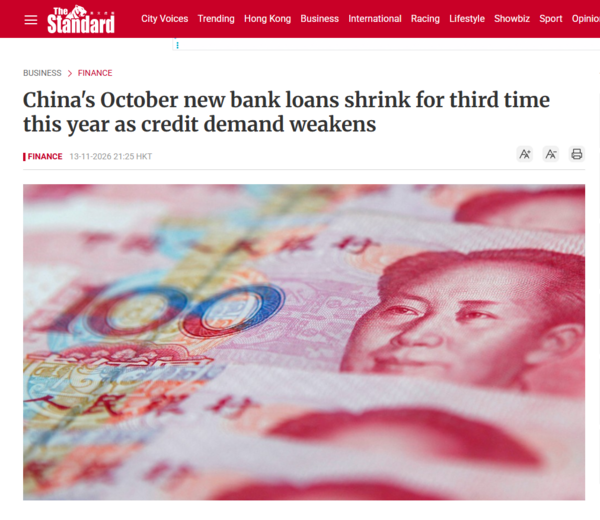
On the 14th, Hong Kong’s The Standard, citing a Reuters analysis of People’s Bank of China (PBOC) data, reported that "household loans posted a net decrease of about 430 billion yuan (approx. 86 trillion KRW) in October alone," adding that "the cumulative net decrease from January to October reached 1.46 trillion yuan (approx. 293 trillion KRW)." Reuters noted that "even as outstanding household loan balances shrink, banks are struggling to recover money already lent out." The assessment is that "as credit card delinquencies rise even among middle-aged public-sector employees—whom banks once viewed as prime borrowers—Beijing’s plan to ignite consumption through lending has been blocked by households' repayment burdens."
According to Reuters, yuan-denominated bank loans swung from a net increase of 1.08 trillion yuan (approx. 217 trillion KRW) in September to a net decrease of 100 billion yuan (approx. 20 trillion KRW) in October. Household loans showed virtually no change in September before dropping sharply in October. While credit demand typically softens in October following the National Day holiday and quarter-end loan disbursements, the fact that the cumulative net decrease in short-term household loans from January to October alone reached 1.41 trillion yuan (approx. 283 trillion KRW) demonstrates that the contraction in household credit is no temporary phenomenon.
A net decrease in loan balances is the combined result of new borrowing and repayments; balances fall whether households cut back on new debt or banks tighten lending standards. Reuters also reported in July that "even as authorities urge the expansion of consumer loans, some banks are actually tightening credit checks to prevent further defaults." Although Beijing tripled the interest subsidy cap on consumer loans to 3,000 yuan (approx. 600,000 KRW) per borrower, Moody’s analyst Nicholas Zhu pointed out that "customers with high creditworthiness are cutting back on credit card usage." When borrowers with ample repayment capacity shun debt and only those with lower creditworthiness borrow, expanding loans only heightens the risk of default.
Consumption indicators reflect this burden directly. According to China’s National Bureau of Statistics (NBS), real gross domestic product (GDP) grew 4.6% year-on-year from January to September this year, yet total retail sales of consumer goods rose just 1.1%, and retail sales of goods increased by a mere 1.0%. With short-term household loans plummeting, driving demand for big-ticket items that rely on installment plans and credit—such as automobiles and home appliances—has become all the more difficult.
[Credit card delinquencies rise even among middle-aged borrowers once considered prime customers by banks]
The secondary market for non-performing loans is the earliest barometer of spreading delinquencies. At the end of October, Hong Kong’s South China Morning Post (SCMP) reported that "newly registered non-performing loan packages on the Banking Credit Asset Registration and Transfer Center in the third quarter totaled 148.1 billion yuan (approx. 30 trillion KRW) in principal and interest, surging roughly 50% from the previous quarter," and that "cumulative registrations for the first nine months reached 322.2 billion yuan (approx. 65 trillion KRW), up 26.4% from a year earlier."
Even more shocking is the shifting profile of the borrowers. The SCMP noted that "at the center of the recent surge in delinquencies are middle-aged individuals with university degrees and stable public-sector jobs." A non-performing loan package exceeding 10 billion yuan put up for sale by China Everbright Bank in August explicitly noted a high proportion of borrowers with a bachelor's degree or higher. In the United States, credit card delinquency is largely seen as an issue affecting people in their 20s and 30s. In China, conversely, the middle-aged breadwinners who anchor households are the first to buckle.
[100 million vanished from the books… Gavekal warns, "Personal bad debt will continue to pile up"]
According to an analysis by Gavekal Dragonomics cited by Bloomberg and Reuters, China’s household non-performing loans stood at 2.22 trillion yuan (approx. 445 trillion KRW) at the end of 2025, up 21% from the previous year. After authorities stopped publishing personal delinquency and default figures, Gavekal estimated this number by directly analyzing the financial reports of 26 banks. Based on its findings, up to 10.6% of China’s 1.1 billion adults—roughly 100 million people—are behind on their debt repayments.
Gavekal financial analyst Xiaoxi Zhang warned that "personal non-performing loans will continue to pile up," predicting that "the situation is unlikely to improve without more aggressive government policies to ease income pressures." The Academy of Internet Finance at Zhejiang University also estimated that "personal bad debts that Chinese financial institutions must dispose of annually could reach 2 trillion to 3 trillion yuan (approx. 400 trillion to 600 trillion KRW)." Over the past decade, China’s household debt has roughly tripled to reach 83 trillion yuan (approx. 16,662 trillion KRW).
[ICBC credit card NPL ratio hits 5.37%… What bank ledgers are hiding]
Bank ledgers are sending the same signal. According to the semi-annual reports of listed banks, the personal loan NPL ratios of China’s six major state-owned banks ranged from 1.31% to 2.02% at the end of June, all higher than at the start of the year. The credit card NPL ratio at the Industrial and Commercial Bank of China (ICBC), the world’s largest bank, jumped from 4.61% at the end of last year to 5.37%, while Bank of Communications saw the steepest increase among state-owned lenders, rising from 2.68% to 3.8%. ICBC’s mortgage NPL ratio also climbed 0.23 percentage points to 1.29%.
Markets believe actual defaults are far worse than disclosed figures suggest. May Yan, head of Asian financial research at UBS, estimated that "5% to 6% of retail loans at some major banks could be non-performing." A banking official who requested anonymity told Reuters that "the current retail loan delinquency situation is very severe." To delay classifying loans as non-performing, banks are granting principal and interest repayment grace periods or restructuring loan terms. A pilot program introduced in 2021 allowing the bulk sale of personal NPLs has been extended through the end of this year; sales under the scheme reached 107.6 billion yuan (approx. 21.6 trillion KRW) in the first half of 2025 alone, doubling in a single year. In the first half of this year, 24 consumer finance companies offloaded 53.2 billion yuan (approx. 10.7 trillion KRW) in bad loans onto the market—a sharp jump from 15 companies and 30 billion yuan (approx. 6 trillion KRW) during the same period last year.
[Exports mask a frozen domestic market… Households sink alongside growth]
The rise in delinquencies mirrors the broader macroeconomic slowdown. Third-quarter GDP growth came in at 4.5%, rebounding slightly from 4.3% in the second quarter, which had marked a more than three-year low. Mao Shengyong, deputy head of the National Bureau of Statistics, hailed the figure as a "hard-won achievement worthy of high praise." Yet growth was propelled by exports, which surged over 16% on the back of artificial intelligence (AI)-related demand. Over the same period, fixed-asset investment fell 7.2%, and monthly retail sales growth dropped as low as 0.4% in August.
Employment and asset values are also eroding households' repayment capacity. While the surveyed urban unemployment rate stood at 5.2% in September, youth unemployment for those aged 16 to 24 hit 18%, having reached a one-year high of 18.9% in August. Sales of new commercial housing plunged by more than half, from roughly 18 trillion yuan (approx. 3,612 trillion KRW) in 2021 to 8.39 trillion yuan (approx. 1,683 trillion KRW) in 2025, while real estate development investment fell 17.2% in the same year. As falling home prices—which account for the bulk of household wealth—shrink middle-class balance sheets, they are fueling the surge in middle-aged delinquencies.
[Households that won't borrow, households that can't repay]
In the first half of the year, real per capita disposable income grew 4.2%, yet per capita consumption expenditure rose just 2.7%. Layered atop households unable to spend what they earn is a punishing debt structure, inflated by Big Tech lending platforms. Firms like Ant Group and ByteDance acted as intermediaries between banks and borrowers, aggressively marketing "ultra-fast loans" at annual interest rates ranging from 4% to over 24%. Multiple-debt borrowers who owe money across several platforms are the first to collapse the moment their income falters. Despite this, China lacks a nationwide personal bankruptcy system; a pilot program introduced under a 2021 local regulation in Shenzhen remains virtually the only mechanism of its kind. Cut off from any legal avenue to restructure or discharge their debts, borrowers are trapped in an endless cycle of collection harassment and credit blacklisting.
[Why Times Insight]
What is most dangerous about China’s household debt crisis is not the numbers themselves, but the way the numbers are being concealed. Authorities have stopped releasing personal delinquency data, while banks "manage" their NPL ratios by pushing bad debt off their balance sheets through bulk sales, write-offs, and repayment grace periods. The gap between the official industry-wide NPL figure of around 1.5% and private estimates that 100 million adults are in default represents the true scale of Chinese-style statistical window dressing. Some argue that China’s ratio of bad debt to total household debt on the books remains lower than that of the United States (roughly 4.8%). However, China has neither experience managing mass consumer defaults nor the safety valve of a personal bankruptcy system. Even at the same ratio, the depth of the shock can be entirely different.
The more fundamental problem is that this crisis is structural, not cyclical. The property-led growth model has collapsed, private enterprises and the platform economy have withered under regulatory crackdowns, and youth jobs have vanished. Ultimately, the bill has been passed on to households. A vicious cycle is already in motion: delinquencies freeze consumption, and frozen consumption in turn erodes corporate revenues and employment. When the middle-aged pillars of the household crumble, the fallout spreads to an entire generation's sense of security and trust in the regime. It remains uncertain how much longer 4%-range growth—propped up by exports and massaged statistics—can paper over the wounds of 100 million people. Without a shift in policy trajectory, China’s household economy faces a severe risk of entering a phase from which recovery will be extraordinarily difficult.


-중국 푸단대학교 한국연구원 객좌교수
-전 EDUIN News 대표
-전 OUR NEWS 대표
-제17대 대통령직인수위원회 정책기획팀장
-전 대통령실 홍보기획비서관
-사단법인 한국가정상담연구소 이사장
-저서: 북한급변사태와 한반도통일, 2012 다시우파다, 선거마케팅, 한국의 정치광고, 국회의원 선거매뉴얼 등 50여권