
Update2026.11.17 (화)

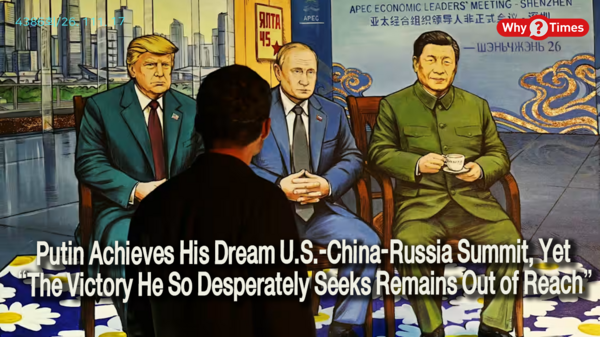
[First trilateral meeting without an agenda… Trump says, "We will discuss nuclear arms control"]
The U.S.-China-Russia trilateral summit that Russian President Vladimir Putin has long desired will take place this week in Shenzhen, China. For Putin, whose regime was shaken three years ago by the Wagner Group’s armed mutiny, it is a dramatic turnaround. Simply standing side by side with U.S. President Donald Trump and Chinese President Xi Jinping gives the Kremlin propaganda fodder to claim that "Western isolation policies have failed." Yet the photo op is unlikely to translate into tangible results. Xi is drawing a line against putting the Ukraine war and nuclear arms control on the agenda. Meanwhile, having lost both the Senate and the House to the Democrats in the midterm elections, Trump has forfeited the political leverage needed to ease sanctions on Russia or pressure Ukraine. Although Russia reportedly put forward demands in the Abu Dhabi talks aimed at reshaping the entire European security order beyond Ukrainian territory, the Shenzhen gathering is not structured to accommodate them. Comparisons to the 1945 Yalta Conference are merely symbolic, and parties outside the summit room are far more likely to dictate the outcome.
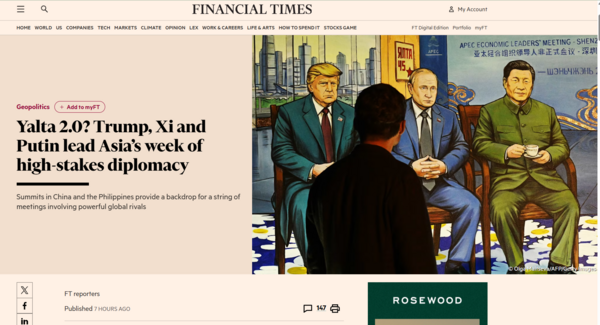
The British daily Financial Times (FT) reported on the 16th that "the Asia-Pacific Economic Cooperation (APEC) summit will be held in Shenzhen, Guangdong Province, on the 18th and 19th, and the leaders of the United States, China, and Russia are scheduled to hold their first-ever trilateral meeting on the sidelines on the 19th," adding that "the three countries have agreed to hold the talks without a pre-agreed agenda."
The FT went on to note that "this is an unusual decision for Xi Jinping, who has strictly scripted his conversations with foreign leaders." Regarding the gathering, President Trump stated, "One of the meetings I will have in China will be with President Putin and President Xi." A U.S. official explained that "Trump will bring up nuclear arms control and non-proliferation," while noting that "the significance lies in initiating discussions among the three major nuclear powers rather than reaching an agreement." The official added, "We know it is a difficult topic for China, but it is time for China to sit at the adults' table."
[A reversal three years in the making… The starting point was Trump's 'goodwill']
Putin’s position has changed dramatically over the past three years. In June 2023, as Wagner Group mercenaries led by Yevgeny Prigozhin marched on Moscow, Putin called the mutiny "treason" and a "mortal threat" to the state in an emergency address to the nation. At the time, the Joe Biden administration focused on coordinating with Europe to isolate Russia on the international stage. Britain’s The Telegraph attributed the realization of this trilateral summit solely to Trump’s goodwill, pointing out that no other U.S. president would have provided such a stage without demanding something in return. John Lough, a senior fellow at the New Eurasian Strategies Centre, remarked, "Russia will be gloating, saying the Biden administration and its allies tried to isolate them, yet look where they are now," before asking, "But what will actually come out of it?"
[Xi Jinping’s calculation: Showcase 'convening power' while avoiding responsibility]
Although China set the table, Beijing’s attitude remains lukewarm. According to the FT, China initially hesitated due to the risks of sitting down with two unpredictable leaders, accepting the summit only after weeks of consultations with Washington and Moscow.
German President Frank-Walter Steinmeier met with Xi in Beijing on the 30th of last month. He relayed that while Xi indicated the three leaders might meet in Shenzhen, it would not be a venue for discussing the Ukraine issue. China’s Ministry of Foreign Affairs has also dismissed calls to join trilateral nuclear arms control negotiations at this stage as "neither fair, reasonable, nor realistic." Kerry Brown, a professor at King's College London, analyzed that "Xi Jinping will try to take on as little responsibility as possible." However, he added that "the mere fact of gathering in one place with Putin and Trump demonstrates Beijing's formidable convening power as the only major power talking to everyone."
Nuclear arms control represents the biggest stumbling block between the U.S. and China. According to U.S. Department of Defense estimates, China’s nuclear warhead stockpile has more than doubled from around 200 in 2020 to over 500 in 2023. With the U.S. and Russia each possessing more than 5,000 warheads, China is expanding its arsenal at the fastest pace in history toward nuclear parity. Professor Brown predicted, "China will say the right things about non-proliferation, but it will not agree to negotiations saying 'let's stop at current levels.' They will say, 'We will stop once we are on par with you,' and that is precisely where things will hit a wall."
[The 'Hormuz-Ukraine swap' scenario: How feasible is it?]
Some in diplomatic circles speculate that the three leaders could attempt a "grand bargain" trading the Iran issue for Ukraine. Under this scenario, Russia—which sells weapons to Iran—and China—which buys Iranian crude—would use their leverage to steer Iran toward a peace agreement with the U.S., and in exchange, Trump would compel Ukraine to end the war on Russia’s terms.
Tim Willasey-Wilsey, a senior visiting fellow at the UK's Royal United Services Institute (RUSI), suggested that "Xi and Putin could tell Trump, 'We can sort out the Iran issue, provided the quid pro quo is a Ukraine settlement along the lines of the 28-point peace plan.'" He warned that "this summit will be a dangerous moment for President Zelenskyy." The 28-point peace plan presented last year by special envoy Steve Witkoff included core Russian demands such as capping the size of Ukraine’s military and ceding territories Russia has not yet occupied.
However, the three leaders' actual ability to enforce such a deal is not as great as they may believe. Although Trump has already cut off grant funding and free weapons aid to Ukraine, Zelenskyy has weathered the pressure as Europe stepped in to fill the void. The decisive variable is the U.S. midterm elections held earlier this month. Once the new Congress convenes in January, it will be virtually impossible for Trump to neutralize legislation sanctioning Russia, and congressional demands to support Ukraine are set to intensify. Russia and China’s leverage is equally limited. Because the U.S. Navy is blockading Iranian ports, China cannot import Iranian crude by sea in the first place. Meanwhile, Iran’s missile and drone industries have grown self-sufficient enough to endure even without Russian military assistance.
[Russia's 'expanded bill' revealed in Abu Dhabi]
The Abu Dhabi talks held just ahead of the Shenzhen summit offered a glimpse into Russia’s true intentions. Delegations from the U.S., Russia, and Ukraine held their first face-to-face negotiations since February in Abu Dhabi, United Arab Emirates, on the 10th and 11th. Yet beyond reaching an agreement in principle on a large-scale prisoner exchange, there was no progress on territorial disputes or a ceasefire.
Germany’s Bild reported on the 13th that "the Russian delegation presented an informal proposal to the European side," containing demands for "Finland’s withdrawal from NATO, a ban on establishing NATO military bases in the three Baltic states, retention of currently occupied territories alongside control of the entire Donbas, and permanent 'non-aligned' status for Ukraine." Bild analyzed that "these demands originated from Putin’s inner circle and aim at a new European security architecture beyond the territorial issue in Ukraine."
Finland pushed back immediately. In an interview with Finnish public broadcaster YLE, Defense Minister Antti Häkkänen stated, "There is zero room for negotiation on such matters. Russia knows that very well. Such demands are completely absurd." Foreign Minister Elina Valtonen also stressed that "NATO membership is a matter for Finland and NATO to decide together," pointing out that "Russia’s attempt to broaden the negotiating agenda from the war in Ukraine to Europe’s security structure means it has no intention of rushing toward an agreement." Kremlin spokesman Dmitry Peskov denied on the 13th that Moscow had "ever demanded Finland’s withdrawal from NATO." Previously, however, The Telegraph had also reported that "Russia could demand that NATO roll back its military deployments to 1997 levels."
[Comparisons to 'Yalta' are exaggerated… Economic share of 85% vs. 44%]
Some media outlets are dubbing the upcoming meeting "Yalta 2.0." Yet the global clout of the "Big Three" at Yalta 81 years ago differs vastly from that of today’s three leaders. In 1945, Roosevelt’s United States accounted for roughly half of the global economy, Churchill’s British Empire a quarter, and Stalin’s Soviet Union 10%—combined, they represented nearly 85% of world GDP. Today, by contrast, the combined share of the U.S. and China is about 42%, with Russia adding a mere 2%. Anton Barbashin, editorial director of the online journal Riddle Russia, quipped, "Comparing this to Yalta is like comparing Renaissance art to contemporary art. Both contain the word 'art,' but they are completely different things." Xi Jinping is also reportedly averse to comparisons with the Yalta Conference, from which China was excluded despite its major contribution to the war against Japan.
[Outlook: "A week later, it will mean nothing"]
Among the three leaders, Putin—the weakest—is the only one seeking concrete outcomes. Barbashin explained, "Putin wants something very solid and tangible from any negotiation," adding that "his is a government that openly says it needs binding agreements, not mere words." Alexander Gabuev, director of the Carnegie Russia Eurasia Center, assessed that "this meeting is a low-risk, high-prestige event for Russia," noting that "even though Russia is objectively not in the same league as the U.S. and China outside the size of its nuclear arsenal, it grants Putin the status of a top-tier world leader." Barbashin reached the same conclusion: "The propaganda value is tremendous, especially for the Global South and for domestic consumption in Russia. But without substance, it is nothing. A week from now, and a year from now, it will mean nothing."
[Why Times Insight]
The Shenzhen trilateral summit is, in effect, the very stage Putin wanted most. He is attempting to leverage a friendly Trump and a strategically aligned Xi Jinping to bring the war in Ukraine to an end on favorable terms. The very framing that likens the meeting to Yalta aligns with the "New Yalta" vision the Kremlin has long cultivated.
However, events are unlikely to unfold as Putin intends. Xi Jinping will stop at hosting the meeting to showcase China’s convening power; he is highly likely to avoid sharing responsibility for the Ukraine war or alienating Europe. Mindful of the European market and Beijing’s future role in Ukraine’s reconstruction, China cannot afford to side overtly with Russia. Trump, too, faces a transformed congressional landscape after a crushing midterm defeat, making it difficult to defy Democratic demands for expanded aid to Ukraine and tougher sanctions on Russia. Meanwhile, Russia’s move in Abu Dhabi to widen the agenda to Finland and the Baltic states signals that Moscow is in no hurry to reach a deal. If the Shenzhen gathering ends as nothing more than a single photograph, we must recognize that the cost will be paid not by Russia—which buys itself more time—but by Ukraine, which continues to endure ongoing airstrikes.
-중국 푸단대학교 한국연구원 객좌교수
-전 EDUIN News 대표
-전 OUR NEWS 대표
-제17대 대통령직인수위원회 정책기획팀장
-전 대통령실 홍보기획비서관
-사단법인 한국가정상담연구소 이사장
-저서: 북한급변사태와 한반도통일, 2012 다시우파다, 선거마케팅, 한국의 정치광고, 국회의원 선거매뉴얼 등 50여권