
Update2026.10.24 (토)


[The Evolution of Chinese AI: "Predicting Intent, Not Just Behavior"]
The 2002 sci-fi film Minority Report, directed by Steven Spielberg and starring Tom Cruise, appears poised to become a reality in China. The premise—that individual freedom and human rights can be completely sacrificed to maintain the flawless state apparatus of Chinese communism—is chilling. In fact, a massive leak of internal documents has sent shockwaves through the international community, revealing that a Chinese state-linked enterprise has been developing technology to analyze citizens' daily data via artificial intelligence (AI) to pre-identify future dissidents.
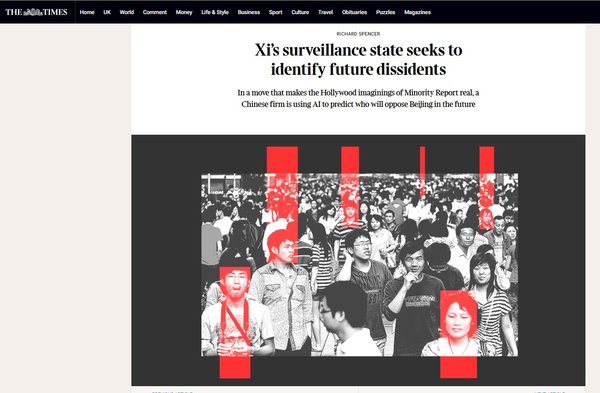
On June 3, the British newspaper The Times delivered a startling report: “The Institute of National Security at Vanderbilt University in the United States recently released a report analyzing approximately 100,000 internal documents from Geedge Networks, a Chinese state-linked tech firm.” The Times added, “The report shows that the company is developing a system that integrates and analyzes citizens’ internet history, movement trajectories, communication logs, and social media activity using AI to filter out individuals likely to pose political threats in the future. It currently appears to be in the research and development stage, and no evidence has yet been confirmed that it is fully completed or deployed in the field.”
The Times further noted, “The research team emphasized that the core of this technology goes beyond simple post-hoc surveillance.” According to the report’s analysis, “The objective was to build behavioral profiles of individuals deemed ‘harmful.’ It was not merely about determining what they had already done, but predicting what they would do next and whom they would be with.”
Professor Brett V. Benson, a political scientist at Vanderbilt University who led the research team, stated, “The research team at China’s Geedge Networks sought to go beyond merely logging behavioral patterns to predicting what a citizen would do next and whom they would contact.” The underlying logic is that the vast pools of data accumulated daily serve as the raw material that defines an individual's future actions.
According to The Times, “Geedge Networks is a company that has sold commercial versions of the surveillance and censorship software that comprises China’s 'Great Firewall.' It has been confirmed that the firm embarked on developing next-generation products to pre-identify potential political critics by combining location data, communication logs, and internet activity with AI models.” The company’s chief scientist is reportedly Professor Fang Binxing, widely known as the architect who designed China's internet censorship infrastructure.
The Times also pointed out, “According to researchers, Geedge Networks, alongside the government-supported research organization MESA Lab, began building behavioral profiles based on telecommunications, social media, and location data in 2024. The goal went beyond classifying individuals and identifying sensitive information to predicting future behavior and human relationships.”
Based on their analysis, the Vanderbilt research team concluded, “This system contains evidence of a comprehensive surveillance architecture that integrates digital traffic, location data, and social networks into a single personal profile.”
This technological direction is often compared to the 2002 sci-fi thriller Minority Report. In the movie, the police unit "PreCrime" relies on the predictions of mutated clairvoyants to arrest suspects before a crime occurs. However, the real-world Chinese model utilizes vast data sets and AI algorithms instead of human intuition, making it far more systematic and scalable. The report from the Institute of National Security at Vanderbilt University defined it as follows: “The trigger for state intervention is no longer something a citizen has done. It is something the state believes the citizen will do.”
[The Evolution of the Great Firewall: From Surveillance to Prediction]
China has pursued predictive surveillance technology for several years, and AI models are now accelerating the pace of this development. Geedge Networks' research shares similarities with the work of GoLaxy, another state-linked enterprise. GoLaxy is a company that developed technology to spread targeted propaganda using AI-based software, an issue previously reported on by Vanderbilt University and The New York Times. Both companies are classified as spin-offs established under the research umbrella of the Chinese Academy of Sciences (CAS). As the peak body of the national scientific research pyramid, CAS creates enterprises that sell services to government agencies—including the Ministry of State Security—while also doing business with private corporations and foreign governments.
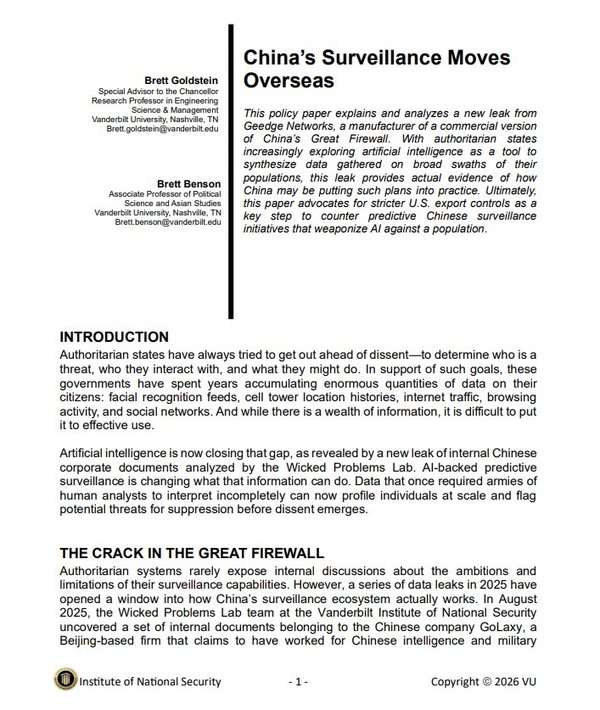
The Vanderbilt report warned, “Predictive surveillance fundamentally alters the nature of authoritarian control. This system pulls government intervention into a much earlier stage. It pre-identifies individuals and networks that could pose potential threats, infers intent, and preemptively intervenes before dissident movements manifest.”
Brett J. Goldstein, director of the Wicked Problems Lab at the Vanderbilt Institute, warned, “This is what happens when mass surveillance meets AI. What China is inflicting on its citizens without checks and balances is a preview of what is possible anywhere these tools go unchecked.”
The Chinese Communist Party's decades-long effort to develop sophisticated mechanisms for public opinion control is deeply rooted in the memory of the 1989 Tiananmen Square pro-democracy protests. The experience of massive crowds mobilizing instantly to threaten party control created an institutional obsession with intervening preemptively before collective opposition can materialize. Consequently, Chinese authorities have repeatedly imposed short-term detentions for unauthorized activities, even on issues that do not directly threaten the party's power base—such as labor rights or sexual harassment—institutionalizing the principle that all social and political activities must go through official channels. The vast network of detention facilities in the Xinjiang region follows the same logic. While authorities designate them as "vocational education and training" centers, international human rights organizations uniformly assess them as a preemptive strike to eradicate the religious and cultural identity of the Uyghur people before it can become the seed of anti-state resistance.
[Digital Authoritarianism Spreading Abroad]
The Vanderbilt report pointed out that the surveillance system developed by Geedge Networks does not stop at China's borders: “Leaked documents show that the company has exported its systems to countries such as Myanmar, Pakistan, Ethiopia, and Kazakhstan.” The report continued, “These countries all have authoritarian-leaning regimes that have faced criticism from human rights groups for their coercive control over political opposition or ethnic minorities. This implies that China is using the digital surveillance apparatus it built at home as an export commodity, effectively spreading an 'authoritarian internet' model to the world.”
The report further noted, “The leaked records include document correspondence, meeting minutes, product technical blueprints, compensation structures, and personnel information. InterSecLab, a security research organization that analyzed the documents, confirmed that Geedge Networks secured contracts with the governments of Kazakhstan, Ethiopia, Pakistan, Myanmar, and one unidentified nation.”
[GPU Export Controls: The Only Brake Left?]
Paradoxically, the most effective factor currently slowing down the expansion of this ambitious surveillance apparatus is U.S. semiconductor export controls. To run predictive AI models in the real world, massive quantities of high-performance Graphics Processing Units (GPUs)—manufactured exclusively by U.S. companies like Nvidia and AMD—are required. While filtering banned keywords from internet censorship text can be done with low computing power, integrating the call logs, videos, and location data of hundreds of millions of people to predict future behavior requires a computing infrastructure of an entirely different dimension.
The Vanderbilt research team analyzed that "while Geedge Networks collaborated with MESA Lab to develop technology that generates citizen profiles and screens politically risky individuals via AI, the pace of development was hindered by the export controls on U.S. AI chips introduced during the Biden administration." According to U.S. officials, “Geedge Networks currently possesses the GPUs required for product operation, but implementing its most ambitious predictive system would require high-performance chips that China currently finds difficult to acquire.”
The leaked documents reveal that Geedge Networks, facing GPU limitations, explored workarounds. These included shifting to traditional knowledge graph methods or implementing a "two-stage fine-tuning" approach to maximize the utility of its existing Nvidia A800 chips. This indicates that while export controls may not completely halt development, they can meaningfully restrict its speed and capability. Although the Trump administration eased some Biden-era export controls, restrictions on Nvidia's highest-performance processors remain in effect to this day.
[Outlook and Commentary: When On-Screen Warnings Become Reality, What Does History Tell Us?]
The movie Minority Report is not just a sci-fi thriller; it is a cautionary tale about how a perfect predictive system collapses under its own weight. In the film, the PreCrime system is initially hailed as a "flawless system" that reduces homicides by 90%. However, when the very people who designed and operated the system begin to conceal and manipulate the truth to escape its predictions, the system implodes from within. The "minority report" that gives the film its title signifies the fragments of doubt that exist within an ostensibly perfect system. Those doubts could not be tolerated, so they were covered up. Yet, the cover-up itself proved that the system was built on a lie.
History provides even more direct evidence. East Germany’s Ministry for State Security, the Stasi, deployed 91,000 full-time agents and 176,000 informants in a country of 16.4 million people, systematically dismantling the fabric of trust across society. The system created a "Super-Panopticon" effect, causing millions of citizens to self-censor out of the sheer belief that they were being watched. Nevertheless, the conclusion was the same. When the Berlin Wall fell, the Stasi was relegated to the scrapheap of an oppressive regime, and its core leadership, including Erich Mielke, stood trial. The human will for freedom ultimately broke through the most sophisticated surveillance network.
The structural contradiction of China’s AI-driven predictive surveillance system lies precisely here. Algorithms learn from past patterns to predict the future, but human consciousness and resistance alter those very patterns non-linearly. Tighter surveillance breeds more sophisticated evasion, and harsher suppression accumulates deeper resentment. The more perfect a predictive system claims to be, the more a single unpredicted variable becomes a fatal vulnerability that can bring down the entire structure. This is not a problem of technology; it is a matter of human nature.
Most importantly, the greatest danger of this technology begins not after it is completed, but in the process of striving toward its completion. The very fear of being monitored stifles speech and thought across society. This stifling erodes societal creativity and adaptability, ultimately leading to a paradox where it gnaws away at the long-term capability of the state operating the system. The path trodden by every totalitarian surveillance state in history bears witness to this truth.
Just like the ending of the movie, and just like the conclusion of history, the unpredictable free will of humanity always remains the final variable that the most sophisticated algorithm cannot solve.


-중국 푸단대학교 한국연구원 객좌교수
-전 EDUIN News 대표
-전 OUR NEWS 대표
-제17대 대통령직인수위원회 정책기획팀장
-전 대통령실 홍보기획비서관
-사단법인 한국가정상담연구소 이사장
-저서: 북한급변사태와 한반도통일, 2012 다시우파다, 선거마케팅, 한국의 정치광고, 국회의원 선거매뉴얼 등 50여권