
Update2026.10.24 (토)


[The Question Raised by Rubio's Remarks—Why is Beijing Still Haunted by Tiananmen?]
The gunfire that echoed through Tiananmen Square on June 4, 1989, continues to haunt the Chinese Communist Party (CCP) even 37 years later. When U.S. Secretary of State Marco Rubio struck a nerve by declaring that "no amount of censorship can erase the past," the Chinese Ministry of Foreign Affairs immediately fired back, labeling it a "distortion of history." However, the reality of China deploying tighter censorship and harsher crackdown on memorials year after year proves that Tiananmen remains the regime's deepest wound. Tiananmen is not a matter of the past; it is the ultimate source of the fear and governance philosophy driving the Xi Jinping regime today.
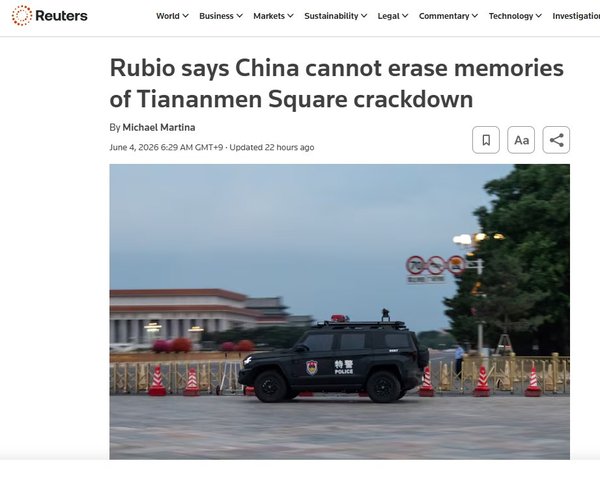
On June 4, Reuters caught widespread attention by reporting, "U.S. Secretary of State Marco Rubio stated that Beijing's censorship cannot erase the memory of the military crackdown on peaceful Tiananmen Square protestors in 1989." The report added, "While this statement aligns with Secretary Rubio's past rhetoric and stance, it carries exceptional weight for Chinese dissidents and pro-democracy advocates, coming at a time when President Trump and President Xi Jinping are repeatedly flaunting close ties—including a direct meeting in Beijing last month."
In fact, Secretary Rubio made it clear through an official statement: "The world remembers that the Chinese Communist Party deployed the military against peaceful protestors in and around Tiananmen Square." He added, "Those who sacrificed their lives for the rights of free expression and peaceful assembly will one day be vindicated." In particular, this statement is being interpreted as a strong signal that even as President Trump seeks to improve relations with President Xi Jinping, the United States will not compromise on the issue of Tiananmen.
In the same report, Reuters noted, "Any mention of the Tiananmen crackdown is taboo within China, and the topic is thoroughly censored. China labeled the protests at the time as a counter-revolutionary rebellion aimed at overthrowing the Communist Party and has never released an official death toll." It also reported, "Due to restrictions in Hong Kong, the once-massive candlelight vigils have completely vanished, leaving cities like London, New York, Berlin, and Taipei to keep the flame of the June 4 commemoration alive."
[A Rattled Beijing: Countering with "Slander" Accusations Exposes the Deep Wound]
Beijing immediately launched a counterattack against Rubio's statement. However, the speed and intensity of the response only served to prove just how sensitive and vulnerable an Achilles' heel this issue remains for China.
During a regular press briefing, Chinese Foreign Ministry Spokesperson Mao Ning expressed strong dissatisfaction and firm opposition regarding Rubio's remarks, stating, "China strongly condemns and firmly opposes the U.S. distorting historical facts and smearing China's political system and development path." Mao Ning also repeated the long-standing position, stating, "The Chinese government has already drawn a clear conclusion regarding the political turmoil that occurred in the late 1980s." This brief statement essentially constitutes the entirety of the Chinese government's official stance. The phrase "clear conclusion" is a sealing declaration meaning there is no room for further discussion, while the word "turmoil" acts as a Chinese euphemism for a massacre that claimed hundreds to thousands of lives.
Regarding this, Euronews pointed out, "While China countered Rubio's remarks by defining them as a 'smear,' public discussion of the event remains completely blocked by censorship within mainland China." Euronews also reported, "On this day in Causeway Bay, Hong Kong, a citizen holding a candle was detained by plainclothes police. Chan Po-ying, a veteran activist of the pro-democracy camp, was taken away in a police vehicle while holding yellow paper flowers, and managed to tell reporters: 'Victoria Park holds 37 years of collective memory for Hong Kongers. I hope people do not forget this memory.'"
[A 37-Year War with Memory… What the Communist Party Fears is the Past]
The broader question revived by the Reuters report is: "Why does the Chinese Communist Party—the world's second-largest economic power and a nuclear-armed superpower—fear a single memory from 37 years ago so intensely?" Simply put, it is because the Tiananmen Square incident is not a mere historical event. Rather, it is closer to an ongoing war with memory that the Chinese Communist Party has failed to conclude to this day.
Within mainland China, information regarding Tiananmen is subject to near-total censorship. The candlelight vigils at Hong Kong's Victoria Park, which once drew hundreds of thousands of participants, disappeared following the implementation of the National Security Law. This year, the suppression escalated further.
Amnesty International noted, "This year, for the first time, Chinese authorities restricted the bereaved families of Tiananmen victims from even visiting cemeteries," and pointed out, "The absolute minimum space for mourning, maintained for decades, has now been blockaded." This implies that the state has begun intervening in personal acts of mourning, transcending standard political control.
Paradoxically, this reveals what the Communist Party fears most. The regime is not threatened by current opposition forces, but by past memories. If this were an event destined to be naturally forgotten over time, there would be no reason to mobilize such a colossal system of censorship and surveillance. The very fact that "Tiananmen" remains a taboo word 37 years later proves that the incident is still the regime's structural weakness.
[The Invisible Blueprint Animating the Xi Jinping Regime]
The significance of Tiananmen does not belong solely to the past. It serves as a vital key to decoding the current Xi Jinping regime. In fact, since Xi took power, China has drastically tightened internet censorship, expanded control over civil society and the media, and intensified the party's ideological education and loyalty screenings far more than before. The anti-corruption campaign was also utilized as a mechanism to reclaim internal control over the party, going far beyond a simple crackdown on graft.
Ultimately, China's current heavy-handed state control model can be seen as a direct extension of the governance philosophy forged in the wake of Tiananmen. The Xi Jinping regime is not one that has forgotten Tiananmen; rather, it is a regime that constantly remembers it.
[Hong Kong—Pro-China Events Replace Asia's Once-Largest Memorial Site]
Radio Free Asia (RFA) reported, "While Hong Kong's Victoria Park was once the epicenter of peaceful democratic resistance, drawing hundreds of thousands annually, the park now hosts pro-China events on this day, and local media completely avoids mentioning the massacre."
RFA continued, "It is not that the Hong Kong media does not know about June 4 or lacks information. They simply do not dare to touch the subject." This underscores how drastically Hong Kong—which once boasted the freest media environment in Asia—has transformed in the six years since the National Security Law was enacted in 2020.
[What Censorship Actually Proves—Fear is Not Stronger than Memory]
Following the United States, the European Union and the United Kingdom also posted 37th-anniversary memorial messages on social media on this day. Taiwan's President Lai Ching-te issued a statement saying, "We hope China can face the June 4 incident squarely, acknowledge the truth, heal the pain, and open the door to reconciliation and dialogue," and a candlelight vigil was held at Liberty Square in Taipei. A memorial service also took place at a Christian facility chapel in Shinjuku, Tokyo, Japan.
In the U.S. Congress, Arthur Liu, a student leader during the 1989 Tiananmen movement, held a memorial event at the Capitol alongside U.S. lawmakers and supporters. His daughter is the American figure skater Alysa Liu. It was a poignant scene demonstrating how the diaspora of the Tiananmen generation has taken deep root in American society through the next generation.
Furthermore, the Journal of Democracy analyzed that "following the military crackdown in Tiananmen Square, the CCP covered this entire event in a shroud of absolute silence, making any mention of the incident the third rail of Chinese politics." However, there is a paradox: the more thorough the 37 years of censorship, the more that censorship proves the gravity of the event. A state does not deploy such a massive state apparatus to erase something insignificant.
Professor Andrew Nathan of the Department of Political Science at Columbia University outlined three core lessons that the Chinese leadership absorbed post-Tiananmen in a piece for Freedom House: "First, the Communist Party regime is surrounded by domestic and foreign enemies. Second, to prevent the spread of dangerous liberal ideas, ideological discipline among party members and thought control over society must be strictly enforced. Third, the party must unite under a strong leader and must never show indecisiveness or hesitation." These three lessons perfectly explain the governance philosophy of the Xi Jinping regime today.
However, Professor Nathan also clearly highlighted the regime's vulnerabilities in the same piece. He analyzed that "while the Chinese system is strong in many aspects, it is simultaneously fragile." He concluded, "A significant portion of intellectuals, students, private sector entrepreneurs, and the middle class are deeply dissatisfied with thought control and the absence of the rule of law, the economy is slowing down, and in the process of consolidating power, Xi Jinping disrupted established leadership succession norms, increasing the risk of an intense power struggle breaking out whenever he eventually exits the stage for any reason. Ultimately, the very logic dictating that this system requires a strong hand reveals that the regime itself is hyper-aware of its own fragility."
In its 37th-anniversary special analysis, Probe International pointed out, "Despite endless oppression and an intensified campaign of erasure under Xi Jinping, interest in the Tiananmen massacre is growing rather than fading," and noted, "Every year, new photographs, eyewitness accounts, and documents continue to surface." It is a paradox of history: the more state power tries to obliterate a memory, the more stubbornly that memory survives.
The Hoover Institution audited that "Tiananmen Square has transcended a mere historical event to become a proper noun—a metonym—denoting a state waging a punitive war against citizens protesting their demands." This is no longer just China's issue. Whenever and wherever a state turns its guns on its own citizens in any era or country, the name "Tiananmen" is instantly summoned.
Therefore, Rubio's remarks are not just an annual diplomatic formality. They drag the truth Beijing fears most—the fact that the regime slaughtered its own people to crush their demands for democracy—back onto the global stage. China's instant dismissal of the remarks as "slander" and Spokesperson Mao Ning's attempt to shut down discussion by claiming a "clear conclusion has already been reached" are both manifestations of that exact fear. A memory that could not be erased by 37 years of tanks, censorship, and arrests—the immortality of that memory is precisely why Tiananmen will forever remain the Chinese Communist Party's ultimate Achilles' heel.
-중국 푸단대학교 한국연구원 객좌교수
-전 EDUIN News 대표
-전 OUR NEWS 대표
-제17대 대통령직인수위원회 정책기획팀장
-전 대통령실 홍보기획비서관
-사단법인 한국가정상담연구소 이사장
-저서: 북한급변사태와 한반도통일, 2012 다시우파다, 선거마케팅, 한국의 정치광고, 국회의원 선거매뉴얼 등 50여권