
Update2026.10.24 (토)


[Chinese EV Myth Put to the Test: Hit Hard by Government Subsidy Cuts and Supply Chain Regulations]
BYD, once the ultimate symbol of China’s rise in the electric vehicle (EV) sector, now faces a critical trial. Its supply chain financing structure—which sustained the company by delaying payments to subcontractors for over 300 days—has been blocked by regulatory crackdowns. Concurrently, the state support that fueled its growth for years is rapidly evaporating. Market observers are raising alarms, warning that "BYD’s Evergrande Moment may have begun." The core issue extends beyond the crisis of a single enterprise; it signifies that the Chinese state-led growth model itself is hitting a wall.
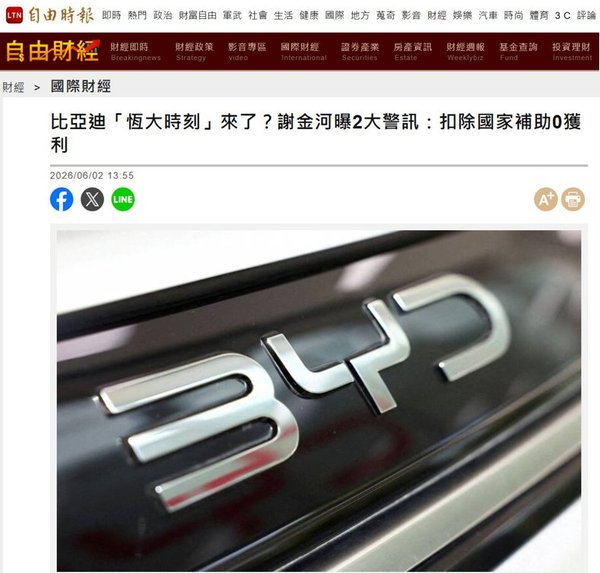
On June 2, Taiwan’s Liberty Times reported shocking developments, stating, "As BYD, China’s top EV maker, faces the dual whammy of tightened supply chain financing regulations and government subsidy cuts, speculation over a potential 'second Evergrande crisis' is mounting." The report added, "Yuan Hsieh Chin-he, Chairman of the Financial Media Group and a prominent figure in Taiwan's business community, asserted on his Facebook page on June 2 that BYD's 'Evergrande Moment' is drawing near."
As reported by the Liberty Times, anxieties within and outside the industry are reaching a tipping point as the world’s leading EV manufacturer encounters comprehensive financial strain. The Financial Times (FT) reported, "BYD's net profit for the first quarter of 2026 plummeted 55.4% year-on-year to 4.08 billion yuan (approx. USD 564 million)," noting that "this marks the sharpest quarterly net profit decline since 2020, a six-year low." The FT further pointed out, "It is not just profitability that has collapsed. Operating cash flow shrank by 67.5% to a mere 2.79 billion yuan, while revenue fell 11.8% to 150.2 billion yuan, marking the third consecutive quarter of negative growth." The structural vulnerabilities that accumulated behind the glamorous growth narrative are finally surfacing in the data.
[The Bare Reality of 'Di Chain' — A Growth Myth Built on 300-Day Accounts Payable]
Regarding BYD's crisis, Bloomberg noted, "At the heart of the BYD crisis theory lies its proprietary supply chain financing system known as 'Di Chain'." Bloomberg explained, "While ostensibly promoted as a tool for supply chain efficiency, it practically functioned by utilizing dealers as interest-free financing vehicles. Upon vehicle delivery, BYD issued internal electronic promissory notes to dealers instead of cash, deferring actual payments for up to 300 days or more. BYD used this interest-free capital to expand its global factories and sustain its aggressive price-cutting wars."
Bloomberg added, "GMT Research, a Hong Kong-based accounting research firm, has long pointed out this structure." GMT asserted, "Regardless of the structure, this is explicitly a form of financing—in other words, hidden debt." Nigel Stevenson, an analyst at GMT, pointed out that "BYD employs sophisticated maneuvers to disguise these liabilities as part of its working capital," even using the expression that BYD has become "addicted" to supply chain financing.
The scale of this hidden debt is staggering. GMT Research stated, "When accounts receivable removed from the balance sheet through sales or collateralization are restored, and payables outstanding for more than 90 days are reclassified as debt, BYD’s actual net debt reached 323 billion yuan (approx. USD 44.6 billion) as of the end of June 2024." This figure is over 11 times higher than the 27.7 billion yuan net debt officially reported by BYD.
According to a April 2024 study conducted by Germany’s Kiel Institute for the World Economy, "BYD has been the largest corporate beneficiary of Chinese state funding, receiving 3.7 billion dollars in direct subsidies between 2018 and 2022 alone. In 2022, this amount accounted for 3.5% of BYD's total revenue."
[Beijing's Gavel — The '60-Day Rule' Shakes Up the Balance Sheet]
Paradoxically, it was the Chinese government that first put the brakes on BYD's supply chain financing practices. Fortune magazine reported, "In March last year, Chinese authorities announced new regulations to protect small and medium-sized enterprises (SMEs), limiting payment settlement periods to within the industry standard of 60 days. The rule bans large corporations from forcing non-cash payments, such as promissory notes, onto smaller suppliers to delay payments." This regulation took effect in June this year.
In relation to this, The Associated Press (AP) reported, "The Ministry of Industry and Information Technology (MIIT) and the China Association of Automobile Manufacturers (CAAM) vowed to curb the unsustainable, hyper-competitive 'involutionary (Neijuan)' price wars. Consequently, 17 automakers, including BYD, signed an agreement pledging to pay suppliers within 60 days." Cui Dongshu, Secretary-General of the China Passenger Car Association (CPCA), explained, "The introduction of the 60-day payment pledge indicates the government’s opposition to involutionary competition. This measure aims to mitigate the risk of an Evergrande-like scenario." The term 'involutionary price war' refers to a phenomenon where companies engage in extreme, self-destructive price dumping and exhausting turf wars to maintain market share, despite severe erosion of profitability and degradation of technological innovation.
Reuters analyzed the impact, stating, "The moment the payment deferral period is slashed from 300 days to 60 days, liabilities previously concealed outside the supply chain will instantly flood back into BYD’s consolidated balance sheet." The shockwaves are already visible in the numbers. As of the end of the first quarter of this year, BYD’s short-term borrowings skyrocketed 72% in just three months to 66.3 billion yuan, signaling that liquidity pressures are becoming a reality.
[Unprofitable Without Subsidies — The Reality of Margins]
Controversy surrounding BYD's true profitability is also intensifying. Hsieh Chin-he, Chairman of Taiwan's Financial Media Group, claims, "BYD received approximately 13.47 billion yuan in government subsidies from Beijing in 2025. Excluding this, BYD practically failed to generate a net profit last year." This claim is largely supported by official statistics. EV-specialized media outlet Electric Vehicles pointed out, "The government subsidies BYD received in 2025 amounted to 12.47 billion yuan, which accounted for 38.2% of its net profit for that year. Without subsidies, more than a third of its earnings would disappear."
[Return of a Year-Old Prophecy — Was the 'Evergrande Moment' a Warning or a Prediction?]
US congressional news outlet The Hill noted, "The 'Evergrande comparison' targeted at BYD had already surfaced on the public stage a year ago." Wei Jianjun, Chairman of Great Wall Motor, warned in a video message posted on social media shortly after BYD aggressively slashed prices on over 20 models: "An 'Evergrande' of the automotive industry already exists; it just hasn't exploded yet." The Hill added, "Two days later, Li Yunfei, BYD's Senior Vice President of Branding and PR, issued a rebuttal stating, 'Frankly, this is confusing, infuriating, and utterly preposterous.' While the controversy was swept under the rug following intervention by China’s State Administration for Market Regulation (SAMR), the warning itself never vanished."
The precedent set by Evergrande highlights the gravity of this warning. Once China’s largest real estate developer and a Fortune Global 500 company, Evergrande imploded in 2021 after Beijing introduced the "Three Red Lines" regulatory framework for property developers in 2020. It subsequently recorded cumulative losses exceeding 800 billion yuan over two fiscal years, leaving behind a total debt of 2.4 trillion yuan—the worst figure in the history of Chinese corporate failures. The core of the analogy is straightforward: a shift in government policy can deal a fatal blow to over-leveraged corporations.
[Has Beijing Stepped Away? — The Implications of Losing Strategic Industry Status]
The most decisive shift lies in the changing attitude of the Chinese government. Reuters reported, "China has excluded New Energy Vehicles (NEVs) from its list of strategic emerging industries in its 15th Five-Year Plan (2026–2030)," noting that "this is the first time such an omission has occurred in 15 years."
Reuters observed, "Experts interpret this decision as a powerful signal that Beijing is effectively bringing the era of heavy subsidies for the EV industry to a close." Dan Wang, Director for China at Eurasia Group, stated, "Excluding EVs from the next Five-Year Plan is an official recognition that the industry no longer requires priority policy support. From now on, the market will dictate the survivors."
China officially terminated its national EV purchase subsidy program at the end of 2022 and plans to phase out purchase tax exemptions progressively by 2027. Experts believe Beijing assesses that the EV sector has sufficiently matured and has decided to leave its further development to market forces.
[Alarm Bells in the Stock Market — Auto Stocks Hit Consecutive Fresh Lows]
Capital markets have already flashed emergency signals. Bloomberg pointed out, "BYD’s annual profit for 2025 recorded negative growth for the first time in four years, and major Chinese EV stocks fell indiscriminately amid plummeting earnings." It added, "Not only BYD, but a wave of Chinese automotive stocks including Xiaomi, Li Auto, Nio, Leapmotor, and Xpeng are consecutively hitting fresh 52-week lows."
An official from the Shanghai financial sector warned, "If overseas sales fail to meet expectations going forward, the rapidly ballooning debt could become a fatal poison to BYD’s cash flow."
In conclusion, the essence of the controversy surrounding BYD is not merely a localized deterioration of corporate earnings. Rather, it serves as a litmus test for whether the Chinese industrial cultivation model—which grew on the three pillars of central government subsidies, local government backing, and supply chain financing—has reached its structural limits.
When Evergrande collapsed, the market did not view it as the isolated failure of a single real estate firm. It was perceived as a crack in the entire Chinese growth model that relies on excessive leverage and state support. The phrase "Evergrande Moment" currently aimed at BYD must be understood within the same context.
If BYD successfully absorbs the dual shocks of subsidy cuts and supply chain financial regulations to demonstrate an independent, sustainable profit structure, the Chinese EV industry could transition into a genuinely mature phase. Conversely, if its overseas expansion falls short of expectations and liquidity pressures intensify, BYD’s crisis is highly likely to be remembered as a symbolic event that exposed the fundamental vulnerabilities of China’s entire manufacturing growth strategy.


-중국 푸단대학교 한국연구원 객좌교수
-전 EDUIN News 대표
-전 OUR NEWS 대표
-제17대 대통령직인수위원회 정책기획팀장
-전 대통령실 홍보기획비서관
-사단법인 한국가정상담연구소 이사장
-저서: 북한급변사태와 한반도통일, 2012 다시우파다, 선거마케팅, 한국의 정치광고, 국회의원 선거매뉴얼 등 50여권