
Update2026.10.24 (토)


1. A New Nuclear Fortress Emerges in Xinjiang: The Reality of China's Nuclear Build-up Revealed
Signs of an unprecedented expansion of nuclear capabilities have been detected in the deserts of northwestern China. Satellite imagery has unveiled a massive strategic complex integrating Intercontinental Ballistic Missile (ICBM) silos, underground bunkers, air defense networks, and communication facilities. Analysts suggest that China has moved beyond mere nuclear deterrence and entered a phase where it seeks to attain a nuclear superpower status on par with the United States. However, this aggressive expansion coincides with deep-seated corruption within the Rocket Force and subsequent purges of military top brass, casting two distinct shadows over China: nuclear proliferation and regime instability.
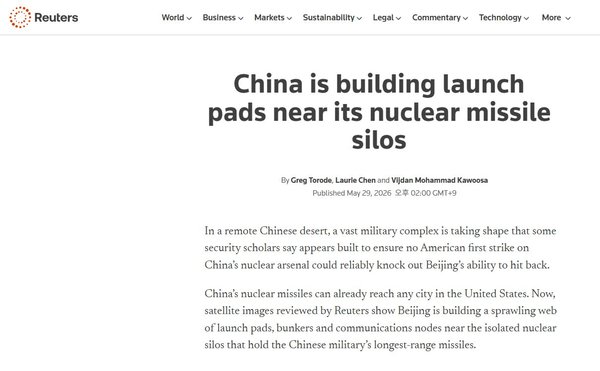
On May 30, Reuters analyzed satellite imagery and reported that "at least three octagonal structural complexes—consisting of launch positions, underground bunkers, and communication hubs—have been identified around nuclear missile silos in a remote desert region of northwestern China." Experts believe these silos are highly likely to house China’s longest-range nuclear missiles.
The scale captured by the satellites is substantial. Over 80 launch platforms have been identified across the Chinese desert, and the octagonal installations are presumed to serve as core hubs for mobile missile units and air defense forces. In particular, two facilities located in eastern Xinjiang are analyzed to function as strategic hubs connected to the Hami nuclear missile base. The interiors of these facilities feature barracks, vehicle depots, armored bunkers, and ammunition storage, all integrated into a logistics network connected via airports and railways. Recent satellite images have also confirmed large-scale military vehicle maneuvers and the deployment of air defense systems.
The discovery sent shockwaves through the nuclear expert community. Hans Kristensen, Director of the Nuclear Information Project at the Federation of American Scientists (FAS), told Reuters, "I've never seen anything like this. It is an unprecedented civil engineering effort." He noted that unlike the U.S. or Russia, China is building its nuclear deterrence by broadly integrating extensive missile defense systems. Alexander Neill, an analyst at the Pacific Forum, a Hawaii-based think tank, also diagnosed that "China is visibly strengthening its strategic nuclear forces by building infrastructure spanning thousands of square kilometers."
2. ICBMs in Xinjiang, China, Targeting the US Mainland
Reuters analyzed that "China has clear geostrategic calculations in making Xinjiang a concentrated deployment zone for its strategic nuclear forces." Situated deep within the inland region of northwestern China, Xinjiang is evaluated as a relatively safe strategic depth.
Military commentator Mark noted, "China’s continued construction of missile launch bases in its western region is, in effect, an expansion of its land-based ICBM capabilities targeting the U.S. mainland." He explained that "ICBMs launched from Xinjiang can secure the shortest flight path to the U.S. mainland by utilizing the Arctic route."
Driven by this strategic value, the pace of silo construction is accelerating. U.S. satellite imagery analysis estimates that China is constructing more than 200 new ICBM silos in Gansu Province and the Hami region. In some areas, training facilities simulating U.S. and Taiwanese targets have also been discovered.
3. Silo Count Alone Does Not Tell the Full Story of Nuclear Capability
However, experts caution against drawing definitive conclusions about China's actual nuclear capabilities solely based on the scale of the facilities seen in satellite images. Shen Ming-shih, a research fellow at Taiwan’s Institute for National Defense and Security Research (INDSR), pointed out, "The presence of a silo does not necessarily mean a missile is deployed inside, and even if a missile is present, we cannot verify whether it is armed with a nuclear warhead." He emphasized that nuclear operations inherently involve deception and concealment.
Military commentator Mark also leaned toward the possibility that "the octagonal facilities might be long-term logistical support bases rather than staging areas for mobile missile launchers." He added, "Given that China's existing missile units have historically maximized stealth by utilizing underground facilities and railway networks, deploying a large number of launch vehicles long-term in an exposed desert space deviates somewhat from their established operational doctrines."
4. The Naked Face of Corruption: Missiles Filled with Water Instead of Fuel
Yet, China’s nuclear ambitions are clashing with structural corruption within its military. Citing U.S. intelligence assessments from last year, Bloomberg News reported that "corruption is rampant within the Chinese Rocket Force and across the broader defense industry, with findings indicating that some missiles were filled with water instead of fuel, and the hatches of certain missile silos failed to function properly."
Lyle Morris, a senior fellow at the Asia Society Policy Institute (ASPI) in New York, analyzed that two conditions must simultaneously coexist for situations like water-filled missiles or malfunctioning silo hatches to occur. "First, there are the top-down mandates from Xi Jinping pressing to meet military modernization goals by 2027, and second, there is the pervasive culture of corruption within the Chinese military," he pointed out. He admitted that while he previously downplayed the impact of corruption on combat readiness, "if these reports are true, a wholesale re-evaluation is inevitable," revising his prior assessment.
This issue is viewed as a structural crisis rather than a short-term anomaly. In July 2023, the leadership of the Rocket Force underwent a de facto total overhaul, with the sudden ousting of Commander Li Yuchao and Political Commissar Xu Zhongbo. Furthermore, in September 2025, five out of six military leaders personally tapped by Xi Jinping—including General Zhang Youxia, the first vice-chairman of the Central Military Commission and the second-highest-ranking official in the Chinese military—were purged. The Wall Street Journal (WSJ) reported that "Zhang Youxia was also accused of leaking core technological data on nuclear weapons to the United States." The fact that classified nuclear weapon secrets may have been leaked to an adversary amid an ambitious nuclear expansion vividly demonstrates the severity of the internal corruption and fractures within the Chinese military.
5. Are Nuclear Weapons Xi Jinping’s "Regime Insurance Policy"?
China's nuclear build-up carries political significance that transcends mere military strategy. The Taejae Research Foundation analyzed that through its nuclear capabilities, China is expressing a desire to be recognized by the United States as an 'equal superpower.' Professor David C. Logan, a leading young scholar in U.S. nuclear security and Sino-American relations, also pointed out that China views nuclear weapons not just as a tool for deterrence, but as a symbol of national status.
The problem is that this nuclear expansion is intertwined with domestic instability. Amid an economic slowdown, a real estate crisis, high youth unemployment, and ongoing military purges, ramping up nuclear capabilities serves as a political mechanism for Xi Jinping to project an image of a 'Strong China.' Indeed, China is continuing its massive infrastructure expansion to rapidly close the nuclear capability gap with the U.S. and Russia.
Ultimately, China’s obsession with nuclear weapons is interpreted as a confluence of international status-seeking, regime consolidation, and Xi Jinping’s personal historic ambitions. The challenge is that these goals do not necessarily align with the stability of the international nuclear order.
Researcher Shen Ming-shih warned, "Just because nuclear deterrence is maintained does not mean the danger disappears." He noted, "Nuclear weapons always carry the inherent risks of miscalculation, malfunctions, and the escalation of localized conflicts. As mutual distrust deepens, the arms race will only accelerate."
What China is constructing in the Xinjiang desert is not merely a collection of missile bases. It is closer to a concrete manifesto signaling that the strategic competition with the United States has entered a protracted war of attrition. The paradox is that this nuclear build-up stems not from confidence, but from regime anxiety and a desperate need for power retention.
Historically, arms races have often been aggressively driven not by robust states, but by insecure ones. The Soviet Union was a prime example, and its military expansion during the late Cold War was deeply intertwined with attempts to mask internal crises.
What satellites captured in the Xinjiang desert today is more than just silos and bunkers. It is a massive, physical manifestation where geopolitical rivalry with the U.S., a faltering economy, internal military corruption, and Xi Jinping's personal historic ambitions converge. And as this structure grows, so too does the strategic uncertainty that the world must confront.

-중국 푸단대학교 한국연구원 객좌교수
-전 EDUIN News 대표
-전 OUR NEWS 대표
-제17대 대통령직인수위원회 정책기획팀장
-전 대통령실 홍보기획비서관
-사단법인 한국가정상담연구소 이사장
-저서: 북한급변사태와 한반도통일, 2012 다시우파다, 선거마케팅, 한국의 정치광고, 국회의원 선거매뉴얼 등 50여권