
Update2026.10.24 (토)

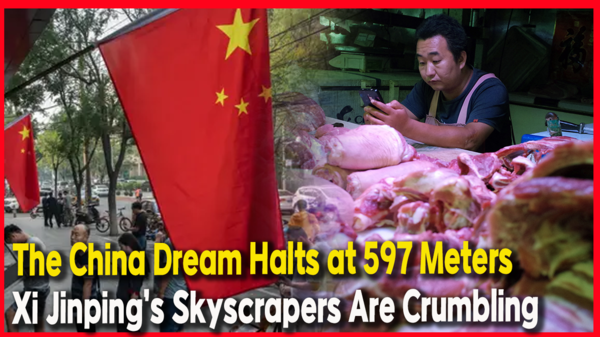
["Can't Even Cover Feed Costs": Pig Farming on the Verge of a Domino Collapse]
As Chinese pork prices plummet to their lowest levels in 16 years, millions of pig farming households are being pushed to the brink of survival. The crux of the issue is that this is not merely a cyclical downturn in the livestock industry. In China, pork serves as the most direct core indicator of inflation, consumer spending, and, by extension, public sentiment. With oversupply and a consumption slump striking simultaneously amidst broadening deflationary pressures, the collapse of pork prices has emerged as a stark symbol of the economic and social instability confronting the Xi Jinping administration.
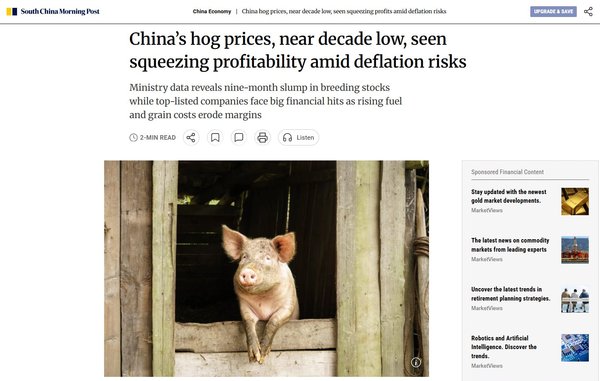
On May 27, the South China Morning Post (SCMP), citing data from China’s Ministry of Agriculture and Rural Affairs, reported that "even though live hog prices rebounded by 15% from a 10-year low in mid-April, they still stand at a mere 10.12 yuan (approximately $1.40) per kilogram, representing a staggering 32.2% plunge compared to the same period last year."
As the price collapse protracts, entire regional economies have begun to fracture. A wave of bankruptcies has already swept through small-scale farmers, and mid-sized operations are finding it increasingly untenable to hold out. Outcries are rampant across the frontlines: "When prices drop, the burden of feed costs forces us into early slaughtering. This surge in slaughtering drives up supply even further, triggering a vicious cycle of compounding price declines that shows no signs of stopping."
['Zhu Liang An Tian Xia': Pork as the Barometer of the Chinese Regime]
The reason this crisis cannot be dismissed as a routine fluctuation in agricultural commodity prices is that pork functions as a political barometer rather than a mere dietary ingredient in China. China alone accounts for half of global pork consumption. The fact that a nation comprising only 18% of the world's population consumes 50% of the world's pork illustrates how deeply integrated this meat is with the daily lives of the Chinese people. Just as the Chinese character for 'home' or 'family' (家) is etymologically derived from a pig (豕) sheltered under a roof (宀), the pig represents the very symbol of livelihood and civilization to the Chinese populace.
The ancient aphorism "Zhu Liang An Tian Xia" (猪糧安天下)—meaning "pork and grain secure peace under heaven"—is far more than a colorful proverb. It is the primary principle of statecraft derived from millennia of governance by China's rulers, and its weight is verified by hard data. Food accounts for 30% of China’s Consumer Price Index (CPI), and within that category, pork alone commands a weighting of approximately 9%. For a single item to constitute nearly 10% of the entire CPI basket is unprecedented globally. For this reason, foreign media frequently refer to China’s CPI as the 'China Pig Index.' The number of individuals employed in pork-related industries is estimated to exceed the combined population of North and South Korea.
History has already demonstrated how ruthlessly this formula operates. When the African Swine Fever (ASF) epidemic swept the nation in 2019–2020, decimating the pig population, pork prices skyrocketed by more than 100% within a single year. As monthly consumer inflation breached the 5% threshold, public discontent boiled over, and resentment toward the Chinese Communist Party (CCP) spread rapidly. It is historically evident that a surge in pork prices transcends economics to become a volatile political issue that agitates public sentiment and can even destabilize the regime. Today, the vector is reversed: prices are collapsing. Yet, the gravity of the fallout is no less severe, as the livelihoods of millions of farmers disintegrate and consumer confidence freezes further.
[State-Driven Glut: The Distorted Legacy of the African Swine Fever Response]
Paradoxically, the current price collapse is a structural catastrophe born out of the Beijing authorities' aggressive overcorrection to past price spikes. Following the nationwide spread of ASF in 2018–2019, the hog inventory cratered from 428 million heads in 2018 to 310 million heads in 2019. Domestic pork production plummeted by 21% in 2019 alone, a shockwave that translated into a gross domestic product (GDP) loss of 0.78% (Nature Food, 2021). While imports were scaled up drastically, they failed to cover even one-fifth of the domestic supply deficit.
Beijing did not stop at stabilization; instead, it doubled down. Applying Xi Jinping’s doctrine of agricultural self-reliance—originally meant for grain—to the livestock sector, the state actively incentivized the construction of massive, multi-story hog farming facilities and flooded the sector with subsidized loans. The 26-story 'pig building' erected in Ezhou, Hubei Province, became the monumental symbol of this policy. Consequently, by 2022, the national inventory rebounded to peak levels: 452.56 million hogs raised, 699.95 million slaughtered, and 55.41 million tons of pork produced. However, at the exact moment these industrial factories reached full operational capacity, Chinese consumer sentiment was already cooling down.
The results were disastrous. The state-mandated expansion of supply collided head-on with a severe contraction in consumption, driving pork prices past 8-year lows and crashing into a 16-year trough. In essence, farmers fell into an oversupply trap engineered by the CCP itself. The paradox where the deepest recession commenced precisely when the state-led mass-production system reached fruition lays bare the structural limitations of China’s economic governance.
[Triple Shock of Demand Collapse: The Disappearance of Construction Sites, Dining Out, and Bureaucratic Banquets]
The fundamental reason pork prices fail to rebound despite hitting rock bottom is the systemic unraveling of the demand base itself. Hannah Liu, a China economist at Nomura, noted in an interview with the New York Times that "construction workers and restaurant diners are the top two consumer segments for pork," diagnosing that "the simultaneous collapse in spending across both groups is precipitating a sharp contraction in overall demand."
The first shock stems from the protracted real estate crisis. Following an 8% decline in China’s new home sales area in 2024, a further decline appears inevitable through 2025 (according to analysis by Macquarie). As construction projects dried up, the pockets of migrant laborers emptied, delivering a direct blow to the pork demand traditionally sustained by this demographic in the affordable dining sector.
The second shock is the overarching contraction in food and beverage consumption. According to data from the Chinese catering platform Canyin 88, per-capita spending among restaurant patrons has dropped markedly compared to several years ago.
The third shock is the near-total evaporation of the banquet culture within the bureaucracy. Official banquets, which were once a matter of routine administrative practice, have been drastically curtailed, with some local governments going so far as to ban civil servants from dining in groups of three or more. Given that restaurants serve as a primary commercial channel for pork distribution, the simultaneous erosion of these three major demand pillars has become a structural barrier rendering price recovery nearly impossible.
Compounding this is the stubbornly high youth unemployment rate, anxiety over a fracturing pension system, and the psychological conditioning of a multi-year deflationary environment, all of which are paralyzing the spending psychology of Chinese households. China's National Bureau of Statistics announced that the annual CPI for 2025 recorded 0% year-on-year growth, indicating that the vast majority of economic sectors have been languishing under deflationary pressures for years.
The SCMP observed that "while a drop in pork prices should theoretically boost household purchasing power, it is instead culminating in the collapse of rural incomes and the exacerbation of an overarching downward price environment rather than a boost in consumption," diagnosing this as "a textbook signal of a deflationary trap."
[The Fallout of the Pork Crisis: Ultimately Converging on Politics]
The tremor radiating from the pork market today extends far beyond the realm of economics. Its vibrations are already permeating the fabric of Chinese society and possess a high probability of converting into a political shockwave that challenges the governance legitimacy of the CCP.
The economic fallout alone is severe. As of April 2026, food prices declined by 1.6%, and the CPI grew by a mere 1.0%, indicating that deflationary pressures remain firmly entrenched. The ING think tank analyzed that "unless the pork price cycle undergoes a fundamental reversal, escaping the deflationary trajectory will remain elusive." Even more alarming is the social impact. It is not merely a price tag that is collapsing; the livelihoods of millions of pig farmers and workers in ancillary industries are unraveling in tandem. Given that the workforce associated with this industry exceeds the entire population of the Korean Peninsula, this crisis delivers a direct blow to the survival base of tens of millions of people. Farmers with diminished incomes pull back on spending, further depressing the economy in a textbook deflationary spiral that is spreading nationwide.
The political ramifications represent the most hazardous domain. The analytical firm SinoInsider assessed that "the political, economic, social, and diplomatic challenges confronting Xi Jinping and the CCP will intensify through 2026," warning that "if the party fails to adequately address accumulating domestic grievances, the adaptive capacity of the regime itself may reach its structural limits." Similarly, Foreign Policy evaluated that "the stability of the CCP relies on a fragile architecture predicated on adaptive resilience rather than durable legitimacy."
What the Chinese Communist Party fears most is neither a stock market correction nor a slump in property values; it is a shift in public sentiment. And in China, public sentiment has historically been animated first and foremost by the cost of the dinner table.
The collapse in pork prices is not an isolated crisis of the livestock sector. It is the nexus where the property slump, consumption contractions, youth unemployment, and local government fiscal distress intersect. What makes it increasingly dangerous is that Beijing finds itself in a position where it can no longer deploy massive stimulus packages to spend its way out of the problem as it did in the past.
Ultimately, the core challenge facing China is not the nominal price of pork itself. The real issue is the demand collapse, deflation, and slowing economic growth that the pork price mirrors. China’s ancient political maxim, "Zhu Liang An Tian Xia," remains entirely valid today. When the dinner table is destabilized, it is not just the market that trembles—public sentiment wavers, and when public sentiment wavers, the stability of the regime is put to the test. Today, the price of pork in China is no longer a mere commodity quote; it has become the most sensitive political-economic metric gauging the structural health of the Xi Jinping regime.


-중국 푸단대학교 한국연구원 객좌교수
-전 EDUIN News 대표
-전 OUR NEWS 대표
-제17대 대통령직인수위원회 정책기획팀장
-전 대통령실 홍보기획비서관
-사단법인 한국가정상담연구소 이사장
-저서: 북한급변사태와 한반도통일, 2012 다시우파다, 선거마케팅, 한국의 정치광고, 국회의원 선거매뉴얼 등 50여권