
Update2026.10.24 (토)

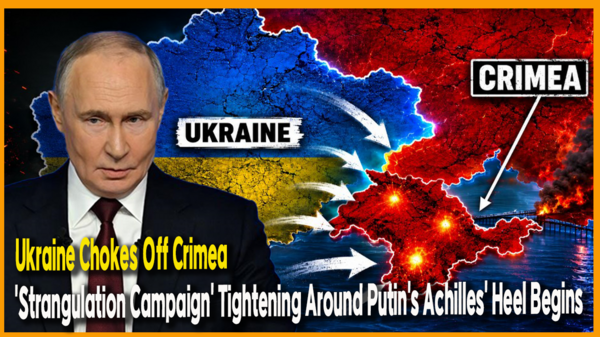
[Severing Bridges, Blocking Fuel… Strategy to Make Crimea an 'Ununtenable Land']
Ukraine has launched a full-scale "strangulation campaign" designed to render the Crimean Peninsula completely untenable for Russia. The objective extends beyond simple territorial liberation. By systematically dismantling the land and sea supply networks leading into Crimea, Ukraine aims to collapse the Russian military’s capacity to wage war, ultimately forcing the Kremlin to contemplate a unilateral withdrawal. Over recent months, Ukraine’s attack patterns have completely shifted from targeting frontline troops to prioritizing rear logistics networks and command structures.
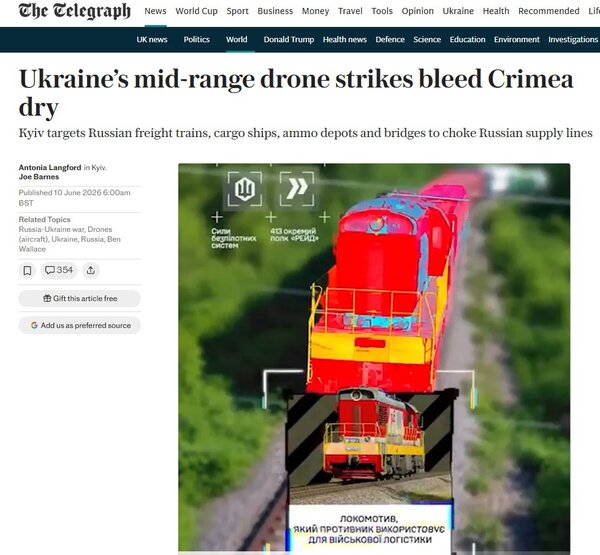
On June 11, the UK's Telegraph reported, "Entering the fifth year of the war, Ukraine is changing the grammar of the conflict. Instead of frontal breakthroughs, it is adopting a strategy of severing the enemy's arteries, systematically destroying the bridges, railways, ports, and fuel depots connecting the Crimean Peninsula to the Russian mainland." The Telegraph evaluated this as a campaign that "could become the most critical turning point of the war this year."
In fact, Ukraine’s deep-strike operations are increasing exponentially. The Telegraph revealed, "Ukraine has nearly quadrupled its attacks on Russian military logistics facilities, command posts, fuel depots, and ammunition dumps located 30 to 180 km behind the front lines, surging from a monthly average of 41 in January to 160 in April this year." The Institute for the Study of War (ISW) analyzed this trend, noting that it is "already generating battlefield effects and will evolve into a more mature form moving forward."
As a result, the Russian military has been forced to relocate major logistical hubs more than 120 km behind the front lines. This is not a mere relocation; it signifies a fundamental degradation in Russia's ability to supply troops, ammunition, and fuel. As Ukraine heavily degrades Russian air defense networks, these deep rear strikes are becoming increasingly frequent and audacious.
Atesh, a Crimean-based Ukrainian resistance organization, recently claimed, "Some Russian units on the Kinburn Spit—a strategic chokepoint at the mouth of the Dnipro River—are abandoning their positions due to severe supply shortages." This indicates that the logistics network is collapsing ahead of the actual front lines.
[71% of Supply Vehicles Vanish… Crimea’s Crisis by the Numbers]
The most symbolic target within Ukraine’s Crimean blockade strategy is the Chonhar Bridge. The New Voice of Ukraine reported, "In the early hours of June 7, Ukraine’s 1st Independent Assault Regiment and 475th Independent Assault Regiment struck the Chonhar Bridge using FPV drones and the new Behemoth kamikaze drones, which boast a 300-km range."
This bridge serves as the critical node for the R-280 highway, which runs from Rostov-on-Don in Russia through occupied Donetsk and into the Crimean Peninsula. For the Russian military, it is a literal lifeline transporting troops, fuel, and ammunition to forces stationed in Crimea.
The strike was not a one-off event. Volodymyr Saldo, the Russian-appointed occupation head of the Kherson region, acknowledged on June 9 that "the Chonhar Bridge was damaged again by a Ukrainian drone attack," advising commuters to use detour routes. This detour is known to extend transportation distances by approximately 130 km.
However, the true impact is revealed in the numbers. Robert Brovdi (callsign 'Madyar'), commander of Ukraine’s Unmanned Systems Forces, stated, "Since June 7, the Russian military has restricted major military transport heading into Crimea. The number of military supply vehicles bound for Crimea plummeted from approximately 3,800 to 1,100 per day." This represents a staggering 71% evaporation in just two weeks.
Total traffic volume also dropped from 11,000 to 6,500 vehicles per day. Kyrylo Budanov, head of Ukraine’s Main Directorate of Intelligence (HUR), assessed the situation: "The attacks on the Crimean land corridor constitute a systematic operation. It is severely complicating the Russian military’s operational plans for the southern front."
[Russian Vessels Ablaze at Sea]
While land supply routes are being choked, Russia is suffering consecutive blows at sea. The Kyiv Independent reported, "On the night of June 4, Ukrainian forces attacked a Russian Project 10410 Svetlyak-class border patrol boat in the Sea of Azov." Video footage released by the Alpha special forces unit of the Security Service of Ukraine (SBU) also captured separate drone strikes targeting a Svetlyak-class patrol boat and a Buyan-class small corvette.
Ukrainian military media outlet Defense Express pointed out, "The Svetlyak-class vessel had its mast—where radar and communications equipment are concentrated—destroyed, while the Buyan-class vessel's superstructure was entirely engulfed in flames, effectively rendering it combat-ineffective."
While Russia has already withdrawn the bulk of its Black Sea Fleet to Novorossiysk, these latest actions demonstrate that even the Sea of Azov and the waters surrounding Crimea are no longer safe havens.
["No Choice But to Buy Horses"… Collapse of Civil Life in Crimea]
The ripple effects of the blockade are spilling past military domains into civil society. The Telegraph reported, "Since June 4, Russian occupation authorities have halted cash sales of gasoline and implemented a restricted rationing system via coupons. Residents are limited to purchasing just 20 liters at a time." In interviews with independent media, residents of Simferopol lamented, "Previously, you could buy gasoline at any gas station, but now it’s difficult even if you have coupons."
An even more striking testimony emerged. The Telegraph quoted a local resident who stated, "People are hoarding not just fuel, but groceries. I walk to work now. Someone even joked that all that's left to do is buy a horse."
The region is also plagued by a collapse in tourism and widespread food shortages. Hotel bookings in Crimea have plummeted, and shortages of basic staples like rice, pasta, and buckwheat have been reported in several districts. Ultimately, even the Russian Ministry of Energy conceded on June 8 that "temporary disruptions in fuel supply have occurred due to increased enemy aerial attacks."
[10km from Moscow… Death of the Ammunition Logistics Chief]
As the Crimean blockade peaked, Ukrainian strikes reached deep into the Russian heartland. The New York Times (NYT) reported, "In the early hours of June 9, Damir Davydov, Chief of the Missile and Artillery Supply Directorate under the Russian Ministry of Defense, was killed in a car explosion in Balashikha, on the outskirts of Moscow." The NYT added, "Russian independent media analyzed that this incident was highly likely a covert operation by the Security Service of Ukraine (SBU)." Davydov was known as a key figure overseeing the overarching supply of ammunition for the Russian military.
The symbolism of this incident goes beyond simple assassination. It signals that Ukraine is no longer just hitting logistics networks on the front lines, but is now actively targeting the high-level personnel who orchestrate them.
[Backed into a Corner, Russia Brandishes the 'Nuclear Card' Once More]
The severity of Russia's predicament is reflected in its response pattern. Faced with fracturing supply chains in Crimea and immense pressure on its rear command structures, Moscow is falling back on nuclear threats rather than conventional counteroffensives. Dmitry Medvedev, Deputy Chairman of the Security Council of Russia—an ultra-hardliner notorious for making erratic, inflammatory claims—cited an alleged Ukrainian attack on the Zaporizhzhia Nuclear Power Plant on May 30, warning of "symmetrical strikes against Western nuclear plants" if Russian facilities were compromised.
"If a nuclear power plant is destroyed, it will trigger symmetrical strikes not only on Ukrainian nuclear plants but also on those in NATO countries." — Dmitry Medvedev
However, experts analyze that the increasing frequency of this nuclear rhetoric actually betrays a degradation in Russia's strategic confidence. The Foundation for Defense of Democracies (FDD), a U.S. think tank, assessed: "Putin understands that the threat of nuclear weapons can yield more potent political leverage than their actual use, and he has consistently exploited this dynamic."
[Analysis: "Make Crimea Untenable"… The Blueprint for Liberation]
The overarching Ukrainian strategy driving these synchronized movements is surprisingly straightforward: do not rush a physical recapture of Crimea right now; instead, make it impossible for Russia to sustain its occupation.
In an interview with The Telegraph, former British Defense Secretary Ben Wallace stated, "To bring Putin to the negotiating table, you have to make him believe he has something to lose. If you make maintaining the occupation of Crimea untenable, Putin will be forced to face reality."
Ultimately, the developments unfolding in Crimea are not isolated drone strikes or random sabotage. Before Ukraine successfully liberated Kherson in 2022, it deployed an identical playbook—severing bridges and supply routes to isolate Russian forces. Left with no viable alternatives, Russia was forced to execute a massive retreat.
Today's Crimea is increasingly mirroring yesterday's Kherson. Bridges are being cut, supply vehicle traffic has plummeted by 71%, fuel is rationed, warships are burning, and logistics chiefs are being eliminated. These are not disparate events; they are a chain of operations moving under a singular blueprint.
Ukraine's ultimate goal is not a bloody storming of Crimea, but rather imposing a cost that Russia simply cannot afford. If current trends persist, the summer of 2026 may well be recorded by future historians as "the moment Russia began to lose Crimea."


-중국 푸단대학교 한국연구원 객좌교수
-전 EDUIN News 대표
-전 OUR NEWS 대표
-제17대 대통령직인수위원회 정책기획팀장
-전 대통령실 홍보기획비서관
-사단법인 한국가정상담연구소 이사장
-저서: 북한급변사태와 한반도통일, 2012 다시우파다, 선거마케팅, 한국의 정치광고, 국회의원 선거매뉴얼 등 50여권