
Update2026.10.24 (토)

[Moving Past Real Estate: The 'New Three' Growth Strategy Faces a Litmus Test]
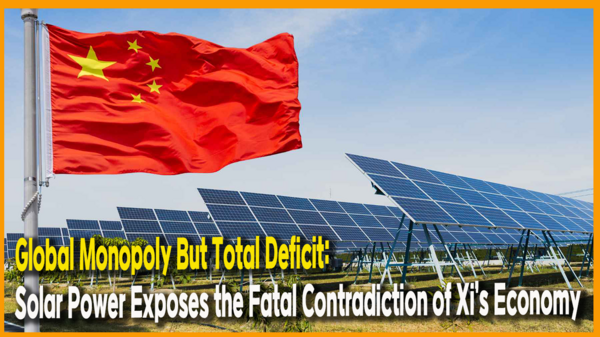
The "New Three" industries—electric vehicles (EVs), batteries, and solar power—which China aggressively cultivated by mobilizing national resources following the real estate collapse, are shaking one after another. With the solar industry, once pinned as the ultimate growth engine, now mired in collective deficits and mass layoffs, the very foundation of Xi Jinping’s economic strategy is being put to the test. The issue is not a simple industry downturn; the real problem is that no alternative growth model is in sight to sustain the post-real estate economy.
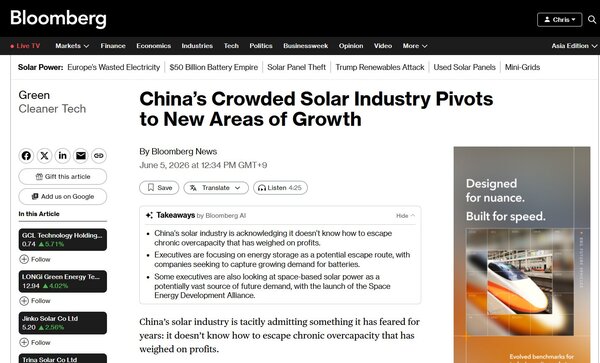
On June 6, Bloomberg reported, "The world’s largest solar exhibition, SNEC 2026, was held in Shanghai in early June," adding that "Chinese solar manufacturers have been stuck in a quagmire of losses for more than two years due to endless competition and overcapacity." Bloomberg further noted, "The most frequently mentioned topic among executives at the exhibition was not new technology, but escape routes into alternative businesses such as batteries and space-based solar power." This implies that even Chinese companies, which virtually monopolize the global market, have conceded that their current business model is unsustainable.
Caixin, a Chinese economic media outlet, also commented, "The atmosphere at the exhibition hall mirrors the reality facing the Chinese solar industry." It added, "The Chinese solar sector has been trapped in a brutal price war triggered by chronic overcapacity since 2023. The combined losses of listed solar companies in 2025 are estimated to exceed 50 billion yuan (approx. $7.3 billion or 10 trillion won)." It is a paradox where an industry dominating the global market stands simultaneously on the brink of mass bankruptcy. However, this crisis is not confined to solar alone; at a deeper level lies a structural self-inflicted wound inherent in China's economic growth model.
[A National Project Aimed at Filling the Void of the Property Collapse]
The reason Beijing bet everything on the solar industry was clear. Triggered by the Evergrande crisis in 2021, the real estate market—the core engine of Chinese economic growth—began to crumble. As the land development and property-centered growth model that had sustained the Chinese economy for decades hit its limit, Beijing had to search for a new economic driver.
Reuters analyzed, "China heavily channeled capital and policy capacity, evacuated from the sinking real estate sector, into the 'New Three' industries represented by EVs, batteries, and solar power."
Indeed, this strategy yielded short-term results. A joint analysis by the UK-based climate research organization Carbon Brief and the Center for Research on Energy and Clean Air (CREA) revealed, "In 2025, China's clean energy industry generated 15.4 trillion yuan in value-added, accounting for 11.4% of China's GDP." More notably, the analysis pointed out, "Without the clean energy industry, China's economic growth rate would have hovered around 3.5% rather than the official target of 5%." Ultimately, the New Three industries were not just promising sectors, but virtually the final line of defense propping up China’s GDP growth.
[After EVs and Batteries, Solar is Next: The Domino Effect of Overcapacity]
However, the problem remains that the Chinese style of growth has not changed. Once the central government designates a strategic industry, state-owned banks flood it with capital, and local governments competitively race to invest. Consequently, a massive influx of companies leads to an exponential surge in production facilities, ultimately culminating in supply gluts.
The South China Morning Post (SCMP) described the overall situation of China's new energy industry as an intensification of "Neijuan" (Involution). In this context, involution refers to a hyper-competitive, cannibalistic price war where companies proliferate and consume one another despite a stagnant market.
The EV industry fell into this trap first. As price wars intensified in both domestic and international markets, profitability deteriorated sharply. The battery industry is under similar pressure. Now, that exact crisis is spreading to the solar sector.
Regarding this, the Center for Strategic and International Studies (CSIS) stated in a report in March this year, "China dominates the solar supply chain to a staggering degree." It noted that as of 2024, China accounted for 93.2% of global polysilicon production, 96.6% of wafers, 92.3% of solar cells, and 86.4% of solar modules. The catch is that despite conquering the world, they are not making any money.
[1,200 GW vs. 650 GW: Supply Tsunami Triggers Price Collapse]
The crisis of the Chinese solar industry is symbolically captured by two figures. In 2025, China’s solar panel production capacity reached approximately 1,200 GW. Conversely, global demand for new installations in the same year was only around 650 GW. Production capacity doubled global demand.
Reuters pointed out, "Double the amount of solar panels the entire world uses annually is being produced, and the vast majority of them are manufactured in China." The inevitable outcome was a total price collapse.
According to CSIS, "Solar module prices dropped by nearly half over the course of 2023 and fell even further in 2024," while "the price of polysilicon, a core raw material, plummeted by over 70% in just two years." Citigroup analyzed that current solar module prices have fallen below the break-even point for most companies. A structural deficit—where the more you sell, the more you lose—has become entrenched across the industry.
[10 Trillion Won Deficit, 87,000 Layoffs: A Collective Crisis of Survival]
The damage is clearly reflected in corporate earnings. Caixin highlighted, "Tongwei, the world’s largest producer of polysilicon and solar cells, recorded a loss of up to 10 billion yuan in 2025, following a 7 billion yuan loss the previous year." It added, "Wafer giant TCL Zhonghuan and module leader Trina Solar also announced multi-billion yuan losses."
Furthermore, Caixin stated, "Major players including LONGi, TCL Zhonghuan, and Trina Solar reported deficits worth billions of yuan. In particular, LONGi, China’s largest solar wafer producer, shocked the industry by posting massive losses for two consecutive years."
The job market is reeling as well. An analysis of corporate regulatory filings by Reuters showed, "Five major companies—LONGi, Trina Solar, JinkoSolar, JA Solar, and Tongwei—laid off approximately 87,000 workers over the course of 2024." For the Chinese government, which prioritizes maintaining social stability above all else, this is a signal that cannot be taken lightly.
[Even Xi Jinping Stepped In, Yet Overcapacity Unleashed Continues]
Beijing is not blind to the issue. Reuters reported, "Major polysilicon companies went as far as discussing the formation of an 'OPEC-style coalition' to regulate production volumes and cut supply," and "President Xi Jinping also publicly instructed last year to 'put an end to disorderly price competition'."
Yet, the reality on the ground was quite the opposite. Some enterprises ignored production quotas and expanded their factories, while local governments turned a blind eye to maintain tax revenues and employment. While the central government orders production cuts, local governments build more factories. The core of China’s solar crisis lies precisely within this structural contradiction.
[The Bare Face of the 5% GDP Target: If Solar Falters, Growth Plummets]
Caixin warned, "In the solar sector, due to the introduction of a new power market pricing system and a sharp deceleration in installations, we cannot rule out the possibility that this sector could reverse into a drag factor, negatively contributing to future GDP growth." This means the grim reality where a growth engine turns into an economic burden could materialize.
Bloomberg also projected that "China's new solar installations in 2026 will decrease by 14% compared to the peak in 2025," analyzing it as "a complex result of market saturation, manufacturing overcapacity, and the power market's transition toward a competitive pricing system." S&P Global Commodity Insights warned, "China's annual solar installations will plummet from around 300 GW in 2025 to about 200 GW in 2026," adding, "Given that China has accounted for 50% of global solar installations over the past decade, this slowdown will send deep shockwaves through the entire global energy transition."
[The Essence of the Solar Crisis: Not the Industry, But the Growth Model]
The crisis rocking the solar industry is more than just a typical cyclical downturn. It serves as a glaring signal that the state-driven growth model China has replicated for the past two decades has reached its structural limits.
When real estate collapsed, China designated EVs, batteries, and solar as its new growth engines. However, when the state dictated the direction, finance flooded in, and local governments raced to invest, the script played out identically: overcapacity.
The problem now is that no backup plan is visible. If the New Three industries, chosen to replace real estate, simultaneously lose profitability, the Chinese economy will have no choice but to rely on debt and subsidies once again just to artificially sustain its growth rate.
Caixin is already warning of the potential for the solar industry to yield a 'negative contribution' to China's future GDP growth. Bloomberg and S&P Global have similarly forecasted a sharp decline in China's new solar installations for 2026.
Ultimately, the essence of the solar crisis is not the deficit of a single sector. It is the first genuine litmus test of whether the "Manufacturing Rise" strategy, offered by Xi Jinping as the post-real estate solution, can sustainably prop up the Chinese economy.
If China, having successfully monopolized the global solar market, cannot turn a profit, what is fracturing right now is not merely the solar industry. It may well be the myth of Chinese economic growth itself.


-중국 푸단대학교 한국연구원 객좌교수
-전 EDUIN News 대표
-전 OUR NEWS 대표
-제17대 대통령직인수위원회 정책기획팀장
-전 대통령실 홍보기획비서관
-사단법인 한국가정상담연구소 이사장
-저서: 북한급변사태와 한반도통일, 2012 다시우파다, 선거마케팅, 한국의 정치광고, 국회의원 선거매뉴얼 등 50여권