Update2026.10.24 (토)


[U.S. Rushes Thousands More Troops to Pressure Iran]
As Washington and Tehran exchange positions over a second ceasefire negotiation, the United States is ramping up pressure to unprecedented levels by deploying more than 10,000 additional troops—including an aircraft carrier—to the Middle East. At the same time, Washington is intensifying what it calls an “economic wrath” campaign against Iran. Faced with this show of force, China has pledged to stop supplying weapons to Iran, signaling a clear retreat.
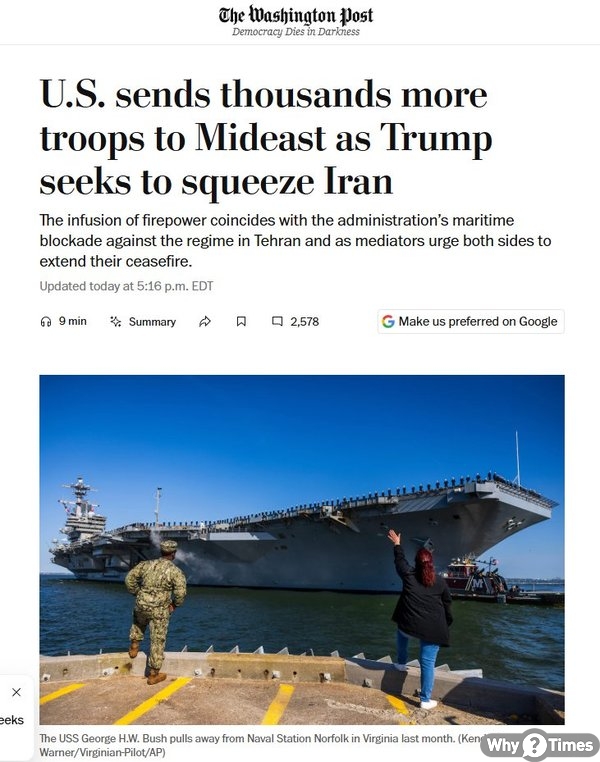
The Washington Post reported on the 16th that Donald Trump ordered the deployment of several thousand additional troops to the region to increase pressure on Iran. The Pentagon plans to send roughly 6,000 personnel aboard the aircraft carrier USS George H.W. Bush and accompanying vessels within days, while another 4,200 troops—including an amphibious ready group centered on USS Boxer and the 11th Marine Expeditionary Unit—are expected to arrive later this month.
According to the report, the U.S. currently operates about 50,000 troops globally in response to Iran. The timing of this deployment is closely linked to the expiration of a two-week ceasefire agreement between the two countries on April 22. Possible operations under discussion include special forces missions to secure Iranian nuclear materials, as well as amphibious assaults to reopen the Strait of Hormuz and seize Kharg Island.
[Maritime Blockade and “Economic Wrath” Intensify Simultaneously]
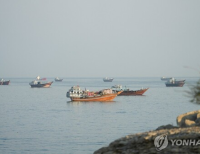
Alongside military escalation, economic pressure is also being strengthened. On the 13th, President Trump formally declared a military blockade of all maritime traffic entering and leaving Iranian ports. More than ten U.S. Navy vessels have since been deployed in the Gulf of Oman and the Arabian Sea, effectively blocking ships attempting to exit the Strait of Hormuz.
According to U.S. military officials, ten vessels have already turned back since the measure took effect. Just a day earlier, an Iranian-flagged ship attempting to pass through the strait was forced to reverse course by the U.S. destroyer USS Spruance.
Reports in South Korea claimed that a Chinese tanker had broken through the blockade, but this was later proven false. The tanker Rich Starry ultimately failed to pass and turned back toward Iranian waters.
The United States Central Command confirmed in a statement on the 15th that no vessels departing Iranian ports had successfully transited the Strait of Hormuz during the first 48 hours of the blockade. Nine ships attempting to enter the Gulf of Oman complied with U.S. naval warnings and returned to Iranian waters, indicating that Washington has effectively seized control of Iran’s critical maritime lifeline.
Economic sanctions are being tightened in parallel. The U.S. Treasury warned that any financial institution holding Iranian assets must immediately halt such activities or face secondary sanctions. Notifications have been sent to the UAE, Oman, Hong Kong, and China. Treasury Secretary Scott Bessent stated that China purchases up to 90% of Iran’s oil and confirmed that letters had been sent to two Chinese banks warning of potential sanctions if Iranian funds are traced through their accounts.
In addition, the Treasury’s Office of Foreign Assets Control (OFAC) sanctioned a vast network linked to Mohammad Hossein Shamkhani, a key figure in Iran-Russia oil trade and son of the late national security official Ali Shamkhani. The sanctions target individuals, companies, and vessels involved in the network. OFAC described the move as the largest single Iran-related sanction package imposed by the Trump administration.
Washington aims to cripple Iran’s war-fighting capacity and force it to abandon its nuclear program. Bessent emphasized that any third-country entity engaged in transactions with Iran would face strict penalties without exception, signaling that the administration’s “maximum pressure” strategy has reached its peak.
[Ground Operation Scenarios Considered as Tensions Escalate]
Alongside diplomatic efforts, the U.S. military is reportedly reviewing contingency plans for potential ground operations. These include covert special forces missions to secure nuclear materials, Marine landings along coastal and island areas to secure the Strait of Hormuz, and the forced seizure of Kharg Island, a critical hub for Iran’s oil exports.
As U.S. pressure intensifies, Iran’s stance appears to be softening. Reuters reported on the 16th that Tehran has proposed allowing safe passage for vessels transiting Omani waters within the Strait of Hormuz during negotiations with the United States. This marks Iran’s first concrete concession since the outbreak of hostilities.
According to sources briefed by Tehran, Iran indicated it would refrain from interfering with ships using Omani territorial waters if a comprehensive agreement to prevent further conflict is reached.
This proposal represents a significant retreat from Iran’s earlier hardline stance. In recent weeks, Tehran had considered imposing transit fees or asserting exclusive sovereignty over the entire strait—measures that would violate international maritime norms. However, under mounting U.S. pressure, Iran now appears to be reverting to the navigation system established under the International Maritime Organization (IMO) guidelines adopted in 1968.
[“Iran’s Economy Could Collapse Within 3 Months Under Blockade”… Warning of Mutual Destruction]
Experts warn that if the U.S.-led maritime blockade is sustained, Iran’s economy could collapse within as little as three months. Middle East outlet The Media Line reported on the 15th that Iran’s heavy dependence on oil exports makes it highly vulnerable. A prolonged blockade could trigger subsidy cuts, runaway hyperinflation, and ultimately mass uprisings threatening regime stability.
Iran currently exports around 2 million barrels of oil per day, most of it to China. A disruption could result in daily losses of approximately $400 million (about 550 billion won). The blockade is also expected to hit China hard, as it relies on discounted Iranian oil for about 8% of its energy needs.
An estimated 158 million barrels of Iranian crude are currently stranded at sea due to the closure of the Strait of Hormuz. Analysts warn that if Iran fails to secure oil revenues within three months, it may not even be able to pay its military and security forces, raising the risk of systemic collapse and broader regional instability.
[Trump: “China Agrees to Halt Arms Supplies to Iran”]
Amid these developments, President Trump announced on the 15th that China has agreed to stop supplying weapons to Iran, suggesting a sudden thaw in U.S.-China relations despite rising tensions over the Middle East conflict.
Posting on his social media platform Truth Social, Trump stated that China is “very happy” with efforts to keep the Strait of Hormuz open permanently, adding that he is acting “for them and for the world.” He further claimed that China agreed to halt arms shipments to Iran and remarked that Chinese President Xi Jinping would “give him a big hug” during a planned visit to Beijing in the coming weeks.
The Chinese Embassy in Washington avoided direct comment but reiterated that China handles military exports with caution and strict legal oversight.
U.S. intelligence agencies had recently been monitoring indications that China might supply Iran with air defense systems, including MANPADS. If the reported agreement holds, Iran’s international position is expected to weaken further, as even its strongest partner appears to be distancing itself in favor of improved ties with Washington.


-중국 푸단대학교 한국연구원 객좌교수
-전 EDUIN News 대표
-전 OUR NEWS 대표
-제17대 대통령직인수위원회 정책기획팀장
-전 대통령실 홍보기획비서관
-사단법인 한국가정상담연구소 이사장
-저서: 북한급변사태와 한반도통일, 2012 다시우파다, 선거마케팅, 한국의 정치광고, 국회의원 선거매뉴얼 등 50여권