
Update2026.11.18 (수)

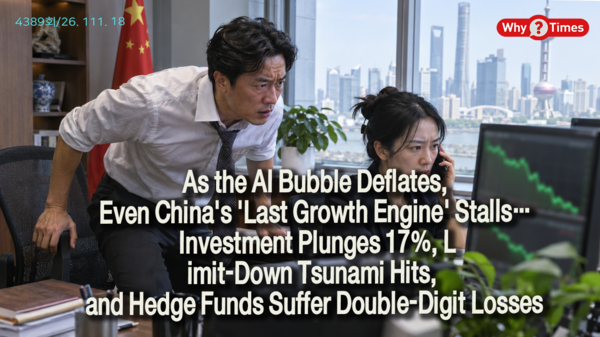
[Jensen Huang's Resignation Pulls the Trigger… A 'Limit-Down Tsunami' Hits Chinese Tech Stocks]
The AI sell-off storm triggered by the sudden resignation of Nvidia CEO Jensen Huang (黃仁勳) has struck the last remaining growth engine of the Chinese economy head-on. On the 16th, in China's A-share market, the ChiNext Index tumbled 4.37% and the STAR 50 Index plunged more than 5%, unleashing a flood of limit-down drops across tech stocks. Social media was filled with cries of distress from debt-fueled retail investors hit by forced liquidations. Zhipu (智譜), once hailed as Hong Kong's flagship AI stock, saw more than 85% of its market value evaporate from its peak, while major Chinese hedge funds also absorbed double-digit losses. October real-economy indicators released the same day painted an even grimmer picture. Having relied on AI and electronics exports to stay afloat after its real estate collapse, China's economy has entered a phase where even its final pillar is shaking.
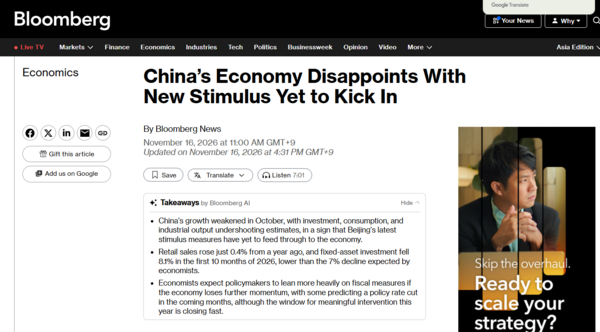
Analyzing China's October economic indicators on the 16th, Bloomberg News reported that "the slump in investment was deeper than market expectations." According to separate monthly estimates by Bloomberg Economics, fixed-asset investment in October fell 17% year-on-year—the steepest contraction outside of the COVID-19 pandemic period. Cumulative investment for the January–October period announced by the National Bureau of Statistics the same day dropped 8.1%, widening from the 7.2% decline recorded in January–September. Retail sales rose just 0.4% and industrial production grew 4.8%, leaving all three major indicators below market forecasts. Real estate development investment fell 21.6%.
What makes the shock particularly severe is its timing. At the end of September, Beijing raised public-sector borrowing limits and sought to front-load construction investment through projects worth 800 billion yuan (approximately 160 trillion won). Even so, infrastructure investment from January to October contracted 5.1%, with steeper declines in road transport (-10.9%) and public facility management (-14.1%). Bloomberg pointed out that local governments are pouring their energy into cleaning up off-balance-sheet debt from local government financing vehicles (LGFVs), while leadership reshuffles and anti-corruption campaigns have made cadres reluctant to approve new projects. Goldman Sachs noted that government deposits in October far exceeded seasonal averages, analyzing that some funds raised in the fourth quarter may not be deployed until early 2027. Carlos Casanova of UBP Private Bank projected that this "policy paralysis" could weigh on growth until the 2027 Party Congress. Bewilderment is palpable inside China as well. One Chinese economic commentary pointed out that "even though 250 billion yuan (about 50 trillion won) in trade-in subsidies was fully disbursed, private investment fell 11.4% in January–October," asking, "If even the National Day holiday failed to lift consumption, what can boost it during ordinary times?"
["Every Tech Stock Is Crashing"… Margin Call Screams From Debt-Fueled Retail Investors]
Market shocks were amplified among retail investors through leverage. Chinese financial media outlet Sina Securities (新浪證券) described the day's trading by stating, "Every stock tied to technology is crashing across the board." On Weibo, "wave of tech stocks hitting limit-down, massive wipeout of retail investors" rose to the top of trending searches, accompanied by accounts from investors who could not avoid forced liquidation despite repeatedly adding margin collateral. National Business Daily (每日經濟新聞) analyzed that tech stocks, which had attempted a rebound earlier in the week, plunged during afternoon trading for two consecutive days, noting that after Huang's resignation, the market shifted from momentum trading to a fundamental reassessment of the event itself. Institutional investors were no exception. According to a Bloomberg report earlier this month, China-focused stock-picking funds suffered losses of 11% as margin calls and forced liquidations spread.
[Hedge Funds Take Double-Digit Losses… What '74% Cash' Says About Market Fear]
An analysis by Bloomberg of investor letters from major Chinese fund managers showed that the funds hardest hit by the October sell-off posted double-digit declines. Hunjin Capital scooped up "quality companies mistakenly dumped in panic selling" while buying overseas oil and gas stocks categorized as "non-AI" plays. Hunjin had offloaded most of its Chinese AI supply chain holdings starting in June, leaving virtually none by September, and expects hardware profits to peak around 2027.
Meanwhile, Liu Xiaolong of Intewise Capital said the market had "lost its direction" and is holding 74% of its assets in cash—a stark reversal from August, when he suggested the correction was "probably over." Zeyuan Private Equity, led by Ren Wenqi, warned that because AI chips have a lifespan of only three to six years, the arms race has entered an "unstoppable conveyor belt" stage, turning capital expenditure from a one-off outlay into an endlessly recurring burden.
[Zhipu's '2,000% Myth' Evaporates by 85% From Its Peak]
The collapse of Zhipu (Z.AI), which surged nearly 2,000% within six months of its January listing in Hong Kong, encapsulates the current crisis. When its intraday share price reached HK$2,980 on June 22, pushing its market capitalization to HK$1.3 trillion, its valuation exceeded 1,000 times its 2025 revenue of 724 million yuan (about 145.1 billion won). Earnings failed to keep pace with expectations. First-half revenue came in at 954 million yuan (about 10.8 billion won), missing market estimates, while adjusted net losses widened to 1.964 billion yuan (about 393.9 billion won).
The decisive blow came from Washington. After the United States moved to restrict Chinese companies' remote access to advanced AI chips and servers in seven countries, including Malaysia and Singapore, Zhipu's shares plunged as much as 6.8% intraday on the 17th. Since their closing prices on the 11th, Zhipu and MiniMax have each lost roughly one-third of their market capitalization. Billy Leung of Global X Management warned that another workaround for accessing Nvidia's computing power had been blocked, predicting higher costs and development delays for Chinese AI firms. Short interest in Zhipu has climbed to a record 9.9% of its tradable shares.
[If AI Falters, No Pillar Remains to Support China's Economy]
What makes this downturn uniquely dangerous is that AI is virtually the only remaining pillar of growth for the Chinese economy. While electronics manufacturing output jumped nearly 20% year-on-year in October, automobile production grew just 0.9%. Even the third-quarter growth rebound was underpinned by net exports, which accounted for nearly 40% of GDP expansion. If global AI capital expenditure slows, exports of optical modules, PCBs, and server components will immediately falter, leaving already paralyzed domestic demand and investment to carry the economy alone. This is precisely the vulnerability targeted by Hunjin's "hardware profit peak" thesis and Zeyuan's "conveyor belt" warning.
Although 4.6% growth over the first three quarters suggests Beijing can still defend the lower bound of its annual target (4.5–5%), hitting a headline figure cannot mask the crisis felt on the ground. Chinese leaders will set policy directions for 2027 at the Central Economic Work Conference in December. Raymond Yeung of ANZ Bank stated that "authorities must first identify the root causes of the sharp drop in investment, and fiscal policy must play a central role at that juncture."
[Why Times Insight]
① The Paradox of "New Quality Productive Forces." Xi Jinping's leadership vowed to break free from real estate dependence and pivot to AI and advanced manufacturing. Yet that new engine proved so externally dependent that a leadership crisis at a single American company could shake it to its core. Rather than transforming its growth model, China merely shifted its dependence from real estate to a U.S.-led AI supply chain.
② Geopolitical Blowback From the Huang Scandal. The fact that Huang's resignation is entangled with suspicions of intelligence leaks to the Chinese government gives Washington powerful ammunition to justify tighter tech controls against Beijing. It is hard to view the immediate crackdown on remote access as a coincidence.
③ Self-Paralysis of a Command Economy. Being unable to spend money even when funds are available is not a fiscal capacity issue—it is a systemic one. Risk-averse bureaucratic behavior aimed at dodging responsibility is neutralizing stimulus tools themselves, raising the prospect of "political hibernation" lasting until the 2027 Party Congress.
④ Collapse of Leveraged Retail Investing and Social Instability. Seeing middle-class citizens who already lost wealth in real estate pile into AI theme stocks with leverage only to be wiped out by margin calls risks spilling over into broader social stability concerns.


-중국 푸단대학교 한국연구원 객좌교수
-전 EDUIN News 대표
-전 OUR NEWS 대표
-제17대 대통령직인수위원회 정책기획팀장
-전 대통령실 홍보기획비서관
-사단법인 한국가정상담연구소 이사장
-저서: 북한급변사태와 한반도통일, 2012 다시우파다, 선거마케팅, 한국의 정치광고, 국회의원 선거매뉴얼 등 50여권