
Update2026.11.18 (수)

[Blocking Third-Country Data Center Workarounds… A Rule Written Directly by Hawks]
China's semiconductor and AI drive, into which the Chinese Communist Party has poured national resources, now stands at the edge of a precipice, squeezed from three directions. On the 16th, the U.S. Department of Commerce unveiled an interim rule blocking workarounds through which China remotely rented Nvidia chips via data centers in Singapore, Malaysia, Thailand, Indonesia, and Brazil. Meanwhile, China's domestic high-bandwidth memory (HBM) remains stuck at yields of 20–30%, forcing reliance on smuggled components. On the same day, the STAR 50 Index on the Chinese stock market plunged over 5%, with 68 stocks hitting their daily downward limit. As the espionage scandal involving former Nvidia CEO Jensen Huang shifted the initiative in Washington to China hawks, the three pillars of China's technological rise—computing power, core memory, and capital markets—are shaking simultaneously.
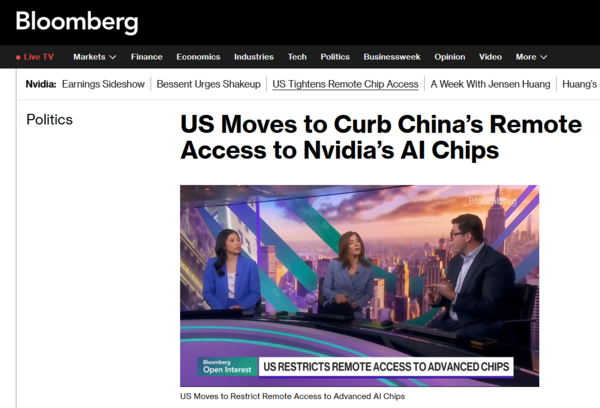
Bloomberg reported on the 16th (local time) that "the U.S. Department of Commerce is expanding export licensing requirements for advanced AI semiconductors bound for Singapore, Malaysia, Thailand, Indonesia, and Brazil to restrict Chinese companies' access to overseas AI computing." The interim final rule released by the Commerce Department's Bureau of Industry and Security (BIS) also targets overseas data centers that provide remote computing above a certain threshold to companies headquartered in, or whose ultimate parent companies are located in, restricted regions such as China. The pre-publication version is scheduled to appear in the Federal Register on the 19th (local time) and will take effect upon publication.
According to The Wall Street Journal (WSJ), the rule also includes measures making it difficult for data center operators anywhere in the world to provide Chinese companies with remote access to AI chips, as well as making it harder for Chinese chip designers to cooperate with TSMC. It directly targets the gray area of "renting computing power" rather than acquiring physical chips.
The circumstances behind the drafting of the rule are also unusual. A Commerce Department press release noted that "this rule was drafted by the Department of the Treasury and the National Security Council (NSC) and prepared at their direction." Chris McGuire, a senior fellow at the Council on Foreign Relations (CFR), remarked that "it is unprecedented for the NSC and Treasury to draft a Commerce Department regulation," adding that "including this in the press release means Commerce resisted publishing the rule until the very end and was ultimately forced to issue it by the White House." The drafting of export control rules, normally led by BIS, was taken over by China hawks such as Treasury Secretary Scott Bessent and Secretary of State Marco Rubio, who also serves as National Security Advisor.
[How the Jensen Huang Scandal Reshaped Washington's Dynamics]
The catalyst for this reversal was the collapse of Nvidia's leadership. Last week, Jensen Huang stepped down as CEO after admitting to an extramarital affair with Alice Huang (黄乐), a former executive at Singaporean cloud firm Megaspeed International. U.S. intelligence authorities suspect Alice Huang, who is currently residing in China, of being an asset of Chinese intelligence agencies. Moreover, the scale of her business dealings was substantial. According to The New York Times (NYT), Megaspeed's Malaysian sister company purchased at least $4.8 billion (approximately 6.4 trillion won) worth of AI equipment containing Nvidia chips between June 2024 and February 2026.
Taking aim at Commerce Secretary Howard Lutnick on Fox News, Secretary Bessent said, "As I said, many other agencies pushed for this, and it was the Commerce Department that held the pen." This was a criticism that proposals to place Megaspeed and others on the export blacklist, the "Entity List," had been blocked at Commerce. President Trump defended Lutnick, saying, "He did that because if we hadn't delayed it, a conflict with China could have erupted," and added, "We have a very good relationship with China right now." Nevertheless, the White House's decision to push through the hawks' rule demonstrates that the line of defense collapsed following the exit of former CEO Huang, who had spearheaded lobbying to ease export controls during the second Trump administration.
Markets reacted immediately. According to Bloomberg, Nvidia tumbled over 4% and the Philadelphia Semiconductor Index plunged 5.3%, while AMD and CoreWeave fell around 5%, and Alibaba's American Depositary Receipts (ADRs) dropped nearly 4%. Data also revealed how Southeast Asia served as an "overseas computing base" for Chinese AI. Nvidia's revenue in Singapore surged nearly fourfold year-on-year in fiscal 2025 to approximately $24 billion (about 32 trillion won), accounting for roughly 18% of its total revenue. In May, Bloomberg also reported that the U.S. suspected a key company in Thailand's national AI project of smuggling billions of dollars' worth of Nvidia servers into China.
[Can't Run Even With Chips… Huawei Blocked by the 'HBM Wall']
While chip workarounds are being sealed off, memory bottlenecks are also deepening. Although Huawei and Cambricon (寒武纪) are accelerating the development of domestic AI accelerators to replace Nvidia, they cannot boost performance or production volume without HBM to feed data to processors at high speeds. Hopes for localization rest on China's largest DRAM maker, ChangXin Memory Technologies (CXMT, 长鑫存储). However, according to Reuters, CXMT's HBM3E yield sits at just 20–30%—far below SK Hynix's roughly 70%—and the performance of some prototypes is rated only at the level of the previous-generation HBM3. While Samsung Electronics and SK Hynix are moving on to sixth-generation HBM4, China remains stuck on the hurdle of achieving stable mass production of fifth-generation products.
The root of the gap lies in process technology. HBM stacks multiple DRAM dies vertically and connects them via through-silicon vias (TSVs); a single flaw in stacking, bonding, or thermal management renders the entire stack defective. U.S. equipment export controls limit China's means to improve yields, and the higher unit costs resulting from discarded chips erode the price competitiveness of Chinese-made accelerators.
Consequently, China is turning to the black market. Tech outlet The Information reported on the 2nd that "a smuggling method in which Samsung Electronics and SK Hynix HBM chips are mounted onto circuit boards alongside low-end server processors, brought into China, and then stripped off for resale is rampant." According to the outlet, the price of a single HBM3E unit on China's unofficial market has skyrocketed from a few hundred dollars a year ago to around $4,000 (approximately 5.35 million won) recently. Since a single AI package requires six to eight HBM units, procuring the memory alone costs $24,000 to $32,000 (about 32.1 million to 42.8 million won). Reports have also emerged that Huawei asked some clients to secure South Korean HBM on their own for use in its next-generation "Ascend 960DT" accelerator. SK Hynix maintains that it has not supplied products to Huawei since U.S. sanctions took effect in 2020 and strictly complies with export controls.
[Fear Amplified by Leverage… Chinese Tech Stocks Hit 'Limit-Down Wave']
Pressure from Washington and the leadership vacuum at Nvidia immediately battered Chinese equities. On that day, the STAR 50 Index dropped 5.16% to close at 1,213.68, the ChiNext Index fell 4.37% to 2,320.02, and the Shenzhen Component Index declined 2.53%. Over 4,300 stocks fell, and 68 closed at their daily downward limit. Nvidia supply chain stocks such as PCB makers Wus Printed Circuit (沪电股份), Shennan Circuits (深南电路), and Shengyi Technology (生益科技) hit limit-down, while around 30 stocks—including optical module leaders Zhongji Innolight (中际旭创), Eoptolink (新易盛), and TFC Optical Communication (天孚通信)—plummeted more than 10%. On the previous trading day, the 13th, 34 stocks had also hit limit-down, marking two consecutive days of panic selling.
On Weibo, "wave of tech stocks hitting limit-down, massive forced liquidations of retail investors" became a trending search term, accompanied by complaints from investors who failed to avoid margin calls despite repeatedly depositing additional collateral and confessions of "losing entire family fortunes." However, the crash cannot be explained by the Jensen Huang affair alone. According to Cailian Press (财联社), a state-owned financial news agency under the Shanghai United Media Group, by early this month the STAR 50 Index had already fallen nearly 50% and the ChiNext Index over 45% from their July 1 all-time highs. The shockwaves from Nvidia dealt a decisive blow just as the bubble in AI-themed stocks—inflated by policy expectations and debt-fueled investing—was deflating.
[Variables: Trump's Visit to China and Loopholes in the Rule]
Even so, it is too early to conclude that pressure will intensify in a straight line. President Trump is visiting the Philippines and China this week alongside Secretaries Lutnick and Bessent, and he even remarked that Jensen Huang did not jeopardize national security. This signals that export controls remain a potential bargaining chip for the upcoming summit. The rule itself also contains loopholes: companies headquartered in the U.S. can ship chips to the five designated countries without a license, and data centers used for recommendation systems in e-commerce and social media are exempt.
Questions are also being raised about enforcement. Nazak Nikakhtar, a partner at Wiley Rein and a former senior Commerce Department official, stated that "the rule is far overdue, and the glaring issue is enforcement," asking, "If the Commerce Department distances itself from this rule, which U.S. government agency will lead enforcement?" Nor is the legal foundation fully solidified. While the House of Representatives passed the Remote Access Security Act—which explicitly grants BIS authority to regulate remote access—by a 369–22 vote in January, the bill failed to clear the Senate. The rule will undergo a 60-day public comment period after taking effect. Singapore's government stated it is "closely reviewing the new measures," while Brazil's government said it is "monitoring the situation carefully."
[Why Times Insight]
China's semiconductor rise has rested on three pillars: U.S. chips and computing power routed through Southeast Asia, South Korean memory, and a stock market propped up by state-backed capital and retail investors' leveraged bets. What became clear this week is that all three pillars were "borrowed." Computing power was rented via U.S.-designed chips in third countries, memory was procured through the smuggling of South Korean products, and stock prices were driven up by borrowed money collateralized against future growth. The moment Washington closed off the final gray area of remote access, the bills for all those borrowed assets came due at once.
Particularly noteworthy is the nature of China's "technology acquisition strategy" exposed by the Megaspeed affair. If the espionage allegations prove true, it means China sought to close the technological gap not through research and development, but through circumvention and infiltration. The instant that strategy was uncovered, Jensen Huang—the biggest backer of engagement with China inside the United States—was neutralized. For Beijing, it was a self-inflicted blunder that cost it its strongest ally in Washington.
Of course, standing at a "precipice" does not automatically mean a "fall." President Trump's deal-making instincts, exemptions for U.S. companies, and legislative delays in the Senate all represent potential exits where pressure could ease. CXMT's yields could also improve with the backing of state subsidies. Still, with memory yields in the 20% range and a market seeing 68 stocks hit limit-down in a single day, closing the gap with Nvidia and SK Hynix will be difficult. The "speed war" of China's technological rise has effectively ground to a halt, and the key question now is how long Beijing can endure this stagnation. For South Korea, this episode reaffirms that its technological lead in HBM is a vital strategic asset, even as the compliance burden of preventing leaks through third parties grows heavier.

-중국 푸단대학교 한국연구원 객좌교수
-전 EDUIN News 대표
-전 OUR NEWS 대표
-제17대 대통령직인수위원회 정책기획팀장
-전 대통령실 홍보기획비서관
-사단법인 한국가정상담연구소 이사장
-저서: 북한급변사태와 한반도통일, 2012 다시우파다, 선거마케팅, 한국의 정치광고, 국회의원 선거매뉴얼 등 50여권