Update2026.07.24 (금)


[The Silence of an Economist Who Spoke the Truth: The Most Dangerous Signal for the Chinese Economy]
The Chinese economy has sounded yet another major alarm. Its second-quarter economic growth rate for this year fell to 4.3%, marking the lowest level in three and a half years. However, what demands the most attention in this announcement is not the growth figure itself. Rather, it is the widening chasm between official statistics and the economy felt by ordinary citizens. Coupled with warnings from economists inside the establishment who have pointed out this discrepancy, analysts evaluate that the Chinese economy has now transitioned from a mere cyclical slowdown into a profound "crisis of trust."
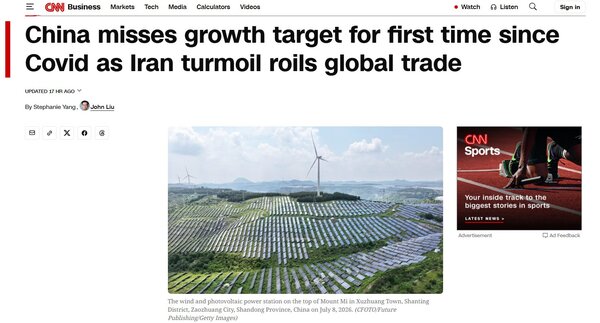
On the 15th (local time), CNN quoted the National Bureau of Statistics of China, reporting that “China’s gross domestic product (GDP) for the second quarter of this year grew by only 4.3% year-on-year.” CNN further noted, “This is not only a sharp deceleration from the first quarter's 5.0% growth, but it also falls short of the market expectation of 4.5% compiled by Reuters, as well as Beijing’s annual growth target of 4.5% to 5% for this year.” The report added, “Overall growth for the first half of the year also remained at 4.7%, and when the quarterly growth rate is annualized, the pace of growth is analyzed to have plummeted from the 6% range in the first quarter to the mid-3% range.”
These figures signify much more than a slightly lower growth rate. For over forty years since its reform and opening-up, the Chinese Communist Party (CCP) has relied on "economic growth" as the core foundation of its regime legitimacy. The cornerstone of the Chinese governance model has been promising continuous economic growth to its citizens in exchange for limitations on political freedom. Therefore, the fact that the growth rate has begun to fall below government targets represents not just a cyclical slowdown, but a destabilization of the very governing logic that the CCP has championed with the greatest confidence.
[Exports Smile While Domestic Demand Cries: The Reality of 'Two Chinese Economies']
What is even more striking is the extreme divergence within the economy itself. Reuters reported that “real estate development investment plunged by 18% in the first half of the year, while manufacturing and infrastructure investment also remained sluggish.” Reuters pointed out that “consumption failed to revive as well,” noting that “retail sales of consumer goods declined for the first time since the lifting of COVID-19 lockdowns before barely managing a slight rebound in June, while local governments are rapidly losing the financial capacity to make new investments due to astronomical levels of debt.”
Conversely, Reuters noted that “exports showed an entirely different trajectory,” pointing out that “June exports surged by 27% year-on-year, and the trade surplus exceeded $125 billion, marking the second-largest on record.” However, the report also highlighted analyses suggesting that "this was heavily influenced by 'front-loading exports,' where companies rushed shipments ahead of looming additional tariffs from the United States and Europe." In other words, the current export boom can hardly be interpreted as a sign of a genuine, full-scale recovery for the Chinese economy.
Song Yu, chief economist at UBS in Switzerland, assessed that “if it were not for the global AI boom, the Chinese economy would be in a far worse state than it is now.” This implies that the AI industry is not necessarily driving robust growth across the Chinese economy, but is rather acting as a temporary cushion slowing down its fall.
Indeed, while AI, semiconductors, advanced manufacturing, and select export-oriented firms are expanding on the back of government support, the real estate, construction, consumer markets, and small and medium-sized enterprises (SMEs) remain mired in stagnation. This has given rise to the simultaneous coexistence of "two Chinese economies"—one where GDP rises, but the economic reality felt by the public continues to deteriorate.
[“Official Unemployment Rates Do Not Reflect Reality”: Warnings from Within the System]
As the public's economic sentiment diverged sharply from official statistics, unprecedented warnings emerged even from within the system—specifically from those who have advised the Chinese government on policy. Li Daokui, director of the Academic Center for Chinese Economic Practice and Thinking (ACCEPT) at Tsinghua University and a former member of the Monetary Policy Committee of the People's Bank of China, diagnosed at the China Macroeconomy Forum (CMF) held on the 11th: “The core issue of the Chinese economy is not a 'K-shaped economy' where only certain industries grow, but rather that the entire economy has been cooling down for three consecutive years.” Given that Li is a prominent establishment economist who has long advised the government on economic policy, his public warning that official statistics alone cannot adequately explain the current state of the Chinese economy carries significant weight.
According to research conducted by his team, "re-analyzing the data to include the 'discouraged workforce'—who are excluded from official unemployment figures—in accordance with International Labour Organization (ILO) standards reveals that China's broad unemployment rate reaches 10.2%." This is exactly double the urban surveyed unemployment rate of 5.1% published by the National Bureau of Statistics.
The research team estimated "the number of long-term unemployed at approximately 24 million, of which 13 million belong to the youth cohort aged 16 to 24." Li also warned that “fixed-asset investment recorded a decline last year for the first time since records began, and the contraction is widening this year.” He cautioned that “the two growth engines that once sustained the Chinese economy—real estate and infrastructure—have ground to a halt simultaneously, yet no new engine has emerged to replace them.”
He further pointed out, “In particular, as local government debt has ballooned to exceed the size of GDP, a structure has become entrenched where financial resources are directed toward servicing existing debt rather than funding new investments. This serves as a clear signal that the Chinese economy is entering a phase of structural low growth.”
[The Silence of an Economist Who Spoke the Truth: What the Chinese Economy Has Lost]
While Li Daokui delivered his warnings from within the system using highly measured language, another economist who went a step further by openly questioning the official growth rate itself ultimately met his end in silence.
The Wall Street Journal (WSJ) reported on the 15th that “Gao Shanwen, one of China’s leading macroeconomic experts and former chief economist at SDIC Securities, passed away on the 7th from lymphoma.” He was 55.
Gao was one of the most influential private-sector economists in the Chinese financial industry. Thus, when he openly remarked at a Peterson Institute for International Economics (PIIE) forum in late 2024 that “China’s actual economic growth rate over the past two to three years may have averaged around 2%,” and that “there could be a major discrepancy between reality and the government-announced growth rate of around 5%樣,” it sent shockwaves through Chinese economic circles. At the time, he also questioned whether the Chinese government still possessed the political will and capacity to implement effective economic stimulus.
According to the WSJ, President Xi Jinping was furious upon hearing these remarks and directly instructed his close aide, Cai Qi, to investigate the matter. Subsequently, Gao's public lectures were repeatedly canceled, and his media interviews and public commentary were virtually halted. He eventually left his securities firm, was diagnosed with stage IV cancer shortly thereafter, and passed away after a battle with the illness.
While it is impossible to definitively establish a direct causal link between his death and the authorities' actions, reactions on Chinese financial networks and social media platforms have been telling, with users lamenting that "he was a rare economist who dared to speak the truth" and that "now, only optimistic economists are left in China." This sequence of events symbolically illustrates the chilling atmosphere that has made it increasingly difficult to freely debate economic reality in contemporary China.
[An Economy Buoyed by AI, Left Unfelt by the Public]
Another message embedded in this latest growth rate announcement is that the Chinese economy is not moving in a single, unified direction. AI, semiconductors, electric vehicles, and high-tech manufacturing are expanding under concentrated government support. Conversely, real estate and construction show no signs of recovery, local governments remain shackled by debt, and the consumer market and SMEs are failing to escape stagnation. Meanwhile, young people are being pushed out of the labor market entirely, unable to find work.
Nomura Securities analyzes this phenomenon as a 'new class division of the AI era.' The firm notes that “while workers in high-tech industries reap the benefits of growth, those in traditional manufacturing, construction, and services are facing the dual pressures of economic downturn and automation.” Wang Dan, chief China economist at Eurasia Group, also pointed out that “policies centered on high-tech industries are deepening structural unemployment and underemployment.”
Ultimately, while China’s GDP continues to register positive growth, the economic reality felt by the public is consistently deteriorating. This is the "broad economic cooling" described by Li Daokui, and it constitutes the most fundamental contradiction of the modern Chinese economy.
[Why Times Insight]
The most critical figure to watch in this assessment of the Chinese economy is not 4.3%. Rather, the numbers that demand closer scrutiny are the 10.2% broad unemployment rate presented by Li Daokui and the "2% actual growth rate possibility" raised by the late Gao Shanwen during his lifetime. All three of these figures converge on a single, fundamental question: "How accurately do the economic statistics published by the Chinese government reflect reality?"
An economy does not run on GDP numbers alone. Markets must be able to trust government statistics, businesses must know the true reality to make investment decisions, and economists must be free to analyze the situation objectively. Yet, in today's China, the gap between official statistics and economic sentiment is widening, and the voices pointing this out are increasingly falling silent.
Later this month, China’s leadership is expected to discuss new economic stimulus measures. However, what the Chinese economy needs to restore first is not its growth rate, but trust. No matter how massive a stimulus package Beijing rolls out, its policy effectiveness will remain fundamentally limited if the market distrusts the government's numbers and the public's lived economic reality continues to diverge from official data.
An economy can collapse due to a lack of funds. However, it unravels far more rapidly when it loses trust. This 4.3% growth announcement may well be a signal that the Chinese economy has moved past a simple slowdown and has entered a much deeper, structural "crisis of trust."

-중국 푸단대학교 한국연구원 객좌교수
-전 EDUIN News 대표
-전 OUR NEWS 대표
-제17대 대통령직인수위원회 정책기획팀장
-전 대통령실 홍보기획비서관
-사단법인 한국가정상담연구소 이사장
-저서: 북한급변사태와 한반도통일, 2012 다시우파다, 선거마케팅, 한국의 정치광고, 국회의원 선거매뉴얼 등 50여권