
Update2026.10.24 (토)

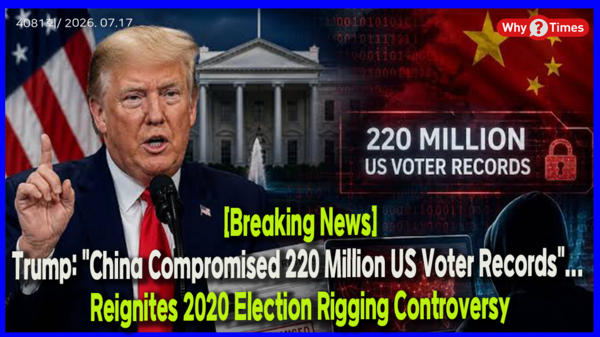
["The Information of 220 Million US Voters Has Fallen into Chinese Hands"]
US President Donald Trump has once again taken aim directly at the 2020 US presidential election. However, the core of his recent address was not merely reviving past controversies over rigged elections. President Trump claimed that China has acquired 220 million pieces of US voter information and accused US intelligence agencies of downplaying or covering up this fact. While debate continues over the veracity of his claims, the broader message conveyed by his remarks is distinct: the US-China rivalry has moved beyond semiconductors and tariffs, entering a new phase of "information warfare" centered on individual citizen data.
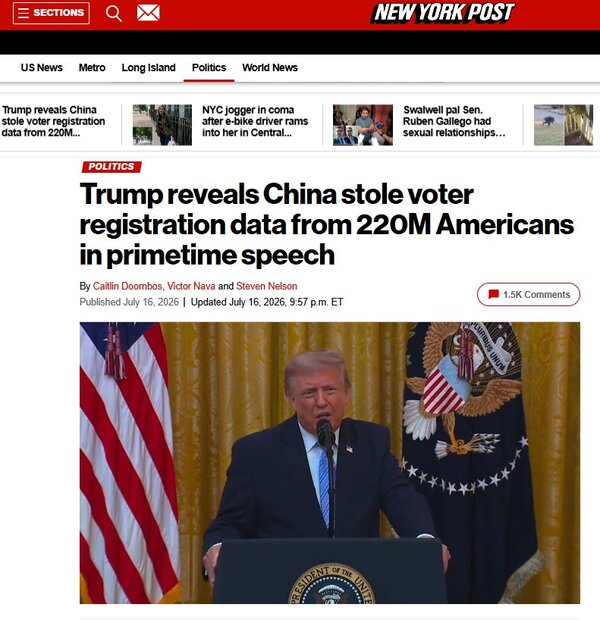
On July 17 (local time), the New York Post reported, "In a 25-minute national address delivered from the East Room of the White House, President Trump publicly raised allegations of a massive Chinese breach of US voter data and a subsequent cover-up by intelligence agencies, citing recently declassified documents."
During his speech, Trump asserted, "Around the 2020 election, China carried out what is believed to be the largest compromise of election data in history." According to his remarks, the data secured by Beijing was not limited to basic names or addresses. Rather, it encompassed names, addresses, phone numbers, political party registration, voting history, and military-related information—data extensive enough to identify individual voters and analyze their political leanings.
Characterizing the breach as "one of the most egregious election security incidents in American history," Trump emphasized, "The transfer of data of this magnitude to a foreign government is not something that can be easily dismissed."
Prior to the address, the White House held a briefing explaining that there were indications China had acquired approximately 220 million US voter registration files between 2020 and 2023. However, the administration did not provide specific evidence detailing exactly how China obtained this data or whether it was actively deployed to influence elections.
[Trump Takes Greater Issue with the "Cover-Up"]
In his address, President Trump directed his sharpest criticism not at China, but at US intelligence agencies. He claimed, "Intelligence regarding China’s election-related activities was not properly reported to the President," alleging that "there was a systematic effort to downplay and cover up this information within the intelligence community."
Citing declassified internal emails, Trump argued that "indications show China-related intelligence was intentionally omitted or softened in the President’s Daily Brief (PDB), a highly sensitive national security report." He also made public an email allegedly written by an FBI insider describing what was effectively a "shadow government," and claimed that "certain factions within intelligence agencies controlled and suppressed information concerning China."
The White House has since instructed the Office of the Director of National Intelligence (ODNI), the FBI, the CIA, and the Department of Justice to investigate the circumstances of the incident and hold those responsible accountable. From Trump's perspective, this is not a simple hacking incident, but a profound "intelligence failure" where critical national security information was withheld from the commander-in-chief.
[However, the Intelligence Community’s Existing Conclusions Differ]
The primary issue is that these allegations largely clash with the official conclusions previously released by US intelligence agencies. CBS News cited a declassified intelligence assessment from 2021, noting that "US intelligence agencies concluded China did not actively intervene to directly alter the outcome of the 2020 US presidential election."
Some of the declassified documents also specify that "while this data could theoretically be used in future cyberattacks or influence operations, its actual intended purpose has not been confirmed."
China reiterated its standard stance on the matter. The Chinese Embassy in Washington dismissed the accusations, stating, "China has never interfered in US elections and will not do so in the future," adding that "China consistently adheres to the principle of non-interference in the internal affairs of other countries."
[The Core of the Issue: The 'Data War']
Interpreting this controversy solely as "political maneuvering over the 2020 election" risks missing the real essence of the event. Today's state-sponsored information warfare is no longer about physical ballot box stuffing or direct vote count manipulation.
Instead, the modern battleground revolves around how much personal data a nation can acquire and how sophisticatedly it can analyze it. By combining voter political leanings, consumer habits, regional demographics, and social networks, adversaries can execute highly tailored public opinion manipulation, psychological operations, and targeted information warfare. As AI technology advances, the strategic value of this data will only escalate.
Indeed, the US government has warned for years about the activities of state-sponsored hacking groups linked to Beijing—such as Volt Typhoon and Salt Typhoon—noting that China has been widely harvesting sensitive data from US critical infrastructure, telecommunications networks, government organizations, and private citizens. Read in this context, President Trump's remarks are more than political rhetoric; they represent a concerted effort to push the issue of Chinese data acquisition back to the forefront of the national security agenda.
[Why Times Insight]
The facts surrounding this controversy have not yet been fully validated. While President Trump alleges a massive data breach by China and an intelligence cover-up, the official assessment of the US intelligence community remains that there is "no evidence showing China directly altered the 2020 election outcome." Therefore, at this stage, it is difficult to treat both claims as established facts.
Nevertheless, the implications of this event are monumental. Today's global competition is no longer decided solely by military might or economic leverage. Who secures data, and how they harness it through AI, is becoming the new cornerstone of national competitiveness. Even if there is no proof that this incident led to actual election manipulation, the fact that a US president has framed Chinese data acquisition itself as a direct threat to national security is symbolic. It signals that the US-China strategic rivalry has officially entered the era of "data sovereignty" and "information warfare." Depending on the release of further declassified documents and the results of the intelligence community's investigation, this dispute has every potential to become a major variable shaping not just domestic US politics, but the broader future of US-China relations.

-중국 푸단대학교 한국연구원 객좌교수
-전 EDUIN News 대표
-전 OUR NEWS 대표
-제17대 대통령직인수위원회 정책기획팀장
-전 대통령실 홍보기획비서관
-사단법인 한국가정상담연구소 이사장
-저서: 북한급변사태와 한반도통일, 2012 다시우파다, 선거마케팅, 한국의 정치광고, 국회의원 선거매뉴얼 등 50여권