
Update2026.07.24 (금)

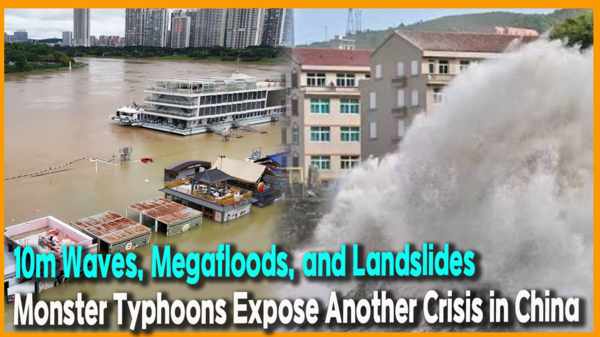
[China is Facing a Simultaneous Attack from 'Heaven and Earth']
As massive natural disasters strike a nation already reeling from an economic crisis, the entire country of China has entered yet another monumental test. What is even more alarming is that this is not merely a single typhoon; floods, landslides, and tornadoes are occurring almost simultaneously, spreading destruction across the country. Analysts suggest that China is moving past mere extreme weather anomalies and is entering the initial stages of a "polycrisis," where its economic, social, and administrative systems are being pressured all at once.
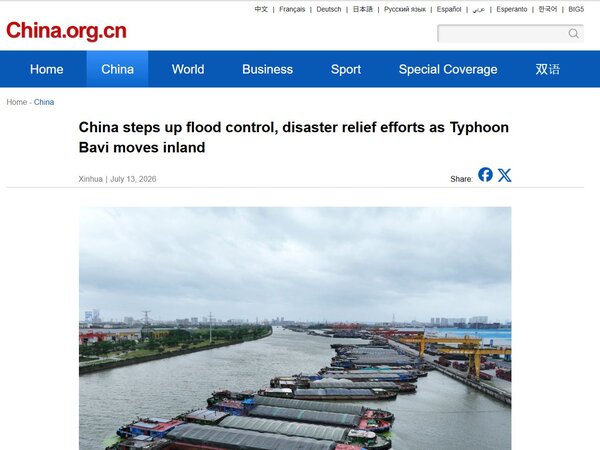
State-run Xinhua News Agency reported on July 13 that "Typhoon Bavi, the ninth of the season, made landfall twice along the coast near Yuhuan, Zhejiang Province, on the night of July 11, with less than an hour's interval between them. At the time of landfall, maximum wind speeds reached 144 kilometers per hour." Xinhua noted that "this is the strongest July typhoon to strike Zhejiang since 1949," adding that "268 million people were evacuated urgently in Zhejiang alone, while large-scale evacuation orders were also issued in Shanghai, Fujian Province, and Beijing."
Xinhua further explained that "this typhoon was exceptionally large in both scale and intensity, triggering massive storm surges along coastal regions and penetrating deep inland, which concurrently heightened the risks of flash floods, urban inundation, and landslides." In fact, floodwaters exceeded depths of 2 meters on some roads in Hebei, residents became stranded in Liaoning, and over 100,000 people were urgently evacuated in Beijing as water discharges began at the Miyun Reservoir, demonstrating how rapidly damage is spreading to northern regions.
However, this situation cannot be viewed merely as typhoon damage. Recovery efforts have not even concluded for Typhoon Maysak, the eighth typhoon of the season, which hammered southern China just a week ago. In the Guangxi Zhuang Autonomous Region, record-setting torrential rains caused the Liuran Reservoir in Hengzhou to collapse. The sudden torrent of flash floods swallowed villages and farmland, claiming at least 26 lives. The number of affected residents has surpassed 375,000, with over 130,000 urgently evacuated. Agricultural damage is also snowballing as 53 square kilometers of farmland have been submerged.
During the same period, a powerful tornado ripped through a city in central Hubei Province, killing at least 11 people and injuring some 300 others. Meanwhile, a landslide killed 21 people in northwestern Gansu Province. Rare disasters featuring typhoons, floods, tornadoes, and landslides are unfolding simultaneously across the entirety of China.
[Why Are China's Natural Disasters Exceptionally Severe This Year?]
Meteorological experts do not view this phenomenon as simply a year of bad luck. Recently, sea surface temperatures in the Northwest Pacific have remained higher than average, allowing typhoons to approach the Chinese coast carrying greater volumes of water vapor. Combined with the seasonal rain front, record-breaking downpours have repeatedly dumped massive amounts of rain in short periods. Chinese meteorological authorities had previously warned that extreme weather events would likely be far more frequent this summer than in previous years.
Yet, climate change alone cannot fully account for the scale of damage currently observed in China. Over the past few decades, China has aggressively pursued rapid urbanization, leading to large-scale development around rivers and streams. In cities blanketed by concrete and asphalt, rainwater cannot seep into the ground, causing it to pool instantly in urban centers. Analysts point out that due to the fiscal strains of local governments, investments in river maintenance and drainage facilities have fallen short, creating a structural vulnerability that makes damage far worse than in the past when heavy rains strike.
The "Sponge City" initiative, which the Chinese government ambitiously promoted over the past decade, is also exposing its limits everywhere. While conceived as a way to absorb and store rainwater to mitigate urban flooding, a growing number of evaluations conclude that existing urban infrastructure simply cannot cope with the recent extreme deluges that dump dozens to hundreds of millimeters of rain per hour. Above all, the greatest problem facing China is that all these disasters are hitting at a time when its economy is at its weakest.
[More Frightening Than Natural Disasters: 'The Collision with the Economy']
The reason these natural disasters are uniquely fatal to China is not solely due to the scale of destruction. The larger problem is that they align perfectly with an already faltering economy. The Chinese economy has yet to escape the long tunnel of its real estate crisis. Since the Evergrande and Country Garden crises, the property market has slumped into a prolonged downturn, and local governments are suffering severe fiscal distress due to a sharp drop in revenues from land-use rights sales. Consumption is showing few signs of revival, and youth unemployment remains high.
Under these conditions, a mega-scale natural disaster brings consequences that extend far beyond mere recovery costs. Submerged factories halt production, and severed railways and roads paralyze logistics. Flooded farmland reduces agricultural output, which can ultimately drive up food prices. When port operations face disruptions, exporting enterprises suffer a direct hit. Ultimately, there is a high probability that these natural disasters will serve as another headwind, further dragging down the pace of China’s economic recovery.
[Zhejiang is the Heart of the Chinese Economy]
The fact that this typhoon struck Zhejiang Province carries deep significance. Zhejiang is not just a typical coastal region. It is the powerhouse of China’s private economy, home to Yiwu—the world’s largest wholesale market for daily necessities—and features the Ningbo-Zhoushan Port, one of the largest cargo ports globally.
The Yiwu market is the world’s largest distribution hub for small commodities, where hundreds of thousands of product types are traded daily. Items departing from this location are exported in bulk to the Middle East, Europe, Africa, and South Korea. The Ningbo-Zhoushan Port is similarly a core pillar of China's import and export cargo volume. Any disruption in port operations could impact not only Chinese manufacturing but the entire global supply chain.
Indeed, when major Chinese ports temporarily halted operations during the COVID-19 pandemic, global shipping rates surged and component deliveries were delayed, causing severe difficulties for global enterprises. While it remains unlikely that this typhoon will cause long-term disruptions to port operations, the reality that a core region of the Chinese economy is repeatedly exposed to natural disasters serves as a new risk signal for the international community.
In particular, the Jiangsu, Shanghai, and Zhejiang areas adjacent to the storm zone are clusters for China's high-tech manufacturing, including electric vehicles, batteries, solar energy, and electronics. If production and logistics shake up in this region, the ripple effects on global supply chains could be significant.
[Disasters Are Pushing Local Governments Further Into a Corner]
Another critical element to monitor in this crisis is the fiscal health of local governments. President Xi Jinping ordered officials to "go all out" in disaster prevention and rescue efforts, and the central government allocated 40 million yuan in emergency response funds to Zhejiang and Fujian provinces, along with a separate 100 million yuan to Guangxi.
The real issue, however, lies in the recovery costs rather than emergency aid. Repairing roads, bridges, dikes, drainage systems, schools, and public facilities damaged by the floods requires an immense budget. The problem is that many local governments have already lost nearly all fiscal capacity due to falling land sale revenues and mounting debt.
Consequently, costs that local governments cannot absorb will likely be transferred to the central government. Yet, the central government is also deploying vast fiscal resources to stimulate the economy, address the real estate crisis, and boost domestic demand. In other words, a vicious cycle is increasingly likely to take hold, where natural disasters compound fiscal burdens, and those heightened burdens in turn impede economic recovery.
When considering that climate change will likely make extreme weather events more frequent in the future, this disaster may not be a one-off incident but rather the beginning of a recurring national burden that China must repeatedly confront.
[What Xi Jinping Faces is Not a Natural Disaster, But a 'Test of Governance']
Historically, China has viewed water management (chishu) as a core tenet of state governance. The ability to control the Yellow and Yangtze Rivers reflected the ruling capability of the emperor, and large-scale water management projects symbolized state power. It is no coincidence that massive floods repeatedly emerged during dynastic transitions throughout Chinese history. When floods recurred and the livelihoods of the populace collapsed, public sentiment shifted rapidly, ultimately testing the legitimacy of the ruling regime.
Modern-day China is not vastly different. Immediately following the typhoon damage, President Xi Jinping directed officials to "exert all efforts to protect the lives and property of the people," and the central government is utilizing emergency relief funds to undertake recovery work. However, the problems China faces today cannot be resolved through emergency responses alone. In recent years, China has endured major natural disasters almost annually—ranging from the Henan floods and Beijing's torrential downpours to record heatwaves, droughts, and now a succession of super typhoons this year.
This indicates that natural disasters are no longer isolated events, but have instead solidified into a permanent risk factor that the Chinese economy and administrative system must continuously absorb. Furthermore, during periods of high economic growth, massive fiscal injections could quickly repair damages. Today, the circumstances are different. Amid slowing growth rates, local government fiscal crises, and a prolonged real estate slump, natural disasters are transforming from simple weather anomalies into variables that test the state's fundamental capacity to govern.
Ultimately, it is no exaggeration to state that the most difficult challenge facing the Xi Jinping leadership is not stopping typhoons, but managing an era in which economic crises and natural disasters occur concurrently.
[Why Times Insight]
The core takeaway of this typhoon is not that its wind speeds reached 144 kilometers per hour. More importantly, China is entering a new phase where economic crises and natural disasters amplify one another. Why Times has consistently analyzed China’s real estate collapse, local government debt, stagnant consumption, youth unemployment, and manufacturing slowdown. Now, natural disasters such as super typhoons, megafloods, and landslides are compounding these issues simultaneously. This is precisely what constitutes a "polycrisis."
The defining characteristic of a polycrisis is that individual crises do not exist in isolation; they interact with and amplify one another, increasing damages exponentially. As the economy weakens, disaster response capacity diminishes, and as disasters grow larger, economic recovery becomes more difficult. Ultimately, a vicious cycle begins where one crisis triggers another.
Of greater note is that this damage occurred heavily around the Yangtze River Delta region, including Zhejiang and Shanghai—the core engines of the Chinese economy. This area serves as the heart of Chinese manufacturing, exports, and logistics. Therefore, recurring extreme weather anomalies have the potential to move beyond domestic Chinese issues and significantly impact global supply chains and the world economy.
Looking back at history, great empires did not collapse due to a single crisis. Cracks in the system began to emerge when economic, social, political, and natural disasters intertwined, gradually eroding the state’s capacity to respond.
The massive natural disasters currently facing China are not mere weather anomalies. They may signal the beginning of a simultaneous test of its economic, social, and administrative systems.
Perhaps what China should fear most going forward is not another typhoon, but the reality that an era has begun where a "polycrisis"—in which economic crises and natural disasters reinforce one another—becomes the new normal.


-중국 푸단대학교 한국연구원 객좌교수
-전 EDUIN News 대표
-전 OUR NEWS 대표
-제17대 대통령직인수위원회 정책기획팀장
-전 대통령실 홍보기획비서관
-사단법인 한국가정상담연구소 이사장
-저서: 북한급변사태와 한반도통일, 2012 다시우파다, 선거마케팅, 한국의 정치광고, 국회의원 선거매뉴얼 등 50여권