
Update2026.07.24 (금)

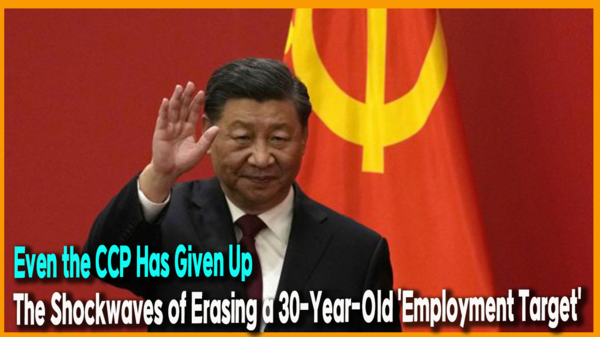
["They could no longer make promises"… Even the command economy's final shred of pride has crumbled.]
For the past three decades, no matter how dire the economic headwinds became, the Chinese Communist Party (CCP) never abandoned one particular anchor: the "employment target," a state-guaranteed pledge to generate jobs. Even when GDP growth slowed, exports faltered, or the real estate market plunged into crisis, Beijing consistently emphasized that the labor market remained firmly under state control. This pledge served as the core political legitimacy underlying China’s state-directed command economy. This time, however, things are different.
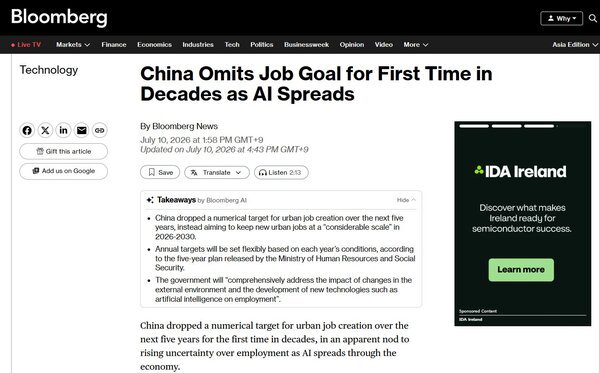
On July 11, the American economic news outlet Bloomberg reported: "In its newly released 15th Five-Year Plan (2026–2030), China’s Ministry of Human Resources and Social Security has for the first time deleted the quantitative target for new urban employment, a fixture maintained for decades." The document now contains only a principled, boilerplate statement to "maintain new urban employment at a substantial scale." The concrete figures of the past—explicitly pledging how many millions of new jobs would be created over the next five years—have vanished entirely. Instead, the government explained that it will set separate annual targets moving forward, depending on prevailing economic conditions.
On the surface, this might look like a routine administrative adjustment. Yet, this shift carries profound implications for how we view the Chinese economy. The essence of a command economy lies in the state setting targets and mobilizing administrative power to achieve them. The fact that the CCP can no longer bring itself to propose a baseline target indicates that Beijing is losing confidence in its ability to steer the economy according to its own blueprint.
[The 'symbol of planning' that endured for 30 years has collapsed.]
In reality, the CCP has always managed employment numbers with far greater sensitivity than GDP growth rates. Unemployment directly fuels social unrest, and social unrest is the single most dangerous threat to the legitimacy of the Party's one-party rule.
Case in point: the preceding 14th Five-Year Plan (2021–2025) explicitly targeted the creation of at least 55 million new urban jobs. Even during the 1996–2000 plan, when the shocks of the Asian Financial Crisis were still reverberating, Beijing codified a specific floor of 40 million jobs. The tougher the economic conditions grew, the harder the state leaned into its core messaging: "The state will always deliver jobs."
Yet, that long-standing principle has now been broken for the first time. This is not a case of lowering the bar; the target itself has been entirely omitted. This goes beyond a simple policy pivot. It reveals that the Chinese leadership can no longer forecast its own labor market, and it signals that the political liability of setting a target and failing to hit it has grown prohibitively high. In short, the CCP has reached a juncture where concealing failure has become more urgent than projecting total economic control.
[Erasing the numbers signals just how severe the reality has become.]
Bloomberg noted that this move is far more than a statistical methodology tweak. It pointed out that China’s official "new urban employment" metric only tallies newly hired individuals, entirely omitting workers who lose their jobs due to corporate restructuring or factory closures. By design, the metric was already calibrated to paint a much rosier picture than actual labor market conditions warranted.
What does it mean, then, when the government cannot bring itself to publish a target for a metric it already controls so tightly? It means the labor market has deteriorated to a point where no amount of statistical window-dressing can mask the reality. Where Beijing used to set a target first and massage the statistics to match it, economic uncertainty has now grown so acute that setting a baseline target is no longer viable.
Ultimately, the 15th Five-Year Plan is not just a document missing a single metric. It is a watershed event symbolizing that the CCP's ultimate pride—its absolute command over its managed economy for the past 30 years—is fracturing.
Yet, this is merely the prologue. The deletion of the target is a symptom, not the root cause. Beneath the surface lies a compounding matrix of crises: a collapsed property sector, stifled private consumption, plummeting corporate investment, and the stark structural limitations of Xi Jinping's signature "New Quality Productive Forces" strategy. The point where we ask why the Chinese economy was pushed to this brink is precisely where its systemic, structural crisis comes into full view.
[As real estate crumbled, the virtuous cycle of China’s economy ground to a halt.]
The catalyst that brought the Chinese economy to its current state is undeniably the collapse of the real estate market. The property sector, which once accounted for 25% to 30% of China’s GDP and drove its economic engine, has entered a period of protracted, structural stagnation triggered by the liquidity crises of mega-developers like Evergrande, Country Garden, and Vanke.
The core issue is that real estate was not just an isolated industry; it was the pillar supporting the entire Chinese economic architecture. Local governments relied on land-use sales to fund their budgets, banks expanded credit using real estate as collateral, and households invested the bulk of their life savings into apartments. When this interlocking structure cracked, it triggered a cascading shock across the entire economy.
Given that roughly 70% of Chinese household wealth is tied up in property, falling home prices did not just erode asset values—it fundamentally crushed consumer sentiment. As anxiety mounted that housing prices would continue to slide, households closed their wallets, corporations scaled back investment, and local governments sank into fiscal distress. Consequently, an economic death spiral of simultaneously shrinking consumption, investment, and public spending began.
[Why Xi Jinping’s 'New Quality Productive Forces' failed to generate jobs]
With the real estate engine dead, the Xi Jinping leadership unveiled a new growth strategy: "New Quality Productive Forces," a blueprint pivoting toward high-tech manufacturing, including artificial intelligence (AI), semiconductors, electric vehicles (EVs), batteries, and robotics.
The fundamental flaw in this strategy is that while it may sustain top-line GDP growth, it is inherently incapable of reviving employment. Historically, the real estate and construction sectors acted as massive labor sinks. They drove employment across a vast spectrum of auxiliary industries, from steel and cement to logistics, interior design, home appliances, and furniture. Conversely, AI hubs and semiconductor fabs demand astronomical capital and cutting-edge technology, but require relatively little human labor. As automation accelerates, the required workforce actually shrinks.
As a result, China has trapped itself in a paradox: factories continue to multiply, but jobs do not. GDP can be propped up, but household incomes stagnate. Without income growth, consumer spending cannot recover. And without a consumption rebound, corporations cut back on investment and downsize their workforces.
An economy cannot run on production alone; it requires consumers to buy what is produced to sustain a virtuous cycle. Yet, while China may have succeeded in expanding its aggregate production capacity, the purchasing power of the households meant to sustain that consumption is actively eroding.
[The market plunges into the survival trap of 'Neijuan' (Involution)]
What happens when production surges while domestic demand remains dead in the water?
The answers are already playing out across China. Corporations are aggressively slashing prices to liquidate unsold inventory, forcing competitors to underbid them just to survive. This is the phenomenon of Neijuan (involution)—a grueling war of attrition where everyone competes furiously, but no one turns a profit.
The automotive sector is the textbook example. Chinese EV makers are locked in an endless price war simply to defend their market share. The story is virtually identical across solar energy, batteries, steel, and chemicals. Overproduction leads to collapsing prices, which ravages corporate profitability, and the very first line items to get cut are jobs and wages.
As this vicious cycle—falling employment, stifled consumption, deteriorating corporate earnings, and subsequent layoffs—loops continuously, the Chinese economy is slipping into a structural trap from which it will be exceptionally difficult to extricate itself.
Therefore, the CCP’s decision to erase the employment target is not a minor bureaucratic adjustment. It is the first clear signal from the Party itself admitting that the economy is no longer obeying its commands.
[320 Million… The shadow of 'Flexible Employment' engulfing the middle class]
The transformation of China's labor market is already starkly visible in the data. Reuters recently reported that the real estate slump has wiped out construction jobs on a massive scale, while manufacturers are accelerating automation and cutting staff to cope with U.S. tariff pressures and intense price competition. The permanent, stable jobs that disappeared have been replaced by "flexible employment"—food delivery couriers, ride-hailing drivers, live-stream sales hosts, and part-time platform labor.
The China New Employment Forms Research Center projects that the number of flexible workers in China will hit 320 million this year. This represents roughly 44% of China’s total working population—a figure nearly equivalent to the entire population of the United States.
More alarming still is the shifting demographic of this workforce. Historically, flexible employment was viewed as the domain of migrant workers (nongmingong) or low-skilled laborers. That is no longer the case. Today, university graduates, alongside white-collar professionals and middle-class workers displaced by corporate restructuring, are flooding into the delivery and gig-economy markets.
Professor Zhan Yang, a cultural anthropologist at Hong Kong Polytechnic University, analyzed the shift: "Flexible employment is no longer just an issue for migrant workers; it is becoming the safety net of last resort for the urban middle class." This is not merely a change in job titles.
It means the middle class—the very bedrock of a stable society—is losing steady income and upward mobility. When the middle class collapses, consumption dries up; when consumption dries up, corporate investment stalls; and when investment stalls, jobs vanish further. This is the precise structural feedback loop currently trapping the Chinese economy.
[The real crisis facing China is not the growth rate]
Many analysts diagnose China’s economic crisis through the lens of GDP growth rates. But that number is a symptom, not the disease. The genuine crisis is that the CCP can no longer run the economy by decree.
A command economy is a system built on target-setting. It sets targets for growth, targets for investment, and targets for employment. Mobilizing total state machinery to hit those benchmarks was the core mechanism of the China development model. Now, that core is fracturing.
Growth rates can still be engineered to some degree through policy levers. Investment figures can be artificially met by mobilizing state-owned enterprises. But employment is an entirely different beast. Jobs are only created when businesses thrive, and businesses only invest when consumers spend. If the market refuses to move, no amount of state budgetary injections can generate sustainable employment. Confronted by this unyielding reality, the CCP chose to erase the target for the first time. This is a symbolic admission that the very paradigm of Chinese economic governance has hit its structural limit.
[Why Times Insight]
What the Chinese government erased from its latest five-year plan was not just a number. It erased its own foundational confidence that the state can dictate economic reality. For 30 years, whenever the economy faltered, the CCP rallied the market by projecting new targets. If a target was missed, they adjusted the metrics, shifted policies, and rebuilt the growth narrative.
This time, they took a different path. Paralyzed by the fear of missing the mark, they chose to eliminate the mark entirely. This is the single most dangerous signal flashing out of the Chinese economy today. Property crises and consumption slumps can eventually bottom out and recover over time. But once faith in the state’s ability to manage and guarantee the economy begins to fracture, trust in the regime itself begins to erode.
Ultimately, the defining crisis for China is not whether GDP growth prints at 5% or 4%. It is the fact that the command economy can no longer plan the actual economy. The vanishing of the 30-year-old employment target may well go down as the first official document in which the CCP quietly signed a confession to that very reality.


-중국 푸단대학교 한국연구원 객좌교수
-전 EDUIN News 대표
-전 OUR NEWS 대표
-제17대 대통령직인수위원회 정책기획팀장
-전 대통령실 홍보기획비서관
-사단법인 한국가정상담연구소 이사장
-저서: 북한급변사태와 한반도통일, 2012 다시우파다, 선거마케팅, 한국의 정치광고, 국회의원 선거매뉴얼 등 50여권