Update2026.07.24 (금)

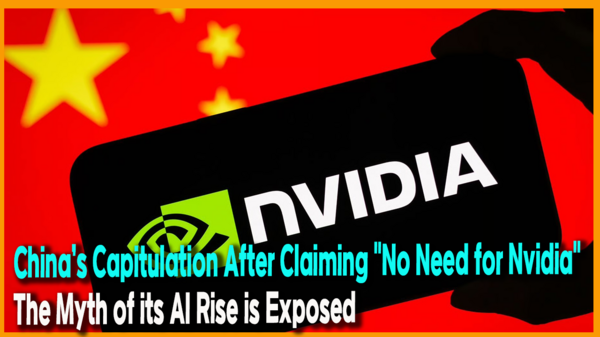
[China, Which Claimed "No Need for Nvidia," Finally Yields to Reality]
China has ultimately reversed its own rhetoric. The Chinese government, which had confidently maintained that "American AI semiconductors are unnecessary" and "domestic chips are more than enough," has finally decided to allow the limited import of NVIDIA’s latest AI semiconductor, the H200. This is not mere regulatory easing. The move carries immense significance as it marks Beijing's tacit admission of its AI industry's most critical vulnerability: a severe deficit in computing power.
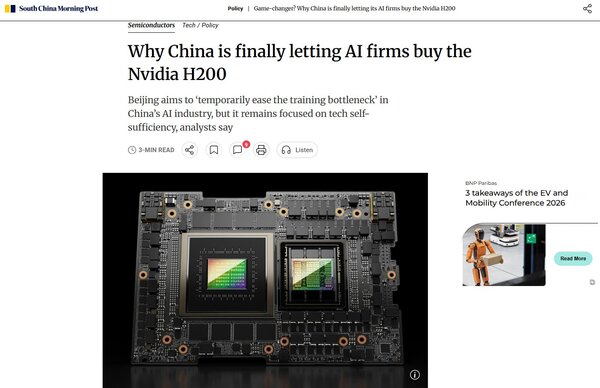
On July 10, the South China Morning Post (SCMP) reported, "The Chinese government is moving forward with a plan to allow the purchase of H200 chips exclusively for a select group of key AI firms, including Alibaba, ByteDance, and DeepSeek, meaning it is not open to everyone." The report added, "Companies must submit detailed justifications for why they require Nvidia products instead of domestic chips. Furthermore, the usage is strictly restricted to AI model training, and the permitted volume is reportedly capped under 200,000 units."
On the surface, it may appear as though Beijing is loosening some regulations. However, the underlying reality is quite the opposite. China, which has long championed "semiconductor self-reliance," has effectively conceded to the harsh reality that its domestic technology alone cannot sustain the AI race.
[Xi Jinping’s Miscalculation: "Domestic Semiconductors Are Enough"]
Since the implementation of U.S. semiconductor sanctions, China has repeatedly spun the situation as an opportunity. The Xi Jinping administration consistently emphasized that "AI can advance without American technology," "domestic AI chips can replace Nvidia," and "we can independently supply HBM (High Bandwidth Memory)." As domestic AI chipmakers such as Huawei’s Ascend, Cambricon, and Biren emerged one after another, internal confidence in "semiconductor self-reliance" swelled within China.
Yet, the reality was starkly different. The core challenge in the AI race is not merely manufacturing a single GPU. The real hurdle lies in clustering tens of thousands of GPUs simultaneously to train large language models (LLMs) and building a stable, high-performance computing environment to operate them. It is precisely at this juncture that China hit its technical ceiling.
Commenting on the decision, SCMP evaluated it as "a compromise intended to temporarily alleviate the training bottlenecks for frontier models in China's AI industry." This underscores that Chinese AI firms have reached a dead end where developing next-generation AI models using only domestic semiconductors is practically impossible. Ultimately, China did not pivot its policy by choice; it retreated in the face of technological reality.
[AI is an Industry of Speed... Lose Time, and You Fall Behind Forever]
China’s sudden return to Nvidia is driven by a stark reality: in the AI industry, time is the ultimate competitive edge. While industries like automobiles or smartphones offer latecomers a chance to catch up over a few years, AI operates under an entirely different paradigm. Companies that train larger models ahead of the curve secure more data and attract more users, creating a virtuous cycle that allows them to build even larger models. In short, falling behind by one year does not mean just a one-year gap—the divide compounds exponentially.
Beijing acutely feels that this vicious cycle has already begun. While America’s OpenAI is looking past GPT-5 to prepare GPT-6, China is only now entering the stage of developing models with roughly one trillion parameters. The gap in training scale and computing power is poised to widen dramatically over time.
China's authorization of the H200 is not born out of a preference for Nvidia, but rather out of a mounting sense of crisis that staying the course would mean permanent disqualification from the AI race.
[China’s Biggest Misconception Was Not About the GPUs]
China mistakenly viewed the AI race merely as a scramble to secure physical GPUs. However, the AI industry does not run on standalone graphics cards. A world-class AI infrastructure requires a unified platform that integrates GPUs, HBM, high-speed interconnects, data centers, power infrastructure, and—most importantly—the software ecosystem that developers rely on.
The United States has already come close to perfecting this platform. In particular, Nvidia’s CUDA is far more than a mere development tool; it is the global standard of the AI ecosystem, built collaboratively by millions of developers over the past two decades. It is the language AI researchers are most fluent in, and the foundation upon which countless AI frameworks and applications have evolved.
Conversely, while Huawei’s CANN platform continues to make strides, experts evaluate that it remains vastly inferior in terms of ecosystem scale, developer convenience, and accumulated engineering expertise. This is precisely why Zhou Chao, a researcher at Anbound, pointed out that "the U.S.-China gap is not a matter of a single GPU, but a disparity between entire AI computing platforms." What China finds nearly impossible to replicate is not the GPU itself, but a 20-year-old entrenched ecosystem.
[Even the DeepSeek Success Story Was Built on Nvidia]
The success of DeepSeek, which took the world by storm earlier this year, serves as a testament to this reality. DeepSeek emerged as the beacon of Chinese AI by developing highly capable models at a fraction of the traditional cost. However, this achievement does not mean Chinese semiconductors have surpassed their U.S. counterparts. On the contrary, DeepSeek's success was largely enabled by leveraging the existing Nvidia ecosystem.
While Chinese AI companies are rapidly advancing their algorithms, they remain heavily reliant on American technology for the underlying computing platforms that power them. Consequently, DeepSeek’s triumph is more accurately viewed as a demonstration of the sheer power of the Nvidia platform rather than a victory for Chinese hardware.
[The H200 Clearance is an Emergency Band-Aid, Not Market Opening]
What is telling is that even as China readmits Nvidia, it refuses to trust the free market. The approvals are restricted to a tiny handful of enterprises, including Alibaba, ByteDance, and DeepSeek. Furthermore, the permitted volume covers less than half of what these companies originally requested.
Beijing's calculation is to put out the immediate fire using Nvidia while buying time for domestic chipmakers like Huawei to catch up. However, a state-controlled approach—where the government dictates the buyers, volumes, and specific use cases—is fundamentally antithetical to fostering a world-class innovation ecosystem. True AI innovation thrives under free competition and open developer ecosystems, not a planned economy.
[Why Times Insight]
The recent decision to import the H200 is not just about bringing in a tens of thousands of GPUs. It stands as the first symbolic admission by Beijing that its loudly trumpeted strategy of "semiconductor self-reliance" is failing to deliver in the AI era.
More importantly, hegemony in the AI era will no longer belong to nations that simply operate the most chip fabrication plants. AI supremacy will be claimed by the nation that can seamlessly weave the world's best chips, HBM, high-speed networks, software, and developer communities into a singular, unified platform.
The United States has already established that ecosystem and is moving on to the next frontier. Meanwhile, China remains stuck at a stage where the central government must manually approve whether a company can import a single GPU. This is the most fundamental disparity defining the current U.S.-China AI race.
This decision is by no means a signal that China is closing the gap with the West. Rather, it is a symbolic collapse of the "AI Rise" myth that domestic chips alone would suffice. Ultimately, China can no longer ignore the reality that the battle for AI supremacy is won not by an individual piece of silicon, but by a nation's entire technological ecosystem.
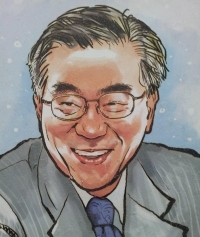
-중국 푸단대학교 한국연구원 객좌교수
-전 EDUIN News 대표
-전 OUR NEWS 대표
-제17대 대통령직인수위원회 정책기획팀장
-전 대통령실 홍보기획비서관
-사단법인 한국가정상담연구소 이사장
-저서: 북한급변사태와 한반도통일, 2012 다시우파다, 선거마케팅, 한국의 정치광고, 국회의원 선거매뉴얼 등 50여권