
Update2026.07.24 (금)


[AI Boom Triggers Supply Chain Realignment, Shaking China First]
For the past decade, the global smartphone market was practically dominated by Chinese manufacturers. Brands like Xiaomi, OPPO, Vivo, and HONOR aggressively pursued Samsung Electronics and Apple with "affordable yet high-performance smartphones." Backed by massive government subsidies, they rapidly expanded their global market share. This low-cost, mass-production strategy was the very core of the "smartphone hegemony" that China so proudly boasted. Today, however, this growth formula is fracturing at its foundation. It is not merely due to economic stagnation or a dip in consumer spending. The AI revolution has completely upended the global semiconductor supply chain order, and the Chinese smartphone industry is the first to take a direct hit.
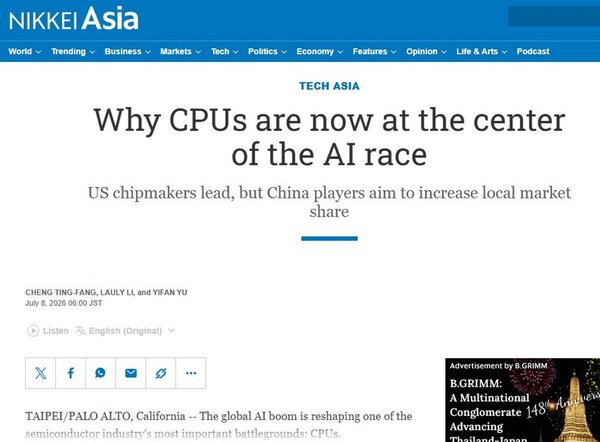
On July 8, Nikkei Asia reported, “With the dawn of the AI era, the conventional growth model that Chinese smartphone makers relied upon has begun to falter. While smartphone manufacturers used to sit at the center of the semiconductor supply chain, AI data centers are now taking that spot.” The report further noted, “This is not a simple industrial shift. It can be interpreted as a symbolic milestone marking the end of the 'smartphone-centric era' that dominated the electronics industry for the past 20 years, and the beginning of the 'AI-centric era.'”
The genesis of this shift is the explosive growth of AI data centers. As the generative AI race—triggered by ChatGPT—intensifies, tech giants like Microsoft, Amazon, Google, and Meta, alongside Chinese titans Alibaba and Tencent, are scrambling to build hyper-scale AI data centers. The most critical components for this infrastructure are High Bandwidth Memory (HBM) and high-performance DRAM for AI servers. Consequently, global memory chipmakers like Samsung Electronics, SK Hynix, and Micron have naturally shifted their production capacities toward AI memory, given its far higher profitability compared to mobile memory.
The bottleneck lies in the fact that memory production capacity is finite. As the manufacturing of AI memory scales up, the production of mobile DRAM and NAND flash for smartphones inevitably shrinks. Compounded by tightening supplies of other core components like advanced packaging and printed circuit boards (PCBs), smartphone manufacturing costs have started to skyrocket.
Counterpoint Research analyzed, “In the first quarter of this year, mobile DRAM prices surged by more than 50% quarter-on-quarter, while NAND flash prices jumped nearly 90%. Low-to-mid-range smartphones are bearing the brunt of the impact, with their Bill of Materials (BOM) rising by over 20%.” Ultimately, a new structural reality has emerged: the more the AI industry grows, the harder it becomes for the smartphone sector to secure critical components.
[Why Chinese Manufacturers Were the First to Falter]
Why, then, are Chinese manufacturers stumbling ahead of Samsung or Apple? The core reason lies in the stark contrast between their business models. Apple and Samsung Electronics have a high proportion of premium products in their portfolios. When production costs rise, they can pass a portion of the burden onto consumers by raising retail prices. Given their high brand loyalty, the market is reasonably resilient to price hikes.
Chinese manufacturers, however, operate in a completely different reality. The primary competitive edge for Xiaomi, OPPO, and Vivo is their "price-to-performance ratio." The moment prices tick upward, consumers defect to alternative brands. In other words, their structural realities prevent them from raising prices despite surging manufacturing costs. As a result, Chinese smartphone makers now face a paradox: the more they produce, the heavier the burden of component costs becomes; the more they sell, the worse their profitability deteriorates. The high-volume, low-margin strategy that once served as their primary weapon for growth has transformed into their greatest vulnerability in the AI era. This explains why Chinese smartphone makers have begun slashing production targets far ahead of their competitors.
[Even Xiaomi Kneels… Slashed Shipment Targets Across the Board]
This supply chain shockwaves are fundamentally disrupting the production strategies of Chinese smartphone makers. Nikkei Asia reported, “Major Chinese smartphone manufacturers, including Xiaomi, OPPO, and Vivo, recently notified component suppliers that they are drastically lowering their smartphone shipment targets for this year. This is not driven simply by a bleak sales forecast, but by a realistic calculation that they can no longer absorb the manufacturing costs.”
The most symbolic case is Xiaomi. In 2021, Chairman Lei Jun confidently declared his ambition to take on Apple and Samsung, pledging to “become the world’s number one smartphone brand within three years.” Back then, China’s smartphone hegemony seemed unstoppable.
However, the tide turned completely once AI began reshaping the supply chain. While Xiaomi shipped roughly 170 million units last year, it has reportedly slashed its target for this year to approximately 95 million units—a downward revision even from the target set at the beginning of the year. Similarly, OPPO and Vivo have adjusted their shipment targets to below 90 million units, while HONOR has reportedly concluded that it cannot sustain last year's growth momentum.
The blow to smaller, tier-two players is even more severe. Chinese smartphone brand Meizu canceled the release of its new model, the 'Meizu 22 Air', explicitly citing skyrocketing memory prices. The decision stemmed from the assessment that launching the product would yield no profit. This is not just a standard product delay; it is a highly significant move that effectively acknowledges a structural crisis where "selling leads to losses."
[Government Subsidies Fail to Shield Against the AI Supply Chain Paradigm]
To counter domestic economic stagnation, the Chinese government has been doling out massive smartphone replacement subsidies through its Yijiuhuanxin (trade-in/equipment upgrade) policy. Under this program, the government subsidizes consumers who replace old home appliances and smartphones with new ones. This policy initially cushioned the Chinese smartphone market, enabling domestic manufacturers to ramp up production.
This time, however, the playbook failed. While Beijing can stimulate consumer demand, it cannot alter the global semiconductor supply chain that has been permanently rewired by AI. With AI servers absorbing vast quantities of memory, no amount of government subsidies could halt the surge in component prices.
The fallout was glaringly evident during the '618 Shopping Festival', China's largest annual retail event. Reuters reported, “During this year's 618 festival, smartphone sales in China dropped 13% year-on-year. Due to rising memory costs, manufacturers reduced their discount margins, resulting in a 24% drop in sales for Xiaomi and a 33% decline for HONOR.”
Historically, Chinese firms expanded their market share by pairing government backing with low-cost strategies. However, analysts note that their growth model is hitting a wall as cost inflation outpaces the buffer provided by subsidies.
[Not Just a Smartphone Problem… A Shadow Over Chinese Manufacturing as a Whole]
This crisis cannot be dismissed as a temporary downturn isolated to the smartphone sector. Recently in China, the solar power industry fell into collective losses due to oversupply and collapsing prices, while the electric vehicle (EV) sector is seeing profitability erode rapidly amid a brutal price war. With the smartphone industry now hitting a wall of rising manufacturing costs, the foundational growth formula of Chinese manufacturing at large appears to be cracking simultaneously.
For decades, Chinese manufacturing conquered global markets via a uniform strategy: low pricing and mass production. In the AI era, however, the dynamics have changed. Competitiveness is no longer determined by how cheaply a product can be made, but by who secures core technologies and critical components. This is precisely the greatest challenge confronting Chinese manufacturing.
[The Era of the Smartphone as 'King' is Over]
The implications of this shift extend far beyond a dip in shipment volumes for Chinese smartphone firms. Crucially, it signals a realignment of the power structure within the global electronics industry.
For over twenty years, the smartphone was the undisputed anchor of the electronics industry. Armed with hundreds of millions of annual purchasing orders, Apple and Samsung Electronics held absolute leverage in price negotiations with semiconductor firms. Memory chipmakers likewise treated the smartphone market as their most vital clientele.
The AI era is rapidly dismantling this established hierarchy. Today, memory chipmakers prioritize AI data centers over smartphones. NVIDIA's AI accelerators and the servers that house them yield far higher profit margins than smartphones. From the perspective of semiconductor companies, allocating production capacity to AI memory is the only rational choice.
Consequently, smartphone manufacturers have been dethroned from their position as supply chain dictators. They are now forced to compete for limited manufacturing capacity against the AI behemoth. The leverage in the electronics industry has shifted from smartphones to AI semiconductors.
[Why China Shakes First]
Amid this transition, the Chinese smartphone industry is absorbing the heaviest blow. For a long time, Chinese companies thrived on a three-pronged foundation: low prices, mass production, and government subsidies. While this successfully captured global market share, they failed to cultivate alternative competitive advantages for the moment their price competitiveness evaporated.
The AI era is exposing this structural vulnerability. The core value of the industry—including AI chips, advanced memory, and high-end packaging—has migrated away from simple assembly or production volume toward proprietary original technology and supply chain control. Chinese firms find themselves at a distinct disadvantage here. They struggle to secure a stable supply of memory and core components, yet they lack the pricing power to pass those costs onto consumers.
Ultimately, the current crisis is not a standard cyclical downturn in the smartphone industry; it is a signal that the Chinese manufacturing growth model has entered a direct collision course with the AI era.
[Warning Signals Spread Across Chinese Manufacturing]
This phenomenon is echoing beyond smartphones. China's solar industry is logging massive losses due to oversupply, and its EV sector is seeing margins eviscerated by relentless price wars. The real estate market shows no signs of recovery, and sluggish consumer demand is becoming structural. Against this backdrop, the fracturing of the smartphone industry carries profound weight.
One by one, the core manufacturing sectors underpinning the Chinese economy are exhibiting the exact same systemic vulnerabilities. In the past, low pricing and sheer volume were enough to conquer global markets. In the AI era, however, industrial hegemony is rapidly restructuring around nations and corporations that control core technologies and supply chains. This means that China's manufacturing prowess—the area it was most confident in—is facing its ultimate litmus test under the metrics of a new era.
[Why Times Insight]
The collective downward revision of shipment targets by Chinese smartphone makers is not a simple case of sluggish sales. AI has gone beyond creating a new industry; it has begun cannibalizing the resources and profitability of existing ones. The supply chain priority once enjoyed by the smartphone industry has shifted to AI data centers, and chipmakers are realigning their production and capital expenditures around the highly lucrative AI market.
What warrants closer attention is that this may be the first major indicator exposing the structural limits of China's manufacturing growth model. China rapidly dominated global markets in smartphones, solar panels, and EVs via low-cost, mass-production strategies. In the AI era, however, volume alone can no longer sustain competitiveness. The market structure is shifting to favor those who control core components, advanced technologies, and supply chains.
In the final analysis, this event is not merely a crisis for the smartphone industry, but a symbolic case study of how the AI revolution is rewriting the global industrial order. The shaking of China's smartphone hegemony may just be the beginning. In the new industrial order shaped by AI, the metric for survival for both corporations and nations will likely not be "how much they can produce," but "how much of the core technology and supply chain they can control." This is the most critical takeaway from the tectonic shift currently unfolding in the Chinese smartphone industry.


-중국 푸단대학교 한국연구원 객좌교수
-전 EDUIN News 대표
-전 OUR NEWS 대표
-제17대 대통령직인수위원회 정책기획팀장
-전 대통령실 홍보기획비서관
-사단법인 한국가정상담연구소 이사장
-저서: 북한급변사태와 한반도통일, 2012 다시우파다, 선거마케팅, 한국의 정치광고, 국회의원 선거매뉴얼 등 50여권