
Update2026.07.24 (금)

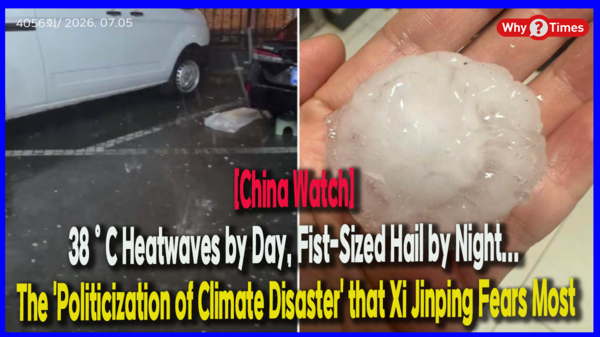
[It's Neither Heatwaves Nor Floods... What the CCP Truly Fears is Governance Risk]
On the very night Beijing's temperature surpassed 38°C, fist-sized hail rained down from the sky. At the exact same time, southern China suffered successive inundations of cities and farmland due to record-breaking torrential rains and floods. As this extreme climate polarization—heatwaves in the north and floods in the south—unfolded simultaneously, President Xi Jinping took the unusual step of personally presiding over a Politburo meeting to coordinate a response. This situation is not merely an anomalous weather event; it serves as a prominent signal that the Chinese leadership has begun to perceive climate disasters as a new security threat endangering national governance and regime stability.
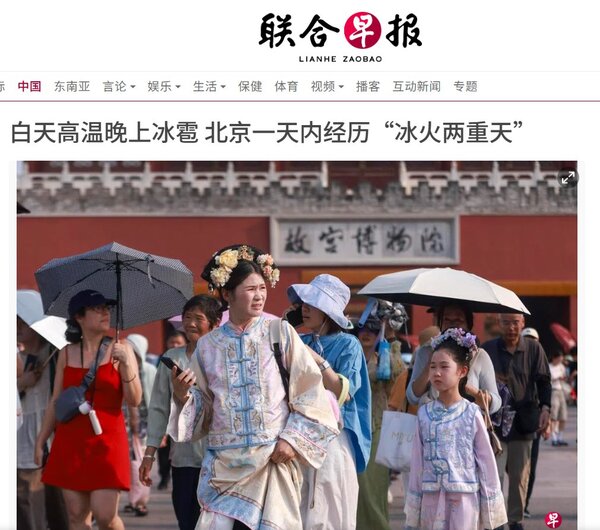
On July 4, Singapore's Lianhe Zaobao reported, "On July 3, the daytime temperature at the Beijing Meteorological Observatory reached 35.1°C at 2:50 PM, marking the second high-heat day of the year. Near the National Stadium (Bird's Nest), where the urban heat island effect is pronounced, the mercury soared to 38.3°C during the same period, pushing most areas of the city past the 35°C high-temperature threshold." The report continued, "However, just a few hours later in the evening, the sky completely inverted. The Beijing Meteorological Bureau issued its first hail warning of the year for the entire city during the afternoon, forecasting that 'scattered hail will appear consecutively from the northwest to the southeast of the city tonight.'"
Indeed, between 6:00 PM and 9:00 PM, a severe convective cloud system slammed into the downtown area and neighboring districts including Mentougou, Fangshan, and Daxing. This process brought sudden gales of Beaufort scale 8 to 10 (approx. 62–88 km/h), thunder, lightning, and brief but intense downpours. The hourly precipitation peaked at 36.6 mm at the Fengtai Sports Center station. Although the Beijing Meteorological Bureau lifted all yellow warnings for strong winds, hail, and lightning by 10:00 PM as the cloud system weakened, four yellow warnings—high temperature, lightning, strong winds, and hail—had been active simultaneously prior to that.
[Haidian Hail Reaches Up to 5 cm... "Bottom of Glass Bowl Pierced"]
The hardest-hit areas were Shangdi and Qinghe in Haidian District. Around 8:00 PM, large hailstones measuring 4 to 5 cm in diameter fell there. Footage captured by citizens showed the bottom of a glass bowl, placed outside to catch the hail, shattered completely through. Jingbao Wang, a media outlet affiliated with the Beijing Daily, described the hail as being "the size of ping-pong balls." Elsewhere, hail measuring up to 3 cm was observed in Shijingshan, Fengtai, and Chaoyang, and about 2 cm in Mentougou, reflecting significant regional variation.
Meteorological expert Hu Xiao warned on social media that evening: "Hail is currently falling in Mentougou. Since hail tends to move along a linear path, the Fengtai area should also be on alert." Sure enough, hail was confirmed in both regions almost simultaneously. The Beijing News explained that because the updrafts generating hail form in narrow, long bands 2 to 3 km wide and dozens of kilometers long, the hailfall zone also appears narrow and elongated along this band. The paper interpreted this event as a textbook case of "striped hail."
Ultimately, weather authorities issued four types of yellow alerts at the same time: high temperature, hail, strong winds, and thunderstorms. It is exceptionally rare for multiple disaster warnings to be issued simultaneously in Beijing. Experts analyze this phenomenon as a classic example of strong convection formed when cold upper-air currents flow over a land surface overheated by intense heatwaves. In essence, the extreme heat of the day generated the massive hail of the night.
[A More Severe Problem: The Whole of China Split into 'Two Seasons']
Beijing's volatile diurnal weather is not an isolated local anomaly; it is a microcosm of the extreme climate polarization splitting the entirety of China into north and south this summer. Lianhe Zaobao, quoting Sun Qianqian, a weather analyst with the China Meteorological Administration, diagnosed that "since last weekend, a powerful continental high-pressure system began moving eastward, hitting Xinjiang first, and has continued to dominate most northern regions from the Northwest to Huabei and Huanghai this week." The outlet added, "With the high-temperature zone continuously expanding, the scope of the heatwave will peak between the 3rd and 5th, making it the most extensive and intense high-temperature phenomenon seen in the north this year."
Conversely, during the same period, South and Central China are grappling with the polar opposite crisis. Xinhua News Agency reported, "China's National State Flood Control and Drought Relief Headquarters has successively triggered Level-IV flood emergency responses since mid-June for eight provinces and municipalities, including Guangdong, Guangxi, Anhui, Jiangxi, Hubei, Hunan, Chongqing, and Guizhou. Since June 13, cumulative rainfall in parts of central-eastern Guangxi and northern, central, and eastern Guangdong has surpassed 600 mm." The report added, "The National Meteorological Center even issued a red alert for mountain torrents in southwestern Hunan, northern Guangxi, and southeastern Guizhou, where risks of landslides and flash floods are high." In short, within the same country, the north is exposed to heatwaves nearing 40°C while the south faces 30-year record rains and landslide risks simultaneously.
[Why Xi Jinping Moved Personally... A Matter of 'Governance,' Not Climate]
This north-south climate polarization has already been elevated to the formal agenda of China's top leadership. The South China Morning Post (SCMP) reported, "The Communist Party of China (CPC) Politburo, presided over by President Xi Jinping, held its first flood and drought prevention meeting of the year in Beijing on the 30 of last month, ordering local governments to take 'powerful' response measures against droughts, floods, and typhoons, urging them to 'always put the safety of the people's lives first.'" The report further noted, "The meeting stated that it is essential to 'ensure the flood control safety of major rivers, large lakes, and core bodies of water, and comprehensively strengthen regulations on flood discharge spaces.' It also demanded that they 'guarantee the safety of major infrastructure and projects under construction during the flood season, investigate risk factors, and improve the protection of agricultural infrastructure.'"
The SCMP continued, "It is unusual for the Politburo to hold its first flood and drought countermeasure meeting of the year at such an early juncture as late June, and particularly in a format personally hosted by Xi Jinping. This suggests that the leadership recognizes the current situation—where southern floods and northern heatwaves are occurring concurrently—not as a mere seasonal weather anomaly, but as a matter requiring a total overhaul of the response framework." In fact, the meeting also discussed upgrading rescue capabilities under extreme conditions, expanding resources for grassroots organizations, and deploying additional frontline response personnel.
Analysts evaluate that while it was ostensibly a disaster response meeting, it strongly functioned as a comprehensive review of state operations. The reason is simple: in China, natural disasters are not just environmental issues; they carry a high probability of spiraling into complex crises that shake the economy, society, and politics as a whole.
[An Already Strained Chinese Economy Hit by Climate Disasters]
China is already wrestling with several structural challenges. The real estate market slump remains ongoing, and local governments are experiencing severe fiscal distress due to falling revenue from land sales. Youth unemployment, sluggish consumption, and deflationary pressures are also weighing heavily on the Chinese economy.
Under these circumstances, climate disasters impose a burden that goes far beyond simple recovery costs. Heatwaves strain the power grid due to surging cooling demands, while droughts slash agricultural productivity. On the flip side, floods paralyze railways, roads, and logistics networks, forcing factories to halt operations. Ultimately, food prices, industrial production, and consumer sentiment are bound to suffer a chain-reaction shock.
A bigger problem is that the fiscal capacity of local governments to handle this has weakened significantly compared to the past. In the past, they could repair damage by injecting massive public funds, but today, not a few local governments find it difficult even to take on more debt.
[What the Communist Party Fears Most is Not the Disaster, But 'Public Sentiment']
There is another reason why the CPC is on high alert. In modern Chinese history, large-scale natural disasters have frequently fused with administrative failures, fueling public outrage. A representative example is the 2021 Zhengzhou floods in Henan Province. At the time, the subway flooding tragedy and controversies over underreporting casualties triggered fierce criticism of the local government's response capabilities, and related videos and testimonies spread rapidly online. Although authorities moved to censor and control the narrative, distrust over disaster response did not easily subside.
The fact that the Chinese leadership repeatedly emphasized "putting the safety of the people's lives first" at this Politburo meeting is not unrelated to such experiences. They understand better than anyone that what is more terrifying than the natural disaster itself is a failure in response that leads to the alienation of public sentiment, which in turn shakes confidence in the regime.
[Why Times Insight]
The heatwaves and hail in Beijing are not mere meteorological news. More importantly, the CPC has begun to register them not as "environmental issues" but as "governance risks." During the era of high economic growth, disasters could be managed by deploying massive fiscal resources. However, today's China is finding it increasingly difficult to employ the same response mechanisms amid structural crises including the property slump, local government debt, and cooling consumption. If extreme weather like heatwaves and floods becomes the norm under these conditions, it could systematically destabilize food, energy, logistics, local finances, and social stability. This is precisely why Xi Jinping personally presided over the Politburo meeting. Going forward, China's climate disasters are highly likely to settle in not as a matter of "weather," but as yet another variable testing the governance capacity and systemic durability of the Chinese Communist Party.


-중국 푸단대학교 한국연구원 객좌교수
-전 EDUIN News 대표
-전 OUR NEWS 대표
-제17대 대통령직인수위원회 정책기획팀장
-전 대통령실 홍보기획비서관
-사단법인 한국가정상담연구소 이사장
-저서: 북한급변사태와 한반도통일, 2012 다시우파다, 선거마케팅, 한국의 정치광고, 국회의원 선거매뉴얼 등 50여권