Update2026.07.24 (금)

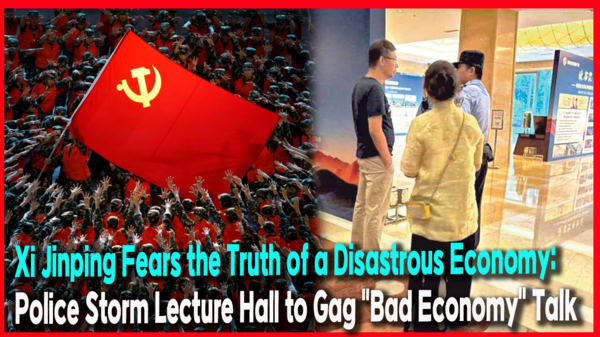
[Police Infiltrate Economist’s Lecture: What is China Truly Afraid Of?]
“Macroeconomically pessimistic, microeconomically optimistic.” This single sentence dissecting the Chinese economy instantly froze the air in the lecture hall. Midway through the presentation, two police officers marched into the venue. Under the watchful eyes of the attendees, the speaker was escorted out of the conference hall for interrogation. It was not terrorism or violence, but an economic forecast that put the public security apparatus into motion.
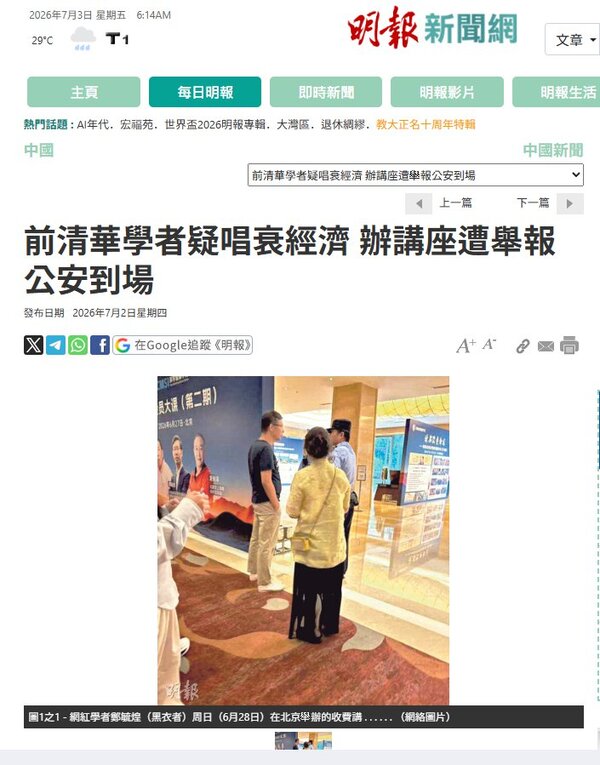
On July 2, Hong Kong’s Ming Pao reported: “On June 28, during a paid lecture by Zheng Yuhuang, a former associate professor at Tsinghua University’s School of Economics and Management held at the Hilton Beijing Capital Airport, police entered the venue and took Zheng out for questioning.” The report added, “While the police cited a report of an 'illegal gathering' as the reason, attendees unanimously noted that 'there was nothing out of the ordinary in the lecture other than economic outlooks.'”
Professor Zheng’s remarks were actually quite measured. He stated, “We are macroeconomically pessimistic and microeconomically optimistic, and this state of affairs could persist for 20 to 30 years.” Although the analysis was reminiscent of Japan’s 'Lost 30 Years,' it was well within the realm of conventional perspectives shared among scholars studying the Chinese economy. Yet, someone reported it, and the police moved in.
An even more intriguing fact lies in a lecture held at the exact same venue just the day before. Sun Liping, a former sociology professor at Tsinghua University, also addressed the structural downturn of the Chinese economy, but faced no interference whatsoever. Same venue, same format—yet one finished his lecture seamlessly while the other faced a police interrogation. This demonstrates that China has become a society where it is difficult to predict not just what cannot be said, but when and to whom it cannot be said.
Taiwan’s Liberty Times pointed out that “this is not an isolated incident,” noting that “Professor Zheng recently had a video deleted in which he stated, ‘It is not the global economy that is bad, but the Chinese economy.’ Last year, his social media accounts were temporarily suspended after he compared the openness of Harvard University and Peking University. In China today, it is no longer the severity of the remarks, but the very act of speaking itself that is being policed.”
To dismiss this as a mere coincidence or two would be to miss a recurring pattern. The space for diverse economic perspectives is not expanding; rather, the arena where the economy can even be discussed is steadily shrinking. What warrants even greater attention, however, is that during the exact same week this incident unfolded, the top leadership in Beijing delivered a message with a starkly contrasting tone.
["Earth-Shattering Storms": 'Economy' and 'Growth' Vanish from CPC Anniversary Speech]
Three days after Professor Zheng was interrogated by police, a ceremony marking the 105th anniversary of the founding of the Chinese Communist Party (CPC) was held at the Great Hall of the People in Beijing. At one of the CPC's most significant political events, President Xi Jinping dedicated the vast majority of his time to emphasizing party survival and internal cohesion, rather than economic recovery or public livelihood.
The very first warning President Xi issued was a vow to “eliminate all elements that harm the advanced nature and purity of the Party.” He then stressed, “We must always be prepared for major ordeals, such as high waves, rapids, and even earth-shattering storms.”
It is rare for a leader to invoke the imagery of a "storm" during a founding anniversary speech. When an economy is stable and a regime feels confident, it typically highlights achievements. Yet, in Xi's speech this year, words like 'struggle', 'danger', and 'purification' appeared far more frequently than 'growth' or 'reform.' The tone carried a heavier weight of vigilance over celebration, and tension over confidence.
The international community took note of this shift. AFP highlighted Xi's remarks, linking them to the recent large-scale purges within the military leadership. AFP reported, “With two defense ministers falling from grace in succession over the past three years, and the Central Military Commission crippled by a series of purges, the military is virtually struggling to maintain a normal chain of command.” It added, “As even core figures personally vetted and appointed by Xi find themselves under investigation, foreign experts are increasingly questioning whether the Chinese military could function effectively in an actual crisis.”
CNBC also focused on the shifting rhetoric of the speech, noting: “While past speeches emphasized economic development and modernization, this time around, the external message—that the CPC is reshaping the global order—was far more pronounced.” It pointed out that “explanations aimed at the domestic economy dwindled, while confidence projected outward was amplified.”
The Washington Times tracked a similar trajectory, reporting that “Xi reaffirmed Taiwan as an unshakeable historical mission, declaring 'the complete reunification of the motherland,' while issuing a stern warning against external interference.”
[Xi Jinping’s Fear of China's Reality]
The reality is telling: the economy is floundering, the military is shaking, and purges are ongoing—yet the leadership's message is growing increasingly hardline. What is fascinating is that all these scenes unfolded within a matter of days. An economist forecasting a bleak outlook was interrogated mid-lecture, and the supreme leader warned of an impending 'storm' on the Party's anniversary. Outwardly, these appear to be disconnected events, but in reality, they point in the exact same direction.
Bloomberg provided the sharpest analysis connecting these dots, raising a compelling question: “In 2018, Xi Jinping declared at a Politburo meeting that the anti-corruption campaign had achieved an ‘overwhelming victory.’ Yet, eight years later, he is waging the exact same anti-corruption war—this time targeting much higher echelons of power. Look at those who have recently fallen: Politburo members have been ousted back-to-back, and the military brass handpicked by Xi himself have mostly become targets of the purge. This can be evaluated as a political upheaval of a scale rarely seen since the realignment of power following the death of Mao Zedong.”
Conventionally, as power consolidates, purges decrease. Conversely, if purges continue to expand despite a total grip on power, it signals not system stability, but rather that internal anxieties remain unresolved.
The same logic applies to the economy. If the economy were truly recovering, a single economist's outlook would not pose a threat to the state. Academic criticism and varied forecasts would naturally be absorbed by the market. However, in today’s China, speaking pessimistically about the economy has itself become a sensitive offense. How people perceive the economy has become a more critical issue for the regime than the actual economic downturn itself.
[Why Times Insight]
Viewing this incident simply as another case of 'suppressing freedom of expression' misses the most critical point. The real shift lies in the fundamental transformation of the CPC’s governance model.
Since the Reform and Opening-up era, the CPC has secured its legitimacy through economic growth. Political freedoms were restricted, but living standards improved, and the Chinese public accepted this trade-off. What anchored the Chinese system was not ideology, but a collective faith in growth.
Today, that faith is fracturing. The real estate slump is dragging on, youth unemployment shows little sign of structural improvement, and the fiscal distress of local governments is worsening by the day. No short-term silver bullet for an economic turnaround is in sight.
In times like these, what the regime fears most is not a bad economic data point. It is the exact moment a social consensus forms around the bleak reality that things will not get better.
Economics is not driven by numbers alone. When public expectations and psychology collapse, consumption freezes, investment grinds to a halt, and capital flees. Ultimately, an economic crisis materializes in collective social perception long before it shows up in official statistics.
Therefore, what mobilized the public security forces was not just the remarks of a single academic, Professor Zheng Yuhuang. It was the hundreds of listeners in that room, and the dangerous potential for those words to ripple across the entire fabric of society.
In the same vein, the rhetoric of ‘storms,’ ‘struggle,’ and ‘purification’ repeated by Xi Jinping on the Party's anniversary is no mere political hyperbole. It is less a declaration to revitalize the economy and more of a political manifesto signaling an intent to control a shaking regime at all costs.
Rather than fixing the economy, the priority has shifted to monopolizing the right to interpret it. This appears to be the path the CPC is currently choosing.
Many countries face economic hardships. However, the moment a regime begins prioritizing the control of its citizens' perceptions and speech over solving economic realities, it transitions from a phase of proving legitimacy through growth to a phase of maintaining legitimacy through control.
The two public security officers who stepped into that Beijing lecture hall did not merely come to interrogate a professor. They were symbols, manifesting exactly what today's China fears most.
-중국 푸단대학교 한국연구원 객좌교수
-전 EDUIN News 대표
-전 OUR NEWS 대표
-제17대 대통령직인수위원회 정책기획팀장
-전 대통령실 홍보기획비서관
-사단법인 한국가정상담연구소 이사장
-저서: 북한급변사태와 한반도통일, 2012 다시우파다, 선거마케팅, 한국의 정치광고, 국회의원 선거매뉴얼 등 50여권