
Update2026.07.24 (금)


[Hidden Debt, Price Wars, and Overcapacity... Cracks in the Chinese EV Model]
Analyses are mounting that BYD, China’s top electric vehicle (EV) maker, has entered a phase where it can no longer maintain its historical growth formula. Amid controversies over hidden debt, combined with price wars, sluggish domestic demand, and overcapacity, diagnoses suggest this is not just an isolated problem for BYD, but a structural crisis for the entire Chinese EV industry. In particular, recent deteriorating quarterly earnings and surging borrowings indicate that previously concealed financial burdens are surfacing. The market views the next few quarters as a watershed moment that will determine the survivors of the Chinese EV sector.
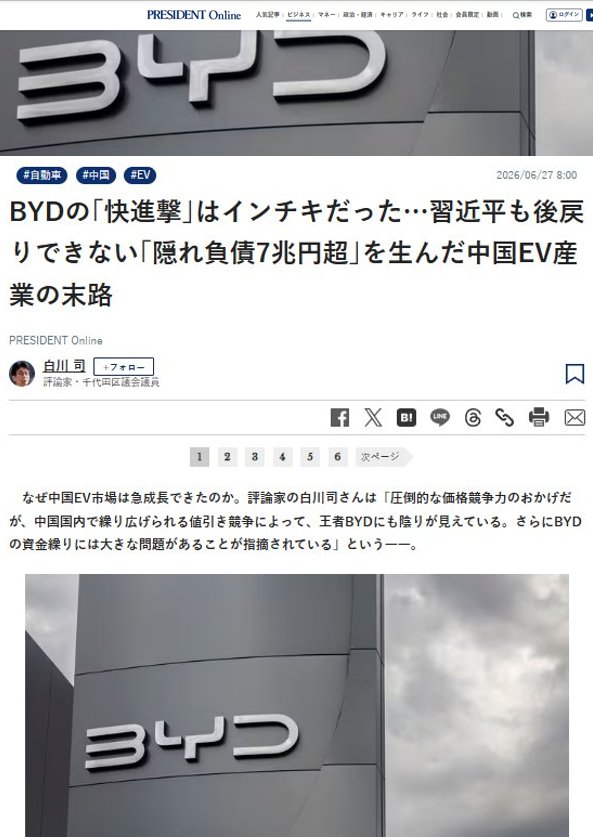
On June 27, PRESIDENT Online, a Japanese business publication, featured an op-ed by Tsukasa Shirakawa, a commentator and member of the Chiyoda Ward Assembly in Tokyo. Citing estimates from Hong Kong-based research firm GMT Research, Shirakawa argued that "as of the end of June 2024, BYD’s actual net debt reached 323 billion yuan (approx. $54.3 billion / 73.9 trillion KRW), whereas BYD’s officially disclosed net debt stood at a mere 27.7 billion yuan (6.3 trillion KRW), meaning the GMT estimate exceeds the official figure by more than tenfold." He pointed to "supply chain finance"—which prolongs payments to suppliers—as the cause of this discrepancy, comparing it to a type of "intra-group promissory note" used exclusively within the BYD Group.
Of course, this figure is not entirely new. The analysis was first reported by Bloomberg last year based on a report compiled by GMT Research, and was later reconfirmed by Reuters through in-depth reporting on the supply chain finance issue. In other words, rather than the Japanese media raising new allegations, the long-standing controversy over BYD's financial structure is regaining attention in tandem with the company's recent earnings shock.
[The Illusion Created by 'Dilian'... Burdens Growing Off-Balance Sheet]
The core of the controversy is not simply the size of the debt. What the market is focusing on is the method BYD uses to pay its suppliers. PRESIDENT Online noted, "BYD issues its own electronic promissory notes called 'Dilian' and distributes them to suppliers instead of cash. Suppliers must hold these until maturity or cash them out early at a discount, with rumors suggesting this discount rate reaches up to 6% annually." The piece highlighted that "the fundamental flaw of this system is that Dilian is issued on BYD’s platform without passing through banks, making its usability outside the group uncertain, and its value and liquidity depend entirely on BYD’s creditworthiness and sales capacity."
The problem is that this system differs fundamentally from commercial paper issued by regular banks. Dilian is a proprietary settlement method circulating within BYD's ecosystem; its value hinges on BYD's credibility and sales performance, not the credit of external financial institutions. Experts point out that this structure forces suppliers to effectively shoulder BYD's cash flow constraints without receiving timely cash payments.
In fact, according to the GMT Research analysis cited by Bloomberg, "BYD's average supplier payment period is approximately 275 days, vastly exceeding the global automotive industry average of 45 to 60 days." GMT Research analyzed that "BYD securitized accounts receivable or utilized collateralized loans and then classified them off-balance sheet, while treating accounts payable unpaid for over 90 days as working capital rather than regular debt, creating an effect that makes the actual financial burden appear significantly downscaled compared to official figures."
[Crisis Theory Backed by Latest Earnings... Q1 Net Profit Slashed in Half]
Aside from Shirakawa's debt warnings, the most recent quarterly performance lends even greater weight to the crisis narrative. Bloomberg reported, "BYD's net profit for the first quarter of 2026 plunged 55% year-on-year, hitting a three-year low, while revenue fell 12% to 150.2 billion yuan, marking the third consecutive quarter of declining revenue." The report added, "Operating cash flow deteriorated even more sharply, plummeting 67.48% year-on-year to just 279 million yuan, and the company filled this gap with short-term borrowing, causing short-term debt to balloon by 72.3% in just three months to 66.3 billion yuan."
This expansion of borrowing points in the same direction as the "hidden debt" structure highlighted by Shirakawa. Bloomberg interpreted that "as BYD abandoned its IOU-based payment method and shifted to interest-bearing debt due to pressure from Beijing authorities, its net debt-to-equity ratio, which had remained negative for four years, flipped to positive 25%." Borrowing Shirakawa's sentiment, regulatory pressure from authorities to shorten payment windows has merely "saddled BYD with new challenges rather than normalizing its cash situation."
[Wang Chuanfu Admits "Brutal Knockout Phase"... Wei Jianjun's 'Evergrande' Warning Becomes Reality]
Under this mounting pressure, BYD founder and Chairman Wang Chuanfu himself acknowledged the crisis. The Business Times highlighted, "Wang Chuanfu stated in a letter to management that the Chinese auto industry has entered a 'brutal knockout phase,' describing competition as having reached 'the extreme,' and noted that the weak will go bankrupt while only companies with scale, technology, and overseas market access will survive."
This precisely aligns with remarks made a year ago, which were also cited in Shirakawa's column. Japanese outlet JB Press noted, "'An Evergrande of the auto industry already exists. It just hasn’t burst yet'—this statement was made on May 23, 2025, by Great Wall Motor Chairman Wei Jianjun during a dialogue program with Sina Finance CEO Deng Qingxu. Although he did not explicitly name BYD, everyone knew from the context he was referring to them." The outlet pointed out that "BYD, which countered at the time by calling it 'exaggerated,' has now displayed a similar perception of crisis through the mouth of its own chairman a year later."
[Structural Overcapacity... 'Natural Shakeout' Underway from 500 to 129 Players]
Shirakawa pointed to the aftereffects of government-led industrial policy as the root cause of this crisis. He cited that "the number of EV manufacturers in China, which crowded the market at 487 companies in 2018, dwindled to 129 with actual sales records as of 2024, and consulting firm AlixPartners forecasts that only around 15 companies will survive by 2030." He analyzed that "local governments triggered artificial hyper-competition by aggressively competing to attract enterprises, offering free factory land, low-interest financing, and direct capital injections."
This structural overcapacity is echoed by other foreign media. Automotive World reported, "The annual production capacity of Chinese factories reaches 55.5 million units—equivalent to two-thirds of last year's global sales of 91.7 million units—whereas China's domestic sales hover around only 23 million units, leaving the average capacity utilization rate at roughly 50%." It added, "It has been nearly a year since China’s State Administration for Market Regulation urged a full correction of 'involutionary' competition, yet discounting wars have barely abated."
The most recent sales metrics show somewhat mixed signals. CnEVPost, a media outlet specializing in China's EV industry and supply chain news, noted, "BYD's total wholesale sales in May reached 383,453 units, a minor 0.26% increase year-on-year, halting an eight-month streak of declining sales." However, it pointed out that "the recovery relies almost entirely on overseas exports; May overseas sales surged 80.40% year-on-year to a record high of 160,644 units, while Chinese domestic sales dropped 24.07% year-on-year to 222,809 units."
[Shirakawa: "Japanese Government Must Halt Chinese EV Subsidies"]
Shirakawa concluded his column with a policy recommendation. He noted, "The Japanese government is providing subsidies to BYD vehicles through its 'Clean Energy Vehicle Introduction Promotion Subsidy'." He questioned "whether it is appropriate for Japan to stack additional subsidies on top of China’s strategy to expand global market share by relying on state subsidies." He warned that "this structural crisis is not 'fire on the other side of the river,'" adding that "the wave of overcapacity that cannot be absorbed within China is spilling over into other nations."
To be sure, the possibility of BYD surviving cannot be entirely ruled out. However, the financial structures, price wars, and sluggish domestic demand currently coming to light reflect structural cracks across the entire EV industry that the Chinese government has bloated with subsidies and overinvestment, rather than a problem unique to a single enterprise. Ultimately, whether sales recover over the coming quarters will likely serve as a testing ground for the success or failure of Chinese-style industrial policy, not just for BYD.


-중국 푸단대학교 한국연구원 객좌교수
-전 EDUIN News 대표
-전 OUR NEWS 대표
-제17대 대통령직인수위원회 정책기획팀장
-전 대통령실 홍보기획비서관
-사단법인 한국가정상담연구소 이사장
-저서: 북한급변사태와 한반도통일, 2012 다시우파다, 선거마케팅, 한국의 정치광고, 국회의원 선거매뉴얼 등 50여권