Update2026.07.24 (금)

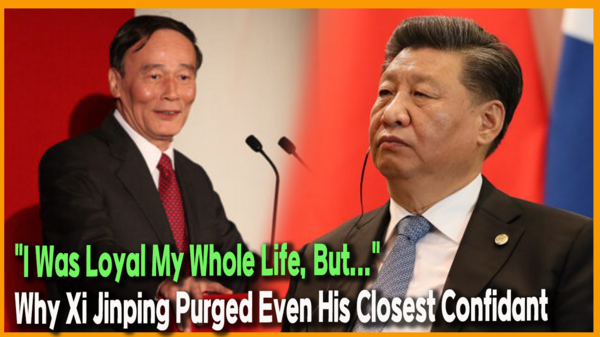
[Targeting Party Elders After the Military... Xi Jinping's Power Consolidation Ahead of a Fourth Term]
Chinese President Xi Jinping, who has been conducting a massive purge within the military, is now analyzed to be effectively dismantling the political network of former Vice President Wang Qishan, who was once his closest ally. Although Wang himself has not been officially indicted, his former aides have consecutively received suspended death sentences or come under investigation. Speculation has even arisen that Wang is under de facto house arrest. U.S. experts interpret this not as a simple anti-corruption campaign, but as a preemptive move to eliminate potential power bases that could obstruct Xi's path to a fourth term ahead of the 21st National Party Congress in 2027.
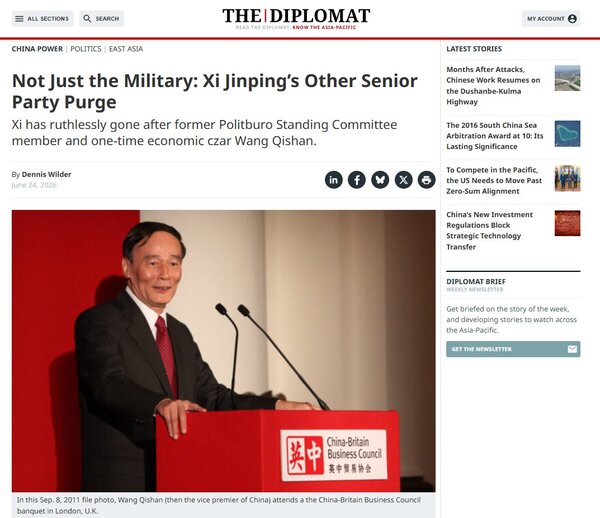
On June 24, The Diplomat, a U.S.-based foreign affairs magazine, published an op-ed by Dennis Wilder—a senior fellow at the Georgetown University Initiative for U.S.-China Global Dialogue and former National Security Council (NSC) senior director for Asian affairs during the George W. Bush administration. Wilder wrote, "Wang Qishan is living under de facto house arrest in Beijing, even though Xi Jinping has not brought any criminal charges against him," adding that "Wang has not been mentioned in China's official media even once since October 2023."
The Diplomat characterized this development as "a new process of power realignment in which Xi is eliminating the influence of his former closest political ally," noting that this trend has not received as much attention as the military purges.
[Subtle Cracks Detected in Zhongnanhai in 2018]
Wilder also shared a scene he witnessed firsthand. "In 2018, when Wang Qishan was serving as vice president, I visited Zhongnanhai as part of a Brookings Institution delegation and met with him," Wilder said. "At the time, Wang showed up dressed not in his usual suit, but like an ordinary Chinese factory worker, and he seemed to feel a repetitive need to emphasize to the delegation that Xi Jinping was the sole decision-maker." Wilder revealed that from this encounter, he "already sensed that Wang was in a politically difficult position with Xi." The Diplomat pointed out that "in fact, out of Wang's former personal secretaries, four have been purged or are currently under investigation."
Wang Qishan was the key power broker who practically designed and executed the anti-corruption campaign during Xi's first term. While serving as the Secretary of the Central Commission for Discipline Inspection (CCDI), he brought down top-ranking Communist Party figures such as Zhou Yongkang and Bo Xilai. He later served as vice president and was long evaluated as a core pillar of the Xi Jinping regime.
[Aides Fall Out of Favor One After Another... Wang's Political Base Effectively Dismantled]
The Diplomat analyzed that "Wang Qishan's political base has been dismantled in phases over recent years."
First, Dong Hong, a key aide to Wang, was investigated in 2020 and sentenced to a suspended death penalty in 2022. Subsequently, Tian Huiyu, the former president of China Merchants Bank, was also sentenced to a suspended death penalty on charges including bribery.
Furthermore, Fan Yifei, a former deputy governor of the People's Bank of China, received a suspended death sentence. Zhou Liang, who served as Wang's personal secretary for a long time, has been under investigation since March this year for violations of discipline and law.
With Li Xiaohong, the former disciplinary chief of the China Securities Regulatory Commission, recently added to the investigation list, Wilder assesses that the core network formed around Wang Qishan has practically been entirely dismantled.
While there has been no official investigation or indictment against Wang himself to date, his political influence is evaluated to have been significantly weakened.
[Why Now? "Removing Potential Obstacles Ahead of the 21st Party Congress"]
Wilder pays close attention to the timing of this network dismantlement. He analyzed, "Xi’s targeting of one of the most trusted party leaders who even carried out the anti-corruption purge for him seems intended to prevent party elders, including Wang, from becoming obstacles to Xi's path to a fourth term at next year's 21st Party Congress." He cited historical precedents where retired party elders exercised significant influence over the selection of top leaders, noting as an example that former Vice Premier Chen Yun played a critical role in choosing Jiang Zemin as the next leader following the Tiananmen Square protests.
This interpretation aligns with the perspectives of other analysts tracking Chinese politics. Cai Shenkun, an independent commentator residing in the U.S., noted in January, "The downfall of General Zhang Youxia, vice chairman of the Central Military Commission (CMC) and the second-highest official in the military, and the dismantling of Wang Qishan's network follow the same trajectory." He added, "Following his handling of Zhang Youxia, Xi has incurred resentment from the descendants of revolutionary elders ('Princelings'), the military elder group, and the party elder class at large. Consequently, his greatest fear is the potential coalition of a small number of national-level leaders who could threaten him."
[The Same Pattern as the Military Purges... "No One is Exempt"]
The dismantling of Wang Qishan's network temporally overlaps with the massive military purges that Xi has conducted over the past two and a half years. The ChinaPower Project at the Center for Strategic and International Studies (CSIS), a U.S. think tank, pointed out, "In the second wave of purges that began in 2023, six military committee members—including former Defense Ministers Wei Fenghe and Li Shangfu, CMC Vice Chairman He Weidong, Political Work Department Director Miao Hua, Joint Staff Department Chief Liu Zhenli, and Senior CMC Vice Chairman Zhang Youxia—dropped out of the lineup one after another." It added, "In January, an unprecedented situation occurred where the CMC leadership was downsized from seven members to just three, as Zhang Youxia and Liu Zhenli came under investigation simultaneously."
CSIS evaluated, "The defining characteristic of this military purge is that Xi did not spare figures he personally selected and rapidly promoted (such as He Weidong), nor did he spare 'Princeling' figures in the PLA who shared decades of family ties with him and his father (such as Zhang Youxia). This makes it crystal clear that no one within the People's Liberation Army is exempt."
Foreign Policy also noted, "Within an 18-month period, the two most powerful networks within the PLA—the 'Old Warlord' network led by Zhang Youxia and Liu Zhenli, and the 'Fujian Faction' network led by He Weidong and Miao Hua—were both dismantled."
The fact that the military and party purges are being carried out simultaneously suggests that Xi's power consolidation strategy has expanded beyond simple anti-corruption to proactively eliminating potential competing centers of power. The China Leadership Monitor assessed in January 2026 that "the purge of Zhang Youxia and Liu Zhenli marks the pinnacle of the massive purge of the PLA leadership that began in mid-2023." However, it also pointed out that "such a large-scale purge may have paradoxically set back Xi's own agenda of fully completing military combat readiness by the 100th anniversary of the PLA's founding in 2027." In other words, the purges aimed at concentrating power are ironically eroding governance efficiency.
["The More Absolute the Power, the More It Prioritizes Safety Over Loyalty"]
This case is drawing significant attention because Wang Qishan is no ordinary former vice president. He is evaluated as a core figure who co-designed and implemented the anti-corruption movement during the early days of Xi's administration, and as one of the politicians who watched the formation of China's current power structure from the closest proximity.
Therefore, observations that his political base is effectively being dismantled lead to interpretations that this is not a simple personnel issue, but rather a process where the Xi Jinping regime is pre-emptively clearing out potential power bases ahead of the 21st Party Congress.
On the other hand, some experts on Chinese politics believe it is unlikely that Wang himself will face criminal punishment. The Wire China cited China political experts noting that "no direct corruption allegations have ever been raised against Wang Qishan, and many hold a cautious view regarding the actual likelihood of his arrest."
Ultimately, the confirmed fact at present is that figures surrounding Wang Qishan are being investigated and punished one after another. Whether the background is simple anti-corruption or part of a power realignment ahead of the 21st Party Congress remains difficult to conclude definitively. However, the recent trend—where party elder networks are being shaken following the military—clearly demonstrates that the Xi Jinping regime is continuously reshaping potential power bases, making it one of the most critical watchpoints in Chinese politics moving forward.
-중국 푸단대학교 한국연구원 객좌교수
-전 EDUIN News 대표
-전 OUR NEWS 대표
-제17대 대통령직인수위원회 정책기획팀장
-전 대통령실 홍보기획비서관
-사단법인 한국가정상담연구소 이사장
-저서: 북한급변사태와 한반도통일, 2012 다시우파다, 선거마케팅, 한국의 정치광고, 국회의원 선거매뉴얼 등 50여권