Update2026.10.24 (토)

[Three Consecutive Defense Ministers Embroiled in Controversy… The Reality of Being Unable to Appear at Shangri-La]
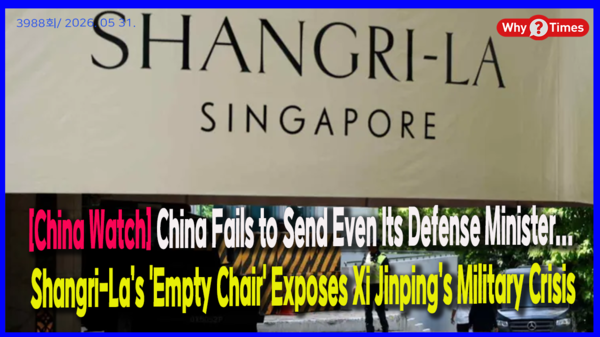
International attention is focusing on the background of China’s failure to send its defense minister to the Shangri-La Dialogue—Asia's largest security forum—for the second consecutive year. Foreign media and military experts analyze that the aftershocks of the military purges, which President Xi Jinping has carried out for several years, are increasingly rising to the surface. They point out that as defense ministers have repeatedly fallen from grace or become embroiled in investigation rumors, and the military leadership has undergone massive reshuffles, the instability within the People's Liberation Army (PLA) has reached a level that can no longer be concealed.
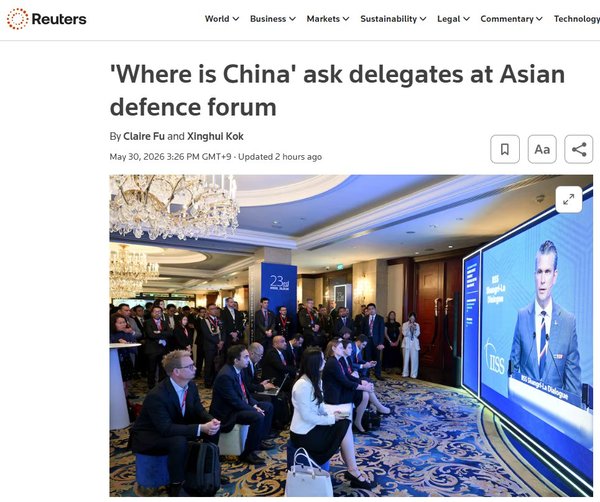
On May 30, Reuters reported, "At this year's Shangri-La Dialogue, Asia's premier defense forum, the biggest question hanging over the event is: 'Where is China?'" The news agency added, "For the second consecutive year, Chinese Defense Minister Dong Jun skipped the free-wheeling Singapore security meeting, missing opportunities to meet with U.S. Defense Secretary Pete Hegseth as well as counterparts from various nations, including Australia, France, Britain, and Japan."
Reuters further noted, "Beijing instead dispatched a low-profile delegation of PLA 'experts and scholars,' representing a step down from the usual presence of high-powered figures."
"A highlight of the dialogue's annual program has been a robust speech by China's defense minister or a senior official laying out Beijing's defense doctrine and outlook on global tensions," Reuters stated. "However, the speech helmed by China was dropped from this year's program, just as it was in 2025."
In connection with this, the Financial Times (FT), citing U.S. government officials last November, reported that "Chinese Defense Minister Dong Jun is under investigation as part of a sweeping anti-corruption probe inside the Chinese military." Although the Chinese government immediately denied the report, slamming it as "groundless fabrication," various allegations surrounding Dong Jun have continued to emerge.
If the FT report is accurate, Dong Jun becomes the third consecutive defense minister to be mired in downfall controversy, following Wei Fenghe and Li Shangfu. Previously, Wei Fenghe and Li Shangfu were expelled from the Communist Party after being investigated for corruption, and China's military court recently disclosed the rulings against them.
Regarding this situation, Asia Times pointed out, "It is no easy task to put a defense minister facing investigation rumors on a public stage where defense ministers and military chiefs from dozens of countries are gathered." The outlet explained, "This is because the Shangri-La Dialogue is not just a formal speech event, but functions strongly as an open debate where delegates exchange spontaneous questions and answers."
Asia Times added, "Consequently, interpretation is gaining traction that China’s decision to send a delegation centered on military experts and scholars instead of the defense minister is a choice to minimize political burdens rather than a diplomatic strategy."
[Massive Purge Shakes Military Leadership… Even Xi’s Handpicked Figures Were No Exception]
The more fundamental issue is not Dong Jun as an individual, but the massive purge shaking the entire Chinese military. Reuters stated, "The military rectification campaign, which began in 2023 with a sweeping investigation into the leadership of the Rocket Force, subsequently expanded to the equipment procurement sector, the defense industry, and organizations across the Central Military Commission (CMC)." It added, "To date, dozens of general-level officers have been dismissed or named as targets of investigation, with some vanishing from public view and failing to appear for extended periods."
This purge draws particular attention because many of the targeted individuals belong to the circle of close aides directly tapped and promoted by Xi Jinping. Analysts suggest that the campaign has evolved beyond purging factions tied to former leaders Jiang Zemin and Hu Jintao, moving into a stage of testing loyalty within the Xi Jinping apparatus itself.
Commenting on this, the East Asia Forum evaluated, "This purge goes beyond a simple anti-corruption drive, placing a significant burden on the stability of the PLA command structure and policy continuity." The forum added, "As top commanders are successively replaced, it could also affect strategy formulation and force operations."
[The Paradox of a Purge Clashing with the 'Strong Army Dream']
Ironically, Xi Jinping’s military purge appears to be clashing with its original goal: military modernization. The U.S. Defense Intelligence Agency (DIA) previously analyzed, "Xi Jinping has set a goal to complete the modernization of the PLA by 2027 and secure the capability to respond militarily to the Taiwan issue if necessary." It noted, "However, the anti-corruption campaign within the Chinese military is directly linked to these military modernization plans."
Yet, a significant number of analyses indicate that the opposite phenomenon is occurring within the military. VOA reported, "While a massive purge under the banner of rooting out corruption may have the effect of tightening organizational discipline, it simultaneously carries the potential to expand passive decision-making among commanders and internal distrust." It added, "Indeed, analyses continue to show that instability within the Chinese military has grown following the reshuffle of the Rocket Force leadership."
Military experts point out that one of the most critical elements in war preparation is the stability of the command structure and mutual trust, meaning that excessive political screening can conversely degrade the efficiency of a military organization. In essence, a purge started to build a strong military is paradoxically creating a situation that hinders the construction of that very military.
[What the 'Empty Chair' at Shangri-La Says]
Against this backdrop, China’s appearance at this year’s Shangri-La Dialogue carries profound implications. Reuters stated, "While China officially explains that 'sending scholars and experts is also a normal form of participation,' the fact that only China failed to send its top military official—at a venue where major nations including the U.S., Japan, Australia, and the UK directly dispatched defense ministers and military leadership to explain security strategies—holds considerable symbolism."
In response, Asia Times pointed out, "In terms of the sheer scale of military power, China ranks at the very top of the Indo-Pacific region, yet it cannot confidently step forward in international security dialogues." The East Asia Forum similarly assessed, "This military purge is exerting a negative impact on the PLA's external credibility and strategic predictability."
Of course, Beijing still emphasizes its confidence. However, a true superpower does not dodge questions. Furthermore, a nation pursuing the world's largest military buildup bears a corresponding responsibility to explain its intentions and direction to the international community. Ultimately, what drew the most attention at this Shangri-La Dialogue was not the remarks of the Chinese delegation, but the "empty seat."
Reuters reported, "That empty chair is not merely the result of a single defense minister's absence." It noted, "It could be a symbol showing that the strategy to control the military, which Xi Jinping has pushed for years, is facing unexpected side effects."
The news agency went on to observe, "The purge, launched under the banner of rooting out corruption and strengthening loyalty, may have succeeded in removing independent power networks within the military, but it is simultaneously producing the result of weakening the continuity of the command structure and trust within the organization."
In a related vein, a report from the U.S. Office of the Director of National Intelligence (ODNI) pointed out, "Amid ongoing tensions surrounding the Taiwan issue, the fact that top generals are being successively replaced and even defense ministers are repeatedly caught up in downfall controversies is raising doubts about the PLA's actual combat readiness." It bluntly remarked, "What Xi Jinping desires may be absolute loyalty, but what is required in war is not just loyalty, but experience, expertise, and a stable command structure."
China continues to expand its aircraft carriers, augment its missile forces, and pursue the world's largest military modernization. However, military power is not evaluated by the number of weapons alone. Who gives the orders in a crisis, who takes responsibility, and who actually executes those orders is far more critical. Yet, the purge of military leadership over recent years is precisely what is fueling doubts on that front.
The empty chair at the Shangri-La Dialogue has ultimately become a paradoxical symbol of what the Chinese military is hiding. What Beijing fails to explain is not a simple diplomatic choice. Perhaps what the international community is curious about right now is not the military power of the PLA, but whether the system that actually commands that military power is functioning normally.
What China, claiming to be the world's second-largest military power, is hiding right now is not the number of its weapons. It is the question of why the generals who are supposed to command those weapons are disappearing.

-중국 푸단대학교 한국연구원 객좌교수
-전 EDUIN News 대표
-전 OUR NEWS 대표
-제17대 대통령직인수위원회 정책기획팀장
-전 대통령실 홍보기획비서관
-사단법인 한국가정상담연구소 이사장
-저서: 북한급변사태와 한반도통일, 2012 다시우파다, 선거마케팅, 한국의 정치광고, 국회의원 선거매뉴얼 등 50여권